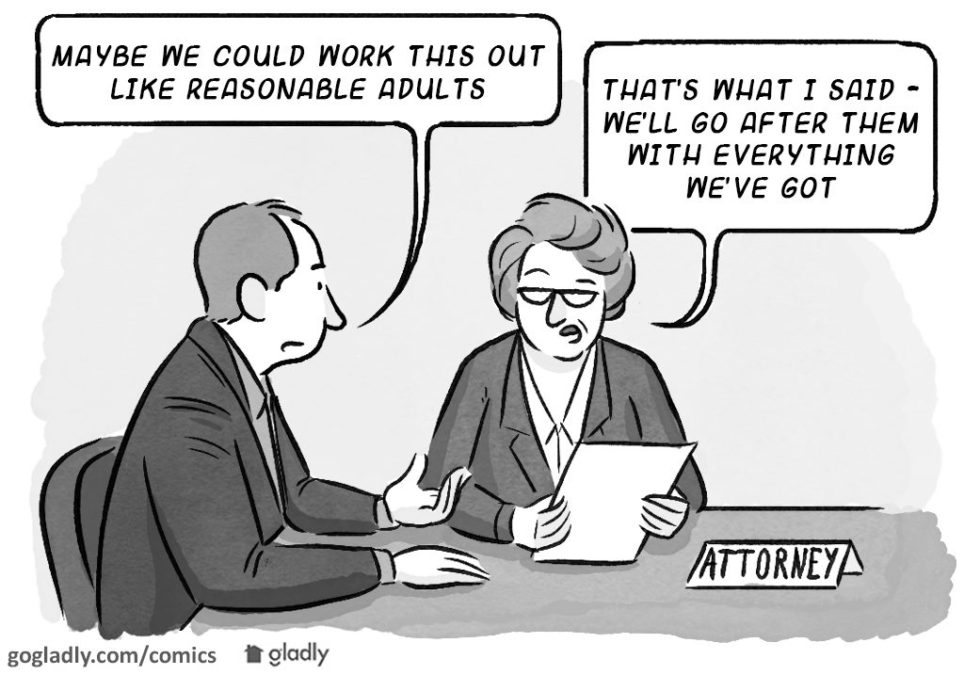
— Jessica Gutierrez Alm, Attorney

Amazon’s patent (U.S. Patent No. 9,280,157) for a “System and Method for Transporting Personnel Within an Active Workspace” has been in the news recently.

The invention is described as a device for keeping human workers safe in an automated (i.e., robotic) work environment.  In the Background, the patent discusses the rapid rise of automation in inventory-handling systems.  “Technological advancements have made an ever-increasing amount of automation possible in inventory-handling and other types of material-handling systems.”  ‘157 patent at col. 1, ll. 7-9.  “However, there may be circumstances where it is necessary for human operators to traverse, or otherwise go onto, an active workspace where the mobile drive units are carrying out their assigned inventory-related tasks.”  ‘157 patent at col. 1, ll. 14-18.  An automated work environment can be dangerous for human workers.  As a solution, the patent proposes a transport device to transport a human worker safely through an automated inventory-handling work area.  The premise, and the described need for the invention, sound reasonable enough.  However, it’s the drawings of this patent that are garnering some unwanted attention.

Amazon worker cages allow users to safely traverse automated work areas.
At least there’s a bench (414) to sit on?

The patent illustrates and describes the transport device as, well, a cage for workers.  The Detailed Description describes the device as a “cage-like structure configured to substantially prevent the user from sticking an appendage through the enclosure.”  ‘157 Patent at col. 13, ll. 51-53.  Importantly, the claims of the patent (i.e. the scope of protection) are relatively broad and do not specifically require the cage-like structure.  Claim 1, for example, is directed to an inventory-handling system to transport a user within a workspace, the system including a first device to transport users within the workspace, a second device to transport users within the workspace, and a management module directing movement of the two devices.  Of course, this doesn’t render the imagery of work cages any less concerning.

A recent study conducted by two artificial intelligence researchers drew attention to the patent.  The authors referred to the patent as: “an extraordinary illustration of worker alienation, a stark moment in the relationship between humans and machines.”  News of the patent quickly reached major outlets and social media.

Amazon’s Senior Vice President of Operations, Dave Clark, responded on Twitter:  “This was never used and we have no plans for usage.”

This patent, the resulting blowback, and Amazon’s response highlight a couple of important points about patent protection.

First, patents (and, typically, patent applications) are publicly accessible documents.  At the heart of the patent system is an exchange.  The inventor obtains the right to exclude anyone from making or using the invention, but in exchange, must disclose that invention to the world.  Thus a company seeking to obtain a patent, and particularly a high profile company like Amazon, should keep in mind that every word and drawing will be viewable by the public.

Second, Clark’s statement that the company has no plans to implement the cages is a reminder of the value a patent can have.  A patent grants the owner a right to exclude others from practicing the invention.  A patent owner need not actively practice the invention herself in order to enforce it against others.  Even when a company is not looking to implement a particular invention, an issued patent on the concept may provide a leg up on competitors.  The relatively broad claims of the Amazon patent, which do not rely on the cage design, allow Amazon to exclude its competitors from employing a system for transporting humans through an automated work space.

As we move into Week 2 of the NFL, the big clash in North Country is Sunday’s Green Bay Packers – Minnesota Vikings game. All the buzz is whether the second-coming-of-Favre Aaron Rodgers will prevail over the vaunted Vikings defense. But here in my trademark bubble, I’m more interested in the Jacksonville Jaguars versus former Jaguar player Dan Skuta. This isn’t a contract negotiation battle, but instead a dispute over who owns the claimed trademark rights in the word SACKSONVILLE. The dispute is now the subject of a pending opposition at the Trademark Trial and Appeal Board.

In the Notice of Opposition to the team’s application, Skuta claims to have been the first to coin the term “Sacksonville,” back in July of 2015, but his pending application was refused based on a possible likelihood of confusion with the team’s already filed application. He created a Twitter account and hired a graphic designer to create the logo below, which appears on Skuta’s website.


In the team’s application to register the claimed #SACKSONVILLE mark, the Jaguars claim a first use date of September 1, 2017.  However, the team has the ability to present evidence of use earlier than the date of first use listed in the application. One article notes that the team has used the phrase as a social media hash tag at least as early as 2013. But in most circumstances, merely using a word as a social media hashtag does not constitute use in commerce.

Unsurprisingly, one local Jacksonville news outlet is skeptical, siding with the team over a “forgettable linebacker . . . who may have been better at anticipating trademark uses than he was at reading offenses.”

It is possible that Skuta may have used the mark in commerce before the team. Skuta hasn’t made his case any easier by including in the logo what appears to be a jaguar skull and the same Jacksonville Jaguar teal color. On top of this, the play on words with “Jacksonville” potentially creates association with the team, too.

It’s a bit of a mess: are there even any trademark rights and, if so, who owns them? It seems the team likely should be the owner, but perhaps they fumbled the rights along the way. We may have to wait for the Trademark Trial and Appeal Board to weight in to see who emerges from the scrum with the ball.

Like many new parents, my wife and I own a Boppy® infant support pillow.  Examining the packaging, I noticed an excellent example of “look-for advertising:”

Typically, look-for advertising is part of a campaign to build consumer recognition of a product design to a level where it can support a claim of “acquired distinctiveness,” that is, the design tells consumers the product comes from a distinct source.  One exception to this process is that a functional product configuration is not distinct and can never acquire distinctiveness – functional features can only be protected by patents, if they meet the requirements for patent eligibility.  We’ve written extensively about these issues here, here, and here.

So, is the “Boppy Shape” functional, that is, unable to acquire distincitiveness?  This expired patent suggests the answer might be “yes,” describing the invention, a support pillow, as follows:

It is generally circular but discontinuous where tapered ends meet, defining a well in the center.

The patent drawings also show the “Boppy Shape” as a preferred embodiment of the invention:

This evidence doesn’t end the inquiry, but it’s strong evidence that the “Boppy Shape” is functional.  The Trademark Manual of Examining Procedure describes patent evidence as follows:

It is important to read the patent to determine whether the patent actually claims the features presented in the proposed mark. If it does, the utility patent is strong evidence that the particular product features claimed as trade dress are functional. If it does not, or if the features are referenced in the patent, but only as arbitrary or incidental features, then the probative value of the patent as evidence of functionality is substantially diminished or negated entirely.

However, even if the “Boppy Shape” itself is functional and not protectable as a trademark, nothing stops Boppy from registering the phrase “Look for the Boppy Shape!” as a trademark, as these registrations show, here, here, and here, or the two-dimensional representation of the shape, here, and doing so is a good move by Boppy regardless of the whether the shape itself can ultimately also be registered.

One reason Boppy might want to do this is because with patent expiration comes generic competition.  And that’s fine – if all this talk about trademark and patent law gives you a headache, you can save a few bucks buying generic ibuprofen instead of brand name Advil – just don’t call it Advil®.

Where we as trademark professionals see generics violating that rule all the time (and counterfeits) is on e-commerce platforms like ebay and Alibaba. Just take a look at these snips from the search results for “Boppy Pillow” on these two websites:

Alibaba:

Ebay:

The listings above are not for Boppy brand pillows. Instead they appear to be generic support pillows, perhaps fairly produced given the expiration of the patent (Boppy owns other patents for other elements of its pillows and other products, which were not examined for this post). But what’s not fair, and what is actually likely infringement, is use of the “Boppy” trademarks to sell generic support pillows.

Based on my review of its product packaging and trademark registrations, Boppy has done an admirable job raising its trademark portfolio. Now the question is, is it time for a pillow fight?

Erik Brunetti is not one step closer to being able to federally-register his vulgar and scandalous FUCT trademark for clothing; his portfolio of applications remain log jammed (here and here):

So, scandalous trademark applications are still on hold at the U.S. Trademark Office, since the government is now asking for the Supreme Court to reverse Brunetti. First prediction, check.

As you will recall, the Court of Appeals for the Federal Circuit in Brunetti, struck down the scandalous and immoral bar on federal trademark registration, as a violation of Free Speech.

The government now contends that denying federal registration of scandalous or immoral matter does not constitute viewpoint discrimination, so Brunetti isn’t controlled by the Tam decision.

The scandalous and immoral registration bar has been applied since the 1905 Trademark Act, and “scandalous” is interpreted to mean, under current attitudesshocking to the sense of propriety.

Putting aside whether much of anything in our current culture can be considered shocking, if it’s possible, doesn’t shocking content express a certain viewpoint, namely one with shock value?

And, if Justice Alito was right in Tam that the disparagement bar is a “happy talk clause,” then isn’t the scandalous bar a “tranquility clause,” appropriately and fully cleansing of any shock value?

Will the Supreme Court decide to review the Brunetti decision? I’ve predicted it won’t, but it should, so I’m hoping to be wrong, it would be priceless to see the Court address Section 7:

“Why did the Tam Court not acknowledge that a Certificate of Registration is issued by the USPTO, under authority of the Department of Commerce, “in the name of the United States of America,” under Section 7 of the Lanham Act, and instead proceed to mock the governmental speech argument without addressing or attempting to explain away this difficult fact?”

That drum we have been beating hard, so kudos to the government in pressing Section 7:

“Congress’s directve that the USPTO refuse federal trademark registration to vulgar words and lewd sexual images is consistent with those First Amendment principles. Congress legitimately determined that a federal agency should not use government funds to issue certificates ‘in the name of the United States of America’ conferring statutory benefits for use of vulgar words and lewd sexual images. 15 U.S.C. 1057(a). Although [Erik Brunetti] has a First Amendment right to use a vulgar word as a mark for his clothing line, he has no comparable right to require the government to register vulgar terms, issue registration certificates for them in the name of the United States, inscribe them on the USPTO’s Principal Register, and bestow valuable benefits on the markholders’ use of the terms in commerce.”

Even if it ends again, with the Free Speech argument prevailing, for reasons beyond my beliefs (here, here, and here), nevertheless it would be helpful for predicting the fate of other portions of the Lanham Act that are content-based and that have been called into question. Wait and see:

In April, news broke that two iconic alcohol brands were joining forces to create a remarkable new beer: Jim Beam Budweiser Copper Lager. Fruit of the joint labor is now available for consumption:

The unique combination doesn’t appear destined to fall flat, as in the early days since launch, it seems to be attracting even self-professed “craft beer snobs,” which is probably the point for Bud.

When iconic brands come together in a co-branding arrangement, it’s interesting to note visual manifestations of the joint trademark use guidelines, a peek into who’s steering the Clydesdales.

Not surprisingly, the reigns of the Clydesdales appear most closely held by Budweiser, as the Copper Lager is beer, not whiskey, and BUDWEISER is the largest wording on the packaging.

That said, the Jim Beam brand name and logo does adorn the six pack carton’s front face with top line prominence, suggesting the brand power it brings to the party – liquid version of Intel Inside?

Figuratively though, not literally, as the Copper Lager isn’t a boilermaker beer cocktail, instead the Jim Beam name and logo indicates aging of the lager on genuine Jim Beam bourbon barrel staves.

One of the things the packaging does well, from a trademark perspective, is keeping the visual identities of the brands separate and distinct, as they appear together in this joint branding effort.

It’s really not a good idea, from a trademark perspective, to mix and blend the combined brands into a single new visual identity, as doing so raises questions of ownership and how to untangle.

So, the packaging does a nice job of keeping each sides trademark elements physically separable while communicating why Budweiser invited Jim Beam to team up for this Copper Lager party.

The trademark filings tell stories too. The only filings currently on the USPTO database that contain the terms Copper and Lager in a mark are owned by Budweiser parent, Anheuser-Busch.

So, Anheuser-Busch views the Copper Lager name to be part of the Budweiser Copper Lager and Budweiser Reserve Copper Lager trademarks, but it disclaims exclusive rights in Copper Lager.

What we don’t know (yet) from the disclaimers, is whether Copper Lager is descriptive (capable of being owned as a trademark element), or generic (you know, meaning zero trademark rights).

If Copper Lager is not a category of beer (i.e., generic and incapable of trademark status), and instead descriptive, since this isn’t Anheuser-Busch’s first such rodeo: acquired distinctiveness?

Either way, this joint effort does appear to be Jim Beam’s first rodeo when it comes to beer, as evidenced by the intent-to-use Jim Beam trademark application it filed in April 2018 for beer.

Thankfully these brand owners are sophisticated enough not to combine Jim Beam and Budweiser into a single trademark filing, sadly I’ve seen commingling before, and it isn’t much fun to unwind.

What do you think, is this joint effort a remarkable one? Is it likely to last, stand the test of time?

As Steve blogged earlier this week, we’ve had a lot of “zero” on the mind lately—marks related to the word and numeral. It got me thinking about the letter ‘O,’ especially since it has been in recent trademark news.

If you missed it, The Ohio State University and Oklahoma State University are now dueling it out at the USPTO over Oklahoma’s trademark application related to the block ‘O.’ Specifically, Oklahoma is attempting to register a mark of “a drum major marching while leaning back with head tilted back”:

According to Oklahoma, it has been using the singular block ‘O’ since 2001, most notably on the jersey of its band’s drum major (but also on sports memorabelia):

But in an opposition to the mark, Ohio says it has been using the same letter since as early as 1898, and it’s current main athletics logo includes the block ‘O’ in the background:

According to Ohio, Oklahoma’s use of the leaning and tilted ‘O’ is likely to cause confusion. I wonder if any other O-state institutions will weigh in—looking at you, Oregon.

On the one hand, the block styling of the Oklahoma ‘O’ could cause consumers to accidentally purchase sports gear from the wrong institution. On the other hand, the letter ‘O’ is such a fundamental unit of the English language that it’s hard to argue just one institution should be entitled to its exclusive use—even if it’s only in the college sports context. And Oklahoma is only seeking registration of a mark which uses ‘O’ in a minor fashion. However, Oklahoma’s marching ‘O’ mark could run into issues related to the requirement that the mark be used in commerce. After all, it’s a mark representing the band major, who wears an ‘O.’ How does Oklahoma otherwise use the mark or plan to use it commerce?

It turns out that the letter ‘O’ is not widely used as a mark on its own. There are some recognizable uses, though. Perhaps the most distinctive use of the letter ‘O’ is the Oprah Magazine:

In 2001, a German magazine also named ‘O’ sued Oprah’s ‘O’ magazine, but the suit appears to have gone nowhere, and Oprah’s ‘O’ lives on.

The only other major ‘O’ competitor appears to be Cirque du Soleil:

Maybe there’s some potential for confusion between the Oklahoma drum major and the high-flying circus performers. Though, I’m guessing the audiences for both don’t substantially overlap.

I think the few recognizable instances of ‘O’ marks can be explained by the overall minor distinctiveness a single letter can generate when used in connection with a brand. This is the up-hill battle both Ohio and Oklahoma will face in arguing their sides of the trademark dispute. Stronger letter marks are paired with other words, such as O Magazine and O Cirque du Soleil. Another example comes to mind: Toys ‘R Us (also in the news lately).

We’ve had a lot of nothing — meaning zero, and the trademark meaning, if any, of zero — on our mind lately, so imagine my surprise to see this soap “brand” for the first time last week in a hotel:

Not sure how to pronounce it, but as we know, there really is no “correct” way to pronounce a trademark, so it could be Zero, or perhaps a telescoped version of Zero Percent, who knows?

What we do know for sure is that neither Zero nor Zero Percent functions as an inherently distinctive trademark to identify, distinguish, and indicate a single source of this body collection:

Why Applicant’s Mark is Deemed Descriptive

“Applicant seeks to register the designation “ZERO%” for bath soaps in liquid solid and gel form; Body lotions; Hair shampoos and conditioners; Shower Gel.” Had applicant not applied under 1(a) and submitted specimens of use consisting of the bottles for shampoo, conditioner, body lotion, shower gel and hair 2 in 1, the mark would likely not have been seen as descriptive.

However the specimen bottles show graphically just what “ZERO%” describes about the applicant’s product. On each bottle is the following legend, explaining the mark:

 “ZERO sulfates

 ZERO parabens

 ZERO phthalates

 ZERO artificial colours

 ZERO animal testing”        

Thus it appears that “ZERO%” refers to the ingredients that are NOT present in applicant’s soaps and hair care and body lotion and shower gel products.  Sulfates and parabens have long been regarded as suspect with respect to human skin. Testing on animals is considered cruel. The ZERO% describes a certain purity in applicant’s products and a certain ethical sensibility about not making money from suffering animals.

In a parallel situation Diet Coke did very well when Coca Cola produced a ZERO caffeine soda, with, of course, zero calories.  Both caffeine and calories are enemies of healthful ingestion.

Applicant is applying the same logic to its toiletries and hair care products. This is to be applauded, however, the mark chosen, “ZERO%,” even without benefit of an explanation on every bottle, would have to have referred to SOMEthing about the goods. “ZERO%” of what? would be the logical question. And there is the answer, front and center, on the bottle.

Another way to look at this is: if using the name of an ingredient of the goods is descriptive use, then surely using a term that indicates the absence of unhealthy or unethical ingredients would also be descriptive.

Two major reasons for not protecting descriptive marks are (1) to prevent the owner of a descriptive mark from inhibiting competition in the marketplace and (2) to avoid the possibility of costly infringement suits brought by the trademark or service mark owner.  In re Abcor Dev. Corp., 588 F.2d 811, 813, 200 USPQ 215, 217 (C.C.P.A. 1978); TMEP §1209.  Businesses and competitors should be free to use descriptive language when describing their own goods and/or services to the public in advertising and marketing materials.  See In re Styleclick.com Inc., 58 USPQ2d 1523, 1527 (TTAB 2001).”

This descriptiveness refusal might be the most conversational and empathetic explanation I’ve seen over the course of my trademark career. Nicely done, USPTO Examining Attorney Jill C. Alt.

More than 6 years ago, Applicant Gilchrist & Soames, accepted the Examining Attorney’s invitation to amend to the Supplemental Register, for marks only “capable” of becoming distinctive.

In most cases, the attentive owner of a Supplemental Registration, in use for 5 consecutive years, already would have filed for Principal Registration, arguing in favor of acquired distinctiveness.

Gilchrist & Soames hasn’t (yet), and given what Zero has evolved to mean, will the noted parallel to Coca Cola’s Zero soda, cleanse zero to mean “incapable” of trademark status as a soap type?


In terms of zero sum games, in the trademark world, even if Zero and Zero Percent turn out to be generic, perhaps Gilchrist & Soames gained more in marketing than they would lose in trademark.

As we share another Labor Day together on DuetsBlog, we’re thankful for the emotional labor of those on this journey with us, and we hope you agree this effort is a win-win, no zero sum game.

Everyone knows if you really want to get zero calories from a beverage without any strings attached, you have to drink water. But what if you hate water? Try sparkling water! Look how exciting it is:

If sparkling water is the remedy to plain old boring water, why are some trademarks for sparkling water so … flat?

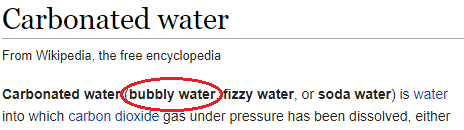
Back in May, Steve wrote about a new Pepsi sparkling water product branded as bubly™. That’s “bubbly” misspelled “bubly.” For sparkling water, it’s also descriptive, probably generic, and definitely not a conceptually strong trademark. Just look at this snip from the Wikipedia page for “carbonated water,” listing “bubbly water” as a generic alternative term:

Then earlier this month, it was announced that Pepsi has agreed to buy SodaStream, the popular manufacturer of at-home sparkling water makers, its most economical model branded Fizzi™.  That’s “fizzy” misspelled “Fizzi.”

De ja vu, anyone?  Take a look at the Wikipedia page again, if you have to:

So, here we have another descriptive, probably generic, definitely not conceptually strong trademark that lacks any suggestive, inherently distinct sparkle. And if there’s any doubt, check out the descriptive uses of the word “fizz” right on the product packaging:

And on the label attached to the machine:

And on the product website:

And in the consumer comments:

And in the FAQs:

Do marketers of sparkling water hate trademarks? (And why are they such bad spellers?)

Perhaps we’ll never know. Or perhaps the answer is simply that these marketing types just wanted to avoid this:

Video: link

Or this:

But what’s the fun in something so flat!

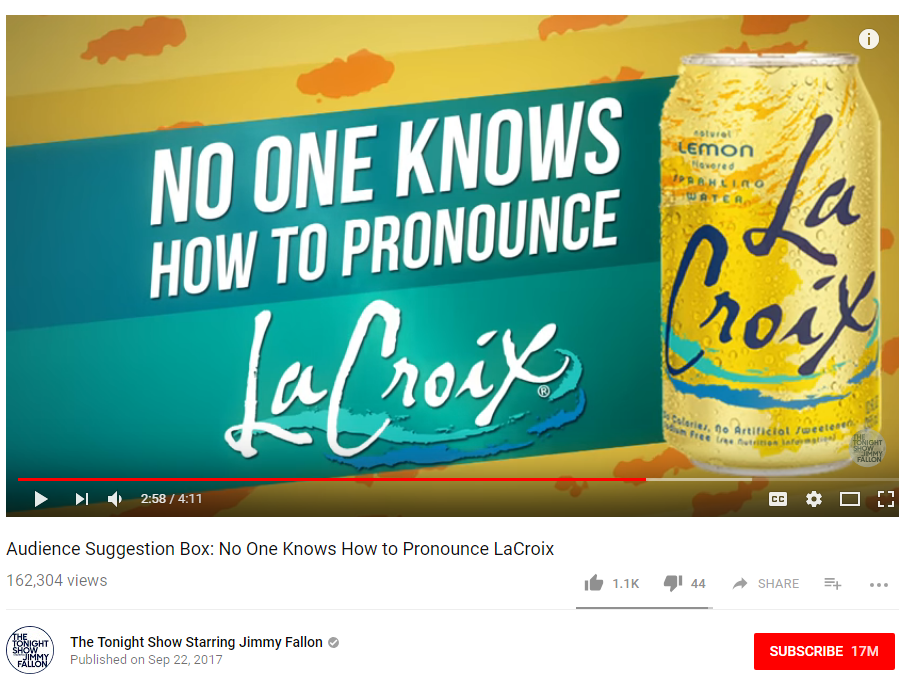
Marketing-types, what would you do? Would you bottle the brand that is so flat it needs no imagination for its meaning to bubble up in the minds of consumers? Or would you go with the brand that nobody knows how to say but plenty of folks enjoy . . . and enjoy poking fun at?

Since launching almost ten years ago, we’ve focused on helping and guiding marketing/branding professionals, as we seek to facilitate their graceful collaborations with trademark professionals.

Our approach has strived to deliver valuable information, without the typical jargon and legalese.

It seriously borders the obvious to say that folks who connect with us here know the importance and value of brands and trademarks, and probably know far less about patents and patentese.

Could novelty be shown, sharing this with patent folks wanting more comfort with trademarks?

In a month, on September 28, at 10:15 AM, I’ll be sharing some of this knowledge at the Midwest IP Institute, in Minneapolis, with a brand new session specifically designed for in-house patent and intellectual property counsel, especially those who may believe that patents are more important than trademarks, called: Trademark Survival Guidance for In-House Patent and IP Counsel.

I’m not saying that one is more important than the other. Nor are there any equivalents here.

What I am saying is that over the last quarter century intellectual property expertise has become far more subspecialized. I’ve witnessed this development first hand over the course of my career. Yet, not all companies have dedicated in-house trademark counsel, so in-house patent counsel often is expected to have at least a working knowledge of the ever-changing trademark landscape.

I’ll be leading a discussion with a very talented group of patent and intellectual property counsel:

  • Paul Sherburne, Associate General Counsel and Intellectual Property Attorney, Graco Inc.
  • Greg Smock, Patent Counsel, Teleflex Incorporated
  • Kirsten Stone, Assistant General Counsel – Chief Intellectual Property Counsel, H.B. Fuller Co.

If you have a strong patent background and want more trademark footing, this session is for you.

If you know patents inside-out, but search for more comfort in trademark matters, this is for you.

If your knowledge of the patent landscape is vast, but you seek to be much better than simply dangerous, when it comes to navigating thorny trademark issues, you won’t want to miss this.

Why? Because we will help you improve your handling and supervision of trademark matters.

In fact, you will learn and apply valuable trademark knowledge to your day-to-day work, and take away the top six trademark tips that will improve and strengthen your trademark advice to business leaders and marketing professionals. Are we speaking your language yet?

If you’re wanting to learn how to translate patentese into valuable trademark skills, here you go.

By the way, I’ll be expanding my patent knowledge and learning more patentese later today (and more than I knew yesterday) at the USPTO China Intellectual Property Road Show at the University of Iowa College of Law, hosted by Dean Kevin Washburn and Professor Jason Rantanen.

The battle for attorneys’ fees after an intense trademark dispute often leaves many prevailing parties empty handed. This is because the Lanham Act only provides for attorneys’ fees in “exceptional cases.” Congress’s (and courts’) reluctance to award attorneys’ fees stems from the “American Rule,” which provides that each party to a lawsuit is responsible for paying its own fees–unless a statute provides otherwise. But the Lanham Act erects a high bar to obtaining fees by requiring that the case be “exceptional.”

On the one hand, trademark owners should not have to fully shoulder the burden of what often turns into expensive litigation just to enforce their rights. Indeed, the estimated cost of protecting one’s rights can dramatically affect the calculus of whether to sue for infringement in the first place. But on the other hand, trademark violations are sometimes debatable and unclear. In such circumstances, the American Rule provides some protection to litigants who would otherwise be discouraged from seeking redress due to the risk that they might have to pay the defendant’s fees in the end if they lose. Thus, the Lanham Act strikes a balance, providing for reimbursement in cases of brazen and clear infringement–or brazen and clear abuse of the litigation process–while retaining the benefits the American Rule otherwise provides.

The Lanham Act’s fee provision has come up recently in two high-profile trademark cases: one involving Comic Con (reported on previously here and here), the other meme-famous Grumpy Cat (also reported on previously here). But the result was legally different in both cases, with Comic-con obtaining millions in fees under the Lanham Act, while Grumpy Cat obtained nothing under the Act, but recovered nevertheless pursuant to a contract between her and the infringer. What explains the different results?

Comic-con: The Comic Con (short for “comic book convention”) dispute began when the San Diego Comic Con sued the Salt Lake Comic Con for infringing on San Diego’s “Comic-Con” trademarks. The San Diego convention was one of the first comics-fan conventions.  And it is the largest convention of its kind, drawing more than 130,000 attendees each year. Salt Lake’s convention began in 2013, but it has quickly grown to over 120,000 attendees. Thus, it is probably no surprise that San Diego took exception to Salt Lake’s competing event and use of the same “Comic Con” name–though, as my colleague Jessica Alm pointed out, there are many other conventions across the United States using the same name.

San Diego Comic Con sued Salt Lake Comic Con for infringement. But despite the seemingly-debatable nature of the dispute (because the name could be generic, and it would be difficult to prove consume confusion), less than a year ago a jury determined that Salt Lake was liable for infringement in the amount of $20,000. Thereafter, San Diego moved for fees in the amount of $5 million–a little disproportionate, one would think (but perhaps not in view of San Diego’s requested $12 million in damages).

The district court judge granted $3.9 million. The reasons? Salt Lake repeatedly disregarded court rules, violated confidentiality rules, squandered judicial resources by relitigating issues, based arguments on irrelevant law, and attempted to bias the jury during the trial. The judge felt that the case stood out from others due to the “unreasonable manner it was litigated.” Expect an appeal on the $20,000:$3.9 million ratio.

Grumpy Cat: The Grumpy Cat dispute began when Grenade Beverage LLC, which had licensed Grumpy Cat’s trademarks (names and likenesses) to be used in trade dress and advertising for a new line of iced coffee products called “Grumppuccinos,” also used the marks in connection with a new coffee bean product without Grumpy Cat’s permission. Like the Comic Con litigation, the parties also litigated this case for three years. In addition, a jury awarded Grumpy Cat over $700,000–much more than San Diego Comic Con. But only $1 of that was for breach of the licensing agreement.

But unlike the Comic Con litigation, a federal judge recently denied Grumpy Cat’s request for approximately $320,000 in fees under the Lanham and Copyright Acts. The judge did, however, granted Grumpy Cat fees under the licensing agreement with Grenade Beverage–though, the judge said that there needs to be additional briefing on how much in fees can be awarded under the contract. Central to the judge’s decision on the Lanham Act fees issue was the fact that Grenade Beverage had not acted frivolously or in bad faith when they adopted an interpretation of the licensing agreement that entitled them to use Grumpy Cat’s marks in a line of Grumpy-Cat- branded “coffee products,” rather than just iced coffee. This reasonable difference of opinion–and, presumably, reasonable litigation behavior throughout the case–did not make out “exceptional” circumstances justifying fees under the Lanham Act.

In general, the Comic Con and Grumpy Cat cases provide two high-level teachings when it comes to fees. First, it is important to choose professional counsel, make reasonable litigation decisions, and take good faith positions throughout the course of a case. Otherwise, that conduct in and of itself may make the case “exceptional,” putting you on the hook. Second, attorneys’ fees provisions in a licensing agreement can serve as a helpful back-up if the Lanham Act fees request fails. But in providing for such fees, one should consider whether it is truly advantageous in the circumstances to remove the American Rule’s protections. That requires some thought…I need a Grumppuccino.

P.S. In April, I wrote about the USPTO’s attempt to obtain attorneys’ fees when it prevails in district court patent litigation. The Federal Circuit rejected this attempt, stating “the American Rule prohibits courts from shifting attorneys’ fees from one party to another absent a ‘specific and explicit’ directive from Congress. The phrase ‘[a]ll the expenses of the proceedings’ [in 35 U.S.C. § 145] falls short of this stringent standard.”