Two months ago, our attention seized on a nutty and woefully deficient USPTO examination of a trademark application to register — Mr. Wonderful — for roasted nuts, and nut-based snack foods, among other food products, given the prior WONDERFUL trademark rights owned by these folks:

Just like clockwork, events now appear to be playing out as expected, so keep your eyes peeled and your watches synchronized. Last Friday, The Wonderful Company LLC, filed an extension of time to oppose registration, so the new deadline for opposition is September 8, 2018.

We’ll likely soon see whether a Letter of Protest was filed behind the scenes, giving the USPTO a chance to correct this mistake and issue a likelihood of confusion refusal —  as it’s hard to imagine the Examining Attorney’s failure to issue a refusal won’t be considered clear error, so stay tuned.

Wonderful likely has made contact with Mr. Wonderful by now — my question would be, how hard will Mr. Wonderful play to salvage the other food items currently in the identification of goods?

What do you think, are these goods sufficiently related to roasted nuts to become toast, as well?

Jellies and jams; Banana chips; Dried fruit-based snacks; Fruit preserved in alcohol; Nut butters; Olive oil for food; Potato chips; and Yogurts.

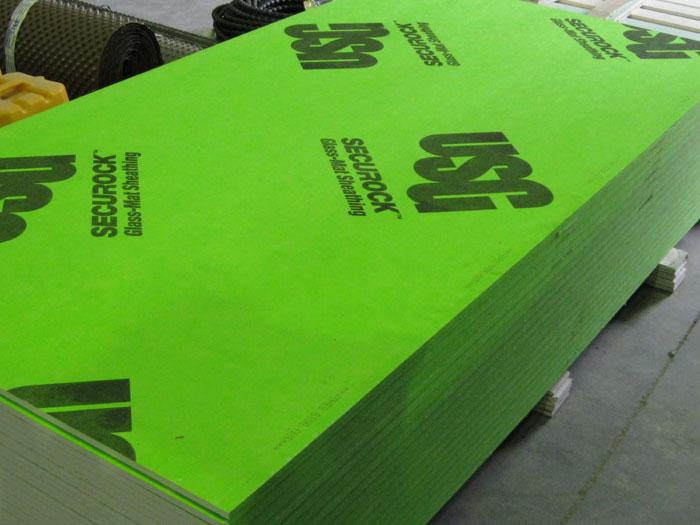
These lime green building sites caught my eye and jogged my trademark memory. First, the future home of the University of Iowa College of Pharmacy, at beam signing, on May 4, 2018:

Second, the expansion of the Metro Transit headquarters near downtown Minneapolis, on June 12:

Of course, the obviously common element of both building sites, besides my iPhone, is the same lime green sheathing, both also branded with the USG and SECUROCK word trademarks.

Then poof, they’re gone, after being covered by some black-colored sheathing, on August 2, 2018:

What’s my point? Actually, I have a few that immediately come to mind, so bear with me.

First, do you suppose United States Gypsum Company views the lime green color of its gypsum panels to be a trademark? Apparently there are no look-for statements on the product itself:

In looking for look-for ads that might draw attention to this particular shade of green as a brand, Green Means Go (scroll down after linking), is the closest I’ve found.

Let’s just say, USG has been far more effective in owning the color red as a band or stripe applied to packaging for plaster products, and the supporting look-for-like TOP RED word mark.

Still, it’s difficult to tell what USG thinks from the general legend used in its online brochures:

“The trademarks USG, FIRECODE, SECUROCK, IT’S YOUR WORLD. BUILD IT., the USG logo, the design elements and colors, and related marks are trademarks of USG Corporation or its affiliates.”

It’s even harder to tell, despite the “colors” mentioned in the legend above, after searching the USPTO, since USG allowed its Supplemental Registration — for what I’m calling the “lime green sheathing” — to expire without first obtaining, or at least, filing for Principal Registration.

The Supplemental Registration described the mark as “the color yellow green (Pantone 375) as applied to the goods.” Namely, “non-metal water-resistant boards and panels for construction.”

Why let it go?

I’m sure the color green is considered difficult to protect for sustainable building materials, but this color mark was narrowed down to the particular Pantone shade. Perhaps the shade changed?

Typically, a Supplemental Registration is considered valuable to a brand owner, while it works to build the evidence necessary to establish acquired distinctiveness for Principal Registration.

In addition, the Supplemental Registration for Pantone 375 was some indication that the USPTO did not view that shade of green as being functional even for sustainable building materials.

We’ll keep watching to see if Principal Registration is pursued.

In the meantime, let us know if you discover any better look-for advertising for USG’s SECUROCK gypsum panel sheathing. Loyal readers know how important look-for ads are for trademark colors.

Last, the now-you-see-them-now-you-don’t green gypsum panels remind me of the lavender color registration I convinced the USPTO to issue for spray in place insulation in 1994, oh the memories!

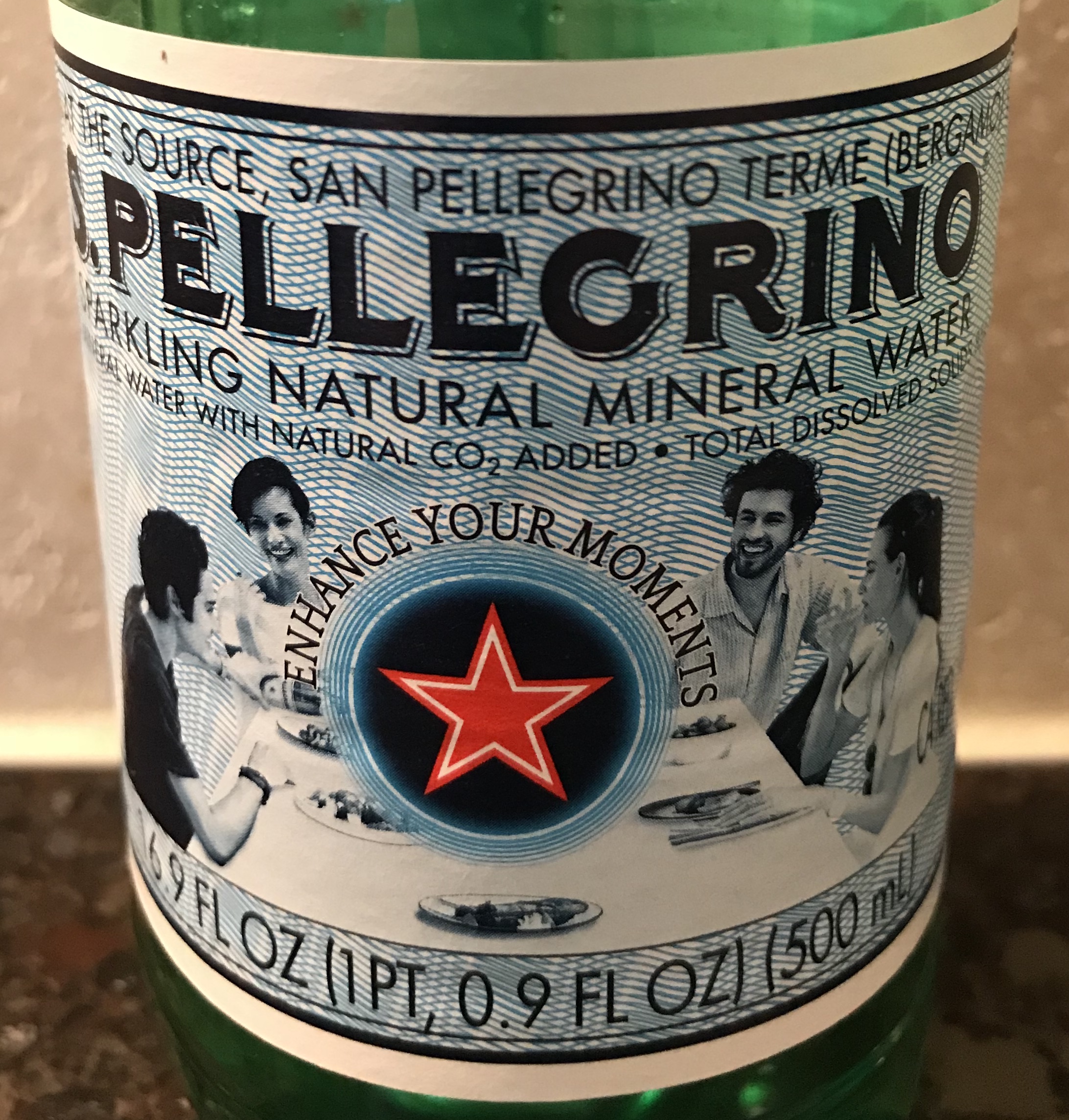
As I’ve been known to do long before now, this past weekend I found myself gazing intently, this time, into the front label and back copy on this S. Pellegrino sparkling natural mineral water bottle:

Putting aside the question of the shiny red star logo, which we already have bloviated about, here, a few years back — my focus is centered on the surrounding Enhance Your Moments tagline.

No gold star for the brand’s failure to capture federally-registered protection for it, despite the obvious association with SanPellegrino, as shown in results of a simple Google search, here.

Another “no gold star” moment that needs a modicum of enhancement would be the back copy:

Why? As you can see, SanPellegrino has taken a perfectly fine, inherently distinctive, and suggestive trademark, and used it in a sentence (without brand emphasis) in a descriptive sense.

Make sense?

You never really need to wonder where the beef empanadas are, inside the display case, at least at Whole Foods, given the literal “beef” branding — visible on the edge of each outer dough shell.

This is a good example of a word appearing on a product that does not function as a trademark, as it does not satisfy the 3 elements of: identifying, distinguishing, and indicating a product’s source.

Instead, the word “beef” above connotes what’s inside, the primary ingredient of each empanada — you might say, it is merely informational, incapable of serving a trademark or brand purpose.

While “beef” could be a perfectly suitable and suggestive trademark for something not containing that meat, like clothing (assuming it’s available); as it is above, it’s simply a generic designation.

I’m thinking Whole Foods is missing out on an opportunity to also imprint on its empanadas a symbol that designates where they came from, who put them out, their source, don’t you think?

– Mark Prus, Principal, NameFlash

Summer is in full swing and that means baseball is top of mind for many of us. As a professional name developer, I continue to get a charge from the names of minor league baseball teams. Following up on my previous post on minor league baseball team names here are some controversial team names:

All of these names were controversial when they were introduced. Think about it…who wants to support the El Paso Chihuahuas? However, according to the brand name developer, Jason Klein of Brandiose, being controversial was the intent.

Today these franchises are successful examples of branding with great ticket sales and high merchandise sales.

Obviously, these are fun names and minor league baseball is all about fun. However, the genius in these names is not that they are just fun…the names leverage a bit of history and are familiar to the target audience.

Take the El Paso, TX Chihuahuas as an example. When the name was introduced there was an uproar in the local community about the derogatory nature of the name. Shortly thereafter, articles of support started appearing (such as this one) and the name became a rallying point.

The same thing was true with the Hartford, CT Yard Goats. Yard Goat is a relevant name in Hartford as “yard goat” is railyard slang for the switch engines or terminal tractors that shuttle train cars between different locomotives, and Hartford has a strong rail presence.

In the 19th century the leading industry in the Lehigh Valley was iron production, and therefore the IronPig name makes sense (“pig iron” is the term for the raw iron that gets melted down to make steel).

Using a “safe” name might seem like a good idea, but safe names are generally mainstream names that don’t stand out.

Finally, please recognize that I’m not advocating “alphabet soup” names that seem to be in vogue with startups. If a name has some relevance, but is different enough to be noticed, then it might be worth the risk in the long run!

Credit: Federal Circuit (what it looks like to argue there)

One week ago, the Federal Circuit Court of Appeals issued its decision in Saint Regis Mohawk Tribe v. Mylan Pharmaceuticals, Inc., 18-1638 (Fed. Cir. July 20, 2018)–by all accounts, one of this decade’s most important decisions concerning the America Invents Act and the patent system. The primary issue in the case was whether the Saint Regis Mohawk Tribe (or any tribe, for that matter) is immune from the USPTO’s inter partes review (“IPR”) proceeding, which can result in cancellation of a patent. Allergan, a pharmaceutical company, had transferred title to certain patents to the Tribe after its competitor, Mylan, had instituted an IPR of the patents. The Tribe claimed that the USPTO could not review the patents due to sovereign immunity.

The Federal Circuit held that tribal sovereign immunity does not apply to IPR proceedings. It cited the Supreme Court’s recent Oil States decision (I wrote about the case earlier this year), which explained that IPRs arise “between the Government and persons subject to its authority in connection with the performance of the constitutional functions of the executive or legislative departments.” Thus, IPR is “simply a reconsideration of” the original patent grant by the federal Government. Although initiated by a private party, the Director of the USPTO must decide to institute the proceedings, and the USPTO acts “as the United States in its role as a superior sovereign to reconsider a prior administrative grant and protect the public interest in keeping patent monopolies ‘within their legitimate scope.'” The federal Government being supreme, tribes cannot invoke sovereign immunity.

The Federal Circuit’s final reference to protecting the public interest resonated with me, as well as Judge Dyk’s concurring opinion, which provided insightful context about the importance of reviewing patents post-grant. Certainly no one expects that the USPTO will perfectly examine every patent application and grant patents without error, but striving to achieve perfection is vital–even if impossible under current circumstances. As Judge Dyk illuminated:

[T]he USPTO–then and now–is an agency with finite resources that sometimes issues patents in error. Currently, for instance, the USPTO receives over 600,000 applications a year. Patent examiners receive roughly 22 hours to review each application, an amount of time that 70% of examiners report as insufficient.  And the USPTO struggles to attract and retain examiners with the technical competence required to understand the inventions being reviewed and to perform sufficiently thorough prior art searches.

The USPTO “is under pressure to make speedy determinations on whether or not to grant patents.” As such, “pre-grant patent examination was–and still is–an imperfect way to separate the good patents from the bad. Resource constraints in the initial examination period inevitably result in erroneously granted patents.” A glut of bad patents–or the perception thereof–negatively affects the public’s view of the patent system’s fairness and credibility. Thus, Congress created IPRs to combat pre-grant examination constraints, creating a streamlined procedure to challenge patents, in the hopes of restoring trust in the patent system. As an initial matter, I’m not sure attempting to solve the effect of the USPTO’s constraints was better than solving its cause.

In a recent article, I wrote about similar concerns as those expressed by Judge Dyk:

The USPTO, as the agency tasked with examining patent applications, is the first line of defense against patent fraud. But some point to the USPTO’s examination policies as potentially inviting fraud. By way of background, the USPTO’s patent examiners (those who review applications) are evaluated on a quota system, which encourages them to examine as many applications as possible. Some commentators have questioned whether this policy has turned the USPTO into a rubber-stamp institution. In the meantime, the number of patent applications and grants since 2000 has almost tripled. This has led to an even greater need for the USPTO to quickly accept or reject patents so as not to fall behind. The cycle is further incentivized by the increasing economic and financial value of patents. And it is also enabled by the difficulty, high cost, and/or impossibility of investigating every representation made by patent applicants. The USPTO simply does not have the wherewithal to investigate every claim of inventorship, utility, novelty, and other issues related to patentability. Thus, along with the important interests at stake, the complexities of patent law and the USPTO’s current weaknesses combine to create a situation in which fraud is less likely to be identified and thwarted.

In the context of the Mohawk Tribe appeal, the overwhelming public interests in reviewing potentially-invalid patents were brought to bear against the amorphous concept of sovereign immunity. It was absolutely necessary that tribes be subject to IPRs, lest private parties be enabled to take advantage of the USPTO’s constraints and “rent” the protection of sovereign immunity. Indeed, in a recent article, another commentator argued that the Federal Circuit’s decision had an “inescapable wisdom” because, had the result been any different, “every holder of questionable U.S. patents would have been rushing to one Native American tribe or another seeking deals to shelter possibly bogus rights.”

Going further, though, one can imagine more than just deals between tribes and private parties, but also the emergence of an entirely new form of patent assertion entity, patent troll (which some, but not all, criticize), and perhaps even a hybrid form of “patent privateer.” A tribe could, itself, become a mass aggegator of patents with a huge advantage: that the avenues for challenging its patents are more limited than a traditional patent holder. And one can imagine patent alliances renting tribal sovereign immunity for large market players. Any of these could exacerbate the David-and-Goliath scenario some defendants find themselves in after being sued for infringement. But, if the Federal Circuit’s decision holds–and I predict it will, especially in view of Oil States–such possible negative effects will not come to pass. However, as Judge Dyk implied (and it bears repeating), the patent system is imperfect and still has a way to go.

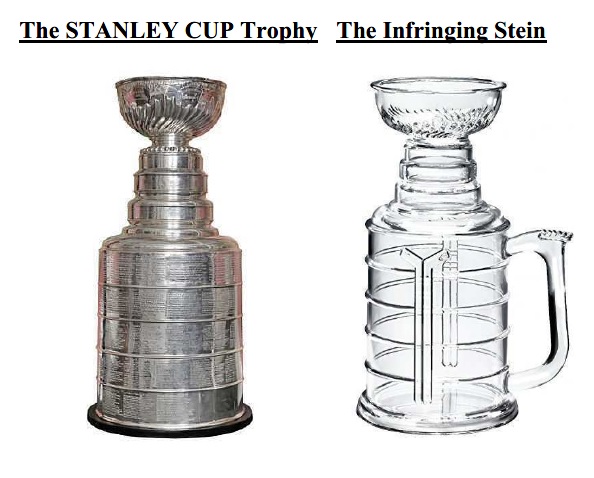
Even in July, with the heat of summer still blazing, you can’t get away from ice hockey in Minnesota. However, now that the Vegas Golden Knights have settled their dispute with the U.S. Army, it was starting to look like we were running out of hockey trademark news. Thankfully, the National Hockey League came through at the last second, filing a trademark infringement lawsuit on July 23. At issue is the NHL’s rights in the design of its championship trophy, the Stanley Cup, and the defendants’ sale of allegedly infringing beer mugs shaped like the Stanley Cup.

The defendants comprise companies, purportedly all owned or managed by the same individual, operating primarily under the name “The Hockey Cup LLC.” According to the complaint, the Hockey Cup has been selling unauthorized reproductions of the Stanley Cup as well as counterfeit jerseys. The company even applied to register trademarks for THE CUP HOCKEY. The NHL opposed the applications and, in response, the Hockey Cup counterclaimed to cancel the twelve registrations asserted by the NHL on the grounds of lack of ownership, abandonment, non-use, and fraud. With the gloves now off, the NHL chose to escalate the skirmish and sue the Hockey Cup in the Southern District of New York for trademark infringement, false association, dilution, copyright infringement, and unfair competition.

There is a good chance that the Hockey Cup will also assert its counterclaim for cancellation of the NHL’s registrations in the lawsuit. The counterclaim essentially argues that the NHL does not control the actual, physical Stanley Cup, and therefore the NHL cannot have trademark rights in the design of, or name of, the Stanley Cup. Strangely enough, this part of the argument has some truth to it. Since 1893, the Stanley Cup has been controlled by a pair of trustees. In 1926, the Trustees reached an agreement with the NHL, and the NHL has been the sole organization associated with the cup ever since, with continued permission from the Trustees. If that’s true, the Hockey Cup’s claims appear to be a bit of an underdog in this legal matchup.

But does the Hockey Cup’s sale of beer mugs in the shape of the Stanley Cup create a likelihood of confusion with the NHL? The NHL claims in its complaint that it has sold beer mugs in the shape of the trophy in the past, but none appear to be available at the moment. The NHL is selling Stanley Cup shaped ornaments, paperweights, inflatable trophies, miniature crystal replicas, and, for some reason, a popcorn maker. If we’re sticking with the booze, the NHL is selling a shot glass with a picture of the Stanley Cup. But yet, no beer mugs in the shape of the trophy.

To prevail though, the NHL does not need to show that it has lost sales due to the defendant’s conduct. Instead, there must only be a likelihood of confusion as to source, sponsorship, connection, or affiliation. One plausible argument in support of the NHL’s claim is that consumers will mistakenly assume that the mug has been licensed by the NHL.

In fact, one recent case from the Eleventh Circuit is quite relevant to the dispute. In that case, the Savannah College of Art and Design, Inc. sued an unauthorized online manufacturer and seller of apparel that was selling clothing with the school’s name. Savannah Coll. of Art and Design, Inc. v. Sportswear, Inc., 872 F.3d 1256 (11th Cir. 2017). The school sued, but the school could not establish that it began selling apparel with the school’s name before the defendant. Based on this, the district court concluded that the school’s rights in the mark with respect to education services did not provide it with trademark rights in the name for clothing. The district court granted summary judgement to the defendant.

On appeal, the Eleventh Circuit reversed, relying on precedent involving – you guessed it – hockey:

One of our older trademark cases, Boston Prof’l Hockey Ass’n, Inc. v. Dallas Cap & Emblem Mfg., Inc., 510 F.2d 1004 (5th Cir. 1975), controls, as it extends protection for federally-registered service marks to goods. Although Boston Hockey does not explain how or why this is so, it constitutes binding precedent that we are bound to follow.

As the quote suggests, the Eleventh Circuit is not certain that the precedent was rightly decided. In that decision, the NHL and the Boston team sued a manufacturer to prevent the sale of patches featuring team names and logos. The NHL had registered the marks for hockey game entertainment services, but not for any goods. The court noted the decision has been criticized but never overturned. As a result, the Eleventh Circuit remanded to the district court for further proceedings consistent with the Boston Hockey ruling. The NHL—and any other school, sport team, or other organization with an appreciable amount of merchandising—will want to pay attention to the resolution of the case, and consider filing applications to register their marks for valuable, merchandised products.

In the meantime, we’ll watch the ownership dispute play out between the NHL and the Hockey Cup. While it appears to be a longshot, perhaps ownership of the cup will return to the people of Canada, as some prefer (mostly Canadians). Until then, we’ll leave you with the words of Lord Stanley himself, announcing the creation of the Stanley Cup in 1892:


Another update on my long-running series of posts following the NHL’s newest hockey team, the Las Vegas Golden Knights, and their embattled trademark applications for VEGAS GOLDEN KNIGHTS that were filed nearly two years ago.

Most recently I posted about a challenge to the trademark applications by the U.S. Army, who opposed registration of the VEGAS GOLDEN KNIGHTS marks in connection with professional ice hockey exhibitions. The Army alleged likelihood of confusion, among other claims, based primarily on the Army’s prior use of a GOLDEN KNIGHTS mark in connection with the Army’s parachute demonstration team.

The hockey team announced last week that they had settled the dispute by executing a co-existence agreement, in which the Army agreed to withdraw the opposition proceeding and allow the hockey team to register the VEGAS GOLDEN KNIGHTS marks, while the hockey team agreed the Army would continue using the Golden Knights name for its parachute team.

This type of settlement involving a co-existence agreement is quite common in opposition proceedings. It is also not surprising for a couple other reasons. As discussed in my last post, the Army would have had a difficult time establishing the necessary “relatedness” factor for its likelihood-of-confusion claim. Although both parties technically are offering types of “entertainment” services, it would have been difficult to show that professional ice hockey exhibitions and parachute demonstrations are sufficiently related to cause likely confusion.

Furthermore, the financial support for the Army by Bill Foley (the owner of the hockey team) may have been a factor that encouraged an amicable settlement. Foley is a graduate of the U.S. Military Academy at West Point, and is the biggest donor to its athletic program. Due to his $15 million donation, Foley’s name is on West Point’s athletic center.

Now that the Army has withdrawn its opposition, the VEGAS GOLDEN KNIGHTS marks will likely register in the next couple months. This was a difficult road to registration in light of the various Office Actions and other challenges discussed in previous posts. But it was well worth the effort, in light of the high value of the team’s brand, especially due to the team’s quick competitive success and business growth. The Golden Knights made it to the Stanley Cup in their first season, and the team sold more merchandise last year than any other other NHL team.

Starbucks is moving away from green straws, actually any plastic straws, to live a little more green. So, we’re unlikely to see any straw trademark filings, despite decent look-for advertising.

While Starbucks appears to have drawn the short straw at the USPTO on its efforts to federally-register a pair of green dot marks, appeals to the TTAB are currently pending, here and here:

Let’s stay tuned to see whether Starbucks gets cooking at the USPTO by filing any service mark applications for its distinctive green colored aprons, can you say look-for advertising?

What do you think, does this GREENER APRON word-only mark filing move Starbucks closer?

Starbucks certainly seems to have a lot of brand equity wrapped up in the color green, so I’m left wondering why this coffee shop in San Francisco Int’l Airport chose its name and green letters?

Is it ironic that I’m writing and publishing this Starbucks post remotely on my lap top from here?

Starbucks, thanks for the great coffee, tasty blueberry muffin, and most importantly, the free wifi!

— Jessica Gutierrez Alm, Attorney


Earlier this month, the United States Postal Service (USPS) was ordered to pay $3.5 million in damages to a sculptor for copyright infringement.

Seeking a unique redesign for its “Forever” stamps, the USPS searched stock photos for images of the Statue of Liberty.  They found a particularly striking photo on Getty Images and paid $1,500 for a license.  Between 2010 and 2014, the USPS produced and sold 4.9 billion Forever stamps featuring the Statue of Liberty photo obtained through Getty Images.  There was only one problem—this was not the Statue of Liberty.  Instead, the photo was of the Lady Liberty replica statue displayed in front of the New York-New York Hotel & Casino in Las Vegas.  The differences may be subtle, but on a side-by-side comparison, the distinction becomes clear.

On close inspection, you can even see the small plaque affixed to the crown of the Las Vegas statue.  “This one’s for you, mom”–the sculptor’s dedication to his mother-in-law.

The USPS discovered the mix-up in 2011 after only a few months of production.  They stated that they still would have selected the image had they known it depicted the Las Vegas statue, and continued producing the stamps.  Robert Davidson is the sculptor of the Las Vegas replica statue.  Recognizing that the USPS was profiting from his original work of art, Davidson sued the USPS for copyright infringement.

After a two-week bench trial, the court found in favor of Davidson.  The $3.5 million damages amount was calculated as a 5% royalty on the USPS’s profits on the stamp.


How can someone claim copyright on a replica of a famous statue?

The short answer is: it’s not an exact replica.  As the court in this case explained, “a work of art need not be wholly original to be copyrightable.”  Rather “it need only be a new and original expression of some previous work or idea.”  The standard for obtaining any copyright protection is relatively low.  To demonstrate that Davidson’s statue is eligible for copyright protection, he need only show a “modicum of creativity.”  In a 1991 case, the Supreme Court described the level of creativity required as “extremely low” and stated that “even a slight amount will suffice.”  Feist Publ’ns, Inc. v. Rural Tel Serv. Co., 499 U.S. 340, 345 (1991).  In addition, to obtain protection for his sculpture, Davidson needed to show some nontrivial variation from the New York statue that distinguishes it in some meaningful way.

The court found that Davidson met this burden.  The court seemed particularly persuaded by Davidson’s testimony that he sought to give his sculpture a more “feminine” and “fresh” face, as compared with the “harsher” and “more masculine” look of the original.  Questions about the application of societal beauty standards to the Statue of Liberty aside, the court determined that the softened jaw line, rounded face, and modified eyes and lips were sufficient for copyright protection in the derivative work.


Since the USPS obtained rights to the image through Getty Images and paid a licensing fee, how was this an infringement?

This was my first question when I learned the USPS paid a licensing fee for the photo.  However, it turns out the photo itself was an infringing work.  According to Davidson’s complaint, the photographer took the photo and posted it for sale on Getty Images without Davidson’s permission.  Thus although USPS paid a licensing fee to the photographer, the license was still based on use of an infringing, unauthorized work.  Continued sale and distribution of the photograph, whether by the photographer or USPS, constituted additional infringement.


Isn’t this protected fair use?

The USPS raised the issue of fair use as a defense to the infringement.  Fair use does not have a clear-cut definition.  In determining whether an otherwise infringing use constitutes fair use, courts look to four factors: (1) The purpose and character of the use; (2) The nature of the copyrighted work; (3) The amount of the copyrighted work that was used; and (4) The effect of the use on the author’s market.  The USPS’s argument for fair use relied in part on its low profit margin on the stamps and a lack of any harm to Davidson’s ability to capitalize on the sculpture.  The court sided with Davidson.  As the court explained, although the profit margin for individual stamps was low, the USPS collected over $70 million in pure profit from the stamps.  The court also noted that the USPS never offered a public attribution or apology to Davidson.


Shouldn’t the sculptor have sued the photographer instead of the USPS?

It seems Davidson had options here.  Both the photographer and the USPS unlawfully used Davidson’s work.  The photographer produced and sold a derivative work (the photo) based on the original copyrighted work (the sculpture).  The USPS then reproduced and sold the same infringing photo.  Both the photographer and USPS used, and profited from, Davidson’s underlying original work.  It is likely that Davidson also could have sued Getty Images for displaying and licensing the infringing work.  It seems Davidson probably made the strategic decision to sue the U.S. government, rather than the photographer or Getty, as the potential for damages was considerably higher.