As an intellectual property lawyer, a common thing I notice is the public treatment of the terms copyright, trademark, and patent.  In the legal community, each of these phrases represent distinct rights and doctrines of law.  A trademark is a word or symbol that identifies source, a copyright protects original literary or artistic works, and a patent protects an "invention."  (Go here for more information if your really interested.) 

However, in general usage, people often use these terms interchangeably as shorthand for something unique to an individual.  For example, there’s Allen Iverson’s "patented cross over dribble" (or carry, if you’re a basketball purist) and there’s Cameron Diaz’s "trademark smile" (which was selected for this post because it was the first Google hit).  It’s admittedly more difficult to come up with an example for general usage of copyright, so I’ll pass on that for now.  Regardless, the point is that generally the public sees patent, trademark, and copyright as the same thing when they really are not.

Now, although each of these are distinct areas of law, there are circumstances where they do overlap.   One example in particular is where copyrighted characters (i.e. original literary characters) become indicative of a particular source, which brings us to the inspiration for today’s post:  Mystique from the X-Men. 

Tragically, I’m not particularly knowledgeable about comic books (who is, right?), but when I see blue skin with green, lizard eyes, I think Marvel Comics and X-Men (Women).  I also think mutant, which means there’s only one of her.  So, imagine my surprise when, out of the blue (that’s one of Brent Lorentz’s trademark bad puns) I saw this movie preview appearing to take place on an entire planet filled with Mystique-like inhabitants.  Except, this movie has nothing to do with Mystique or the X-Men.  Instead, it’s an entirely new race of characters from the imagination of filmmaker James Cameron — the Navi from the movie Avatar.

There are likely too many differences between the characters for there to be either trademark or copyright infringement.  But, this is just one example of a situation where both copyright and trademark need to be considered.  If the Navi were found to be substantially similar to Mystique, there would arguably be a case for copyright infringement.  If the Navi lead to people confusing Marvel Comics as the source of Avatar, rather than James Cameron, there may be a case for trademark infringement.  This is just something to think about when considering how different intellectual property rights may affect your branding.

–Sharon Armstrong, Attorney

Lest you think this post is just an excuse to post the ridiculously viral video of The Muppets singing Queen’s “Bohemian Rhapsody,” guess again.  There is a trademark lesson here.


Do I still have your attention?  The lesson is this – you, the consumer, don’t need to know what the source of a good or service is for that good or service’s mark to function as a mark.  All that matters is that mark is capable of signifying a single source, regardless of whether any consumers know what that single source is.

Case in point – when I saw this video, I thought of the late, great Jim Henson, who passed away from complications of pneumonia in 1990.  But there’s the rub – Mr. Henson hasn’t had a hand in The Muppets since his death (pun intended).  As much as I love The Muppets, I couldn’t for the life of me remember who – or what – is the source of The Muppets.  A bit of searching, and the answer was clear: the owner of The Muppets (and the MUPPETS family of trademark registrations) is the Muppets Studio, LLC (The Walt Disney Company).  In contrast, the JIM HENSON portfolio of marks is owned by the Jim Henson Company, which I believe is unaffiliated with Disney.  The fact that I still think of Jim Henson when Animal cries “Mama!” is irrelevant for the purposes of trademark law.  In the end all that matters is that the source of goods and services featuring Animal – whatever he happens to be crying – is the same source of goods and services featuring Miss Piggy, Fozze the Bear, Kermit the Frog, and the rest of The Muppets.

Schering-Plough Healthcare, owner of the MiraLAX brand — the top-selling OTC oral laxative ($360 Million in OTC sales since launching in February 2007) — has pulled out all of the available stops and then some, in a pre-Thanksgiving Day federal district court action brought in the District of Delaware, asserting a variety of intellectual property and unfair competition claims under both federal and state law. Bloomberg.com’s report on the case from yesterday is here. In addition, here is a link to the Complaint, with Exhibits A, B, and C.

As is typical when the manufacturer of a national brand wants to stop what it perceives as unfair retail store brand competition, Schering-Plough brought suit not against either of its retail customers Kroger or CVS — despite both being mentioned in the complaint — instead, it sued Perrigo the private label manufacturer who provided the competitive products bearing those retailers’ well-known, if not famous store brand names.

Perrigo says it is "the world’s largest manufacturer of OTC pharmaceutical products for the store brand market." Here is how Perrigo describes its business model:

The Perrigo Company manufactures products that compare to national brand products such as Tylenol®, Advil® or ONE-A-DAY®. For example, Tylenol® has acetaminophen as an active ingredient and is available in a store’s analgesic (pain relief) section. Store brand acetaminophen is located right next to the national brand acetaminophen, offering the same active ingredient (acetaminophen) and the same relief.

Store brands and national brand products are both manufactured to meet or exceed quality standards set by the Food and Drug Administration (FDA). Store brand products are sold by retail stores under their own labels and compete with nationally advertised brands. All Perrigo products meet or exceed quality standards set by the Food and Drug Administration (FDA). Store brand OTC and nutritional products have saved consumers many millions of dollars in health-care costs over the past six years.

Although the national brand owner’s strategy of not suing its retail customer directly may be attractive from a business relations perspective, unless the case is promptly resolved on an amicable basis, it will be hard to avoid having representatives of Kroger, CVS, and other retail customers of Schering-Plough, put on the "hot seat" in discovery depositions to determine who created, controlled, and/or approved the "look and feel" of the store brand packaging. It remains to be seen how this strategy will play out here for Schering-Plough.

Continue Reading MiraLAX Won’t “Loosen Up” Against OTC Store Brand Competition


The story of Kentucky Fried Chicken is a fascinating one for certain.

Imagine you manage a brand that has "fried" in the name when an entire culture deems that word to be equal to an early death. The meaning of your name has changed, right under your feet. So what do you do?

Change your name to KFC. Okay, but the "fried" seems to stick around because, well, you do fry your chicken. Hard to avoid. Then, with what seems to be enough time (to someone) you start to refer to yourself as Kitchen Fresh Chicken. Okay, smart strategy but really needed about 100 years to execute (the approximate time for the "fried" generation to expire).

Speaking of expiration dates, let’s talk about AARP. American Association of Retired Persons is a powerful and respected brand with a large audience.

But, for those of us under 40 and perhaps some over 40 it has different meaning. And, when AARP starts to market to us, it might feel like facing the stages of grief (denial, anger, acceptance, etc.). Denial being the stage this author is immersed in presently.

But, what if AARP took a page out of the KFC brand strategy handbook?

American Association of Rewired Persons. Yes, Rewired. Because who’s really retiring after this financial meltdown, really? We’ll get to an age where we decide to do what we want to do for income not what we need to do for income. Rewire our career, not retire. Think about it AARP. We’ll still need you as our advocate and friend in this next stage of life, we’ll just see it different.

Aaron Keller, Capsule

There is a time and a place for the use of double negatives. The Rolling Stones made the double negative "I Can’t Get No" lyrics famous in the legendary hit Satisfaction (#2 on Rolling Stone Magazine’s List of the Top Songs of All Time). Pink Floyd made the double negative lyrical phrase "We Don’t Need No" famous in the song Another Brick in The Wall, Part 2. With respect to song titles, what about Diana Ross’ recording of the double negative Ain’t No Mountain High Enough?

Despite these widely popular uses, we are all taught (at an early age, my children have confirmed) not to use no double negatives, never, ever, as they are grammatically incorrect, inappropriate, and most likely to be avoided at all cost in writing and speech. Indeed, to fix the double negative problem, we also are taught that a double negative should be removed and resolve to a single positive. So, we’re told that a double negative carries the same meaning as a single positive.

Does that mean Mick Jagger and Keith Richards really meant to say, "I Can Get Satisfaction"? What about the "We Don’t Need No" lyrics? Did Roger Waters really intend to communicate that "We Need Both Education and Thought Control? Did Diana Ross really mean, "There is a Mountain High Enough"? Maybe, but I don’t think so. Those "positive" versions of the double negative lyrics create entirely different meanings, in my opinion, and if used, they would have put us into a collective slumber.

So, clearly, there is a creative role for double negatives in music, but how about in branding?

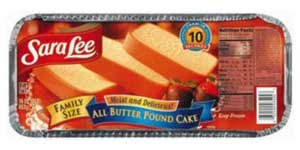
My question was inspired driving into work a couple of weeks ago, as I was passed by a Sara Lee delivery truck prominently displaying a double negative tag line ("Nobody Doesn’t Like Sara Lee"), confirming that the guardians of the Sara Lee brand continue to believe there is a time and place for the use of double negatives in branding.

In fact, Sara Lee owns several federal trademark registrations for the "Nobody Doesn’t Like Sara Lee" tag line covering a wide range of food items, including "rolls, pies, cakes, cheesecake, muffins, ice cream," "flavored mustards, sauces and mayonaises," "cheese," "bread, bagels and buns," "bakery goods," "processed meats," and "frozen prepared meat lasagna entrees."

Perhaps not surprisingly, I couldn’t find any other trademark on the entire USPTO database that included both of the terms "nobody" and "doesn’t." Given how unique and inherently awkward the phrase is, one might wonder whether substituting any term or other brand name for Sara Lee might avoid a likelihood of confusion with the original.

Continue Reading Double Negatives in Branding: Nobody Doesn’t = Everybody Does?

–Dan Kelly, Attorney

I have never participated in early morning Black Friday sales.  For me, those hours each year are most often spent peacefully enjoying the last fruits of a tryptophan-induced slumber.  It is not just a lack of interest, either.  There is a bit of loathing mixed in.  For instance, my goal for the last two year’s shopping seasons was not to go to the largest mall in the area.  Increasingly, when I shop, as I stand in lines, fight traffic, and not find what I’m looking for, I repeatedly arrive at a conclusion I need to recall before I step out the door:  shop online.

The interesting thing about shopping online, though, is the overwhelming number of options.  Comparison shopping conventional retailers’ online stores can sometimes be as time consuming as physically running from store to store.  On the other hand, online clearinghouses don’t always inspire confidence.  It seems that many retailers are a bit slow at comprehending where some of the future value lies on the Internet, but not all.  Toys ‘R Us has figured it out:  it owns toys.com and etoys.com.

Here’s a brief survey of websites residing at some “generic” domain addresses pertinent to the season, roughly in order (as of this writing) of least developed to most developed:

Domain Comments
holidayshopping.com No web site; interestingly, this domain can be promoted as both “HolidayShopping.com” and “HolidaysHopping.com.”
christmashopping.com A classic automated PPC (“pay-per-click”) page (note that this is “ChristmasHopping.com.”)
christmasshopping.com The “real” ChristmasShopping.com; still just an automated PPC page.
blackfriday.com Great address, content only marginally better than a typical automated page of click-through ads.
theblackfriday.com Billed as the “official” Black Friday site, many if not all of the links redirect to pages at dealsofamerica.com.
christmas.com Decent home page, but digging reveals that it is largely automated click-through ad content with a pretty face.
bfads.net Marginal address, but currently the first web hit on both Yahoo! and Google searches for “black friday;” set up in blog style, content appears current and relevant.
shop.com Well developed.
shopping.com Very well developed; its “/holiday” page is the first hit on a Yahoo! search for “holiday shopping.”
gift.com Redirects to JCPenny’s registry page — here is another retailer that gets it.
gifts.com A great website that I’ve actually used before; has a “finder” feature to shop by personality type.


Today is Thanksgiving, and that means turkey, stuffing, cranberry sauce, football, family and friends.  It also means that tomorrow is the official start of the Christmas season – although some jumped the gun (“a wag of my finger” to any business who has had their Christmas decorations up and holiday music playing for the last few weeks).  It also marks the annual return of what I believe to be effective nostalgic advertising  — whether it’s the ever-present Coca-Cola Polar Bears (more here, here, here, here), the rash of "Home for the Holidays" commercials, or the idyllic carriage rides (one more). 

Now, the question is, what do these commercials really do?  None of them have much to do with the products being sold, but for whatever reason, those darn polar bears make me want to drink a Coca-Cola (which I do about twice a year).  I think the answer is the mental associations that these types of advertisements create.  To me, branding and trademarks are all about generating positive associations.  We can’t help but draw a positive association with each of these particular brands because of positive associations we already have with the images in these commercials.  They make us think of, and almost yearn for, this particular time of year when everyone and everything seems to be better.  There’s no more fitting example than the last Coca-Cola commercial above.  When a seal pokes its head above the water, the polar bears give it a Coke, rather than (warning — Thanksgiving pun coming) gobbling it up for a tasty snack. 

While some people may have a problem with these commercial giants wedging their way into our holidays by tugging on our "ahhhhhhhh" strings, I don’t necessarily.  I see these particular advertisements as a polite addition to the merriment of the season.  They’re not force-feeding us.  They’re simply saying, "We know you’re enjoying the holidays, but while you’re at it, why not think of us."  This brings me back to those who got a wag of my finger in paragraph one.  I guess I can understand the thought process: people spend more around the holidays; if you bring the holidays sooner, people start spending sooner.  But, when I hear Christmas music in a department store the day after Halloween, it has two effects on me.  First, it gives me a strong negative association with that particular retailer.  And second, it begins to dilute the positive association that I have with the holidays and advertisers generally.  Rather than envisioning the retailers and businesses as polar bears wanting to share a Coke because it’s the giving time of year, I see retailers wanting to share a Coke to lure me in and finish off the kill.

The holidays are almost like The Goose That Lays the Golden Egg.  They can provide much needed boost, but I think it needs to be approached cautiously.  The "holiday spirit" isn’t something to be created.  Rather, it’s something to be harnessed.  Happy Thanksgiving! 

— Karen Brennan, Attorney

There was a very interesting article in the New York Times this weekend worth reading – Best Soup Ever?  Suits Over Ads Now Seek Proof.

The article addresses several recent issues raised by companies against competitors over statements or claims being made in advertisements.  Specifically, companies are challenging the truth or implied truth in competitive ads in an attempt to get the ad withdrawn or changed.

Apparently, the number of complaints over advertisements with the National Advertising Division, as well as the number of false advertising lawsuits (under Section 43(a) of the Lanham Act) are up significantly.  Some interesting disputes from the article include:

  • AT&T sued Verizon Wireless over an ad chart, claiming it falsely implied that AT&T had no cell phone coverage in the white area (rather than no 3G coverage):

The lawsuit attacks use of the chart in several commercials.  One great example, is Verizon’s Island of Misfit Toys commercial.  In this holiday commercial, out-of-date toys have been banished to an island where Verizon sends one of AT&T’s new phones, due to its allegedly inadequate coverage.  On a related note, the National Advertising Division recently recommended that Sprint discontinue its use of the claim “Most Dependable 3G Network” due to a lack of sufficient support for the claim.

  • Pantene attacked Dove’s claims that its conditioner repairs hair better.  According to the Times, Dove defended its claims with a market study and an expert to defend its use of “wet combing” versus “dry combing” technique.   Based upon a quick review of a few blogs, these two companies are in direct competition over solving the frizzies (for examples, see here and here).

The Times article suggested defending such claims sometimes requires “delving into the minutiae” and raises the question of whether most consumers actually believe and/or rely on statements such as “no other dog food stacks up” or a hair care product that can really “repair hair better.”  Regardless, it is a great article for anyone interesting in marketing.

It’s the last quarter of the year, and if you haven’t done your planning for 2010, I’ve got two things to say to you: 1) you’re late (you undoubtedly know that), and 2) you’re not alone.

But whether you’re in the middle of developing your 2010 plans, directing planning input from multiple sources, or reviewing plans for clarity and consistency, this blog’s for you.

Working with many different clients over the years, I have worked with many who have been given responsibility for planning who are not themselves trained strategic planners. This means that many of them have a limited understanding of the basics of strategic planning. Oh, they know their stuff and are often brilliant marketers, but some come from the technical side, some come from sales, some from communications – you get the picture. I will see the words “Objective”, “Goal”, “Strategy”, and “Tactic” used interchangeably. A stated “Mission” will have the hallmarks of “Vision”; a “Threat” is labeled a “Weakness”, etc. This makes me crazy, as these are all very different things, and they have very different meanings and functions.

In response I have prepared a primer of sorts that covers the basics of strategic planning terms and explanations for the many who are not trained strategic planners. I share its essence here, knowing that some of you will find this a tad didactic and below your level of operation. I would suggest that you can view this as a refresher. Overall I have the belief and fervent hope that others will certainly benefit from it.

Continue Reading Getting Familiar With the Basics: A Planning Primer