Simon Bennett, partner and Rachel Cook, associate Fox Williams LLP

Victoria’s Secret is likely to be feeling less than angelic following its recent defeat in the UK Courts. The problem? PINK. 

PINK is Victoria’s Secret’s entry level brand, aimed at attracting younger customers to Victoria’s Secret, who will ultimately graduate to PINK’s more grown up and sexy sister. Victoria’s Secret has been selling PINK in the US for around 10 years and as a part of its expansion of the Victoria’s Secret brand into Europe in 2012, in particular the UK, PINK came too.

However, the launch of PINK set Victoria’s Secret on a collision course with another brandowner, Thomas Pink. Thomas Pink sells its range of clothing, primarily focussed on menswear and shirts, by reference to “THOMAS PINK” AND “PINK”.

 Thomas Pink claimed that PINK infringed its UK and European registered trade marks, both of which featured “PINK” but were stylised.

Victoria’s Secret’s response – Victoria’s Secret is a well-known brand in its own right and, therefore, when the average consumer sees PINK with Victoria’s Secret or in a Victoria’s Secret context, he or (more likely) she would not be confused.

In addition, no link between the two would be formed by the consumer – Victoria’s Secret emphasised that it considered its activities in the UK and the EU to be simply a natural extension of its US operations and it was not seeking to take advantage of Thomas Pink’s reputation.

Confused?

The Court disagreed and found that there was a likelihood of consumer confusion in relation to the majority of its use of PINK.

The main issue for Victoria’s Secret was the Court’s view on the “sign” that was being used, which impacted on significant aspects of the Judgment. When the Court reviewed the use of PINK it found that on many occasions it was used alone, as part of a slogan with no reference to Victoria’s Secret or that when Victoria’s Secret was used it was not prominent enough to make an impact on the average consumer. The use of VICTORIA’S SECRET PINK together in “locked-up format” was minimal.

Following this conclusion, it was only a small step for the Court to find that the average consumer would be confused, particularly with recent UK case law establishing that the “average consumer” represents a spectrum of consumers, at all levels of the market and of both sexes. Arguably, this broadening of the characteristics of the average consumer makes a brandowner’s position easier, as a more focussed and specific average consumer is less likely to be confused. Although, VICTORIA’S SECRET PINK, was used on the swing tags of products this was insufficient to negate the effects of the wider use of PINK without an accompanying and prominent VICTORIA’S SECRET.

Reputation based infringement

Reputation based infringement allows trade marks with a reputation in the UK or Europe to stop third parties using similar signs on identical or similar goods or services without due cause where a link is formed in the mind of the consumer and the use takes unfair advantage of or is detrimental to the distinctive character of the mark.

As the Court had already found that the use of PINK was confusing, a higher threshold than a “link” being formed, then Victoria’s Secret was always facing an uphill struggle.

The heart of Thomas Pink’s argument was that if Victoria’s Secret as a substantial brandowner was able to fill the clothing market with PINK then quickly Thomas Pink’s trade marks would cease to be linked with Thomas Pink’s products. While the Court was not prepared to accept that Victoria’s Secret “sexy sells” marketing would tarnish Thomas Pink’s reputation, it was prepared to accept the blurring or overtaking of Thomas Pink’s trade marks.

Victoria’s Secret had submitted that simply continuing its PINK brand which was already substantial and successful in the US in the UK and Europe amounted to “due cause”. This was strongly rejected by the Court, which unsurprisingly indicated that activities in a different country do not in and of themselves give a brand carte blanche to operate as it wishes in the UK or Europe if another party holds pre-existing rights.

Conclusion

Given the stakes, Victoria’s Secret is highly likely to appeal the Judgment, however, this is another recent instance of a high profile success in the UK Courts for a trade mark owner. Also, it further emphasises that intellectual property rights have territorial limits and even an established brand cannot simply expand its activities into another country without risk.

Victoria’s Secret could have improved its position by adapting the use of PINK, using it in locked up format – “VICTORIA’S SECRET PINK” – on all products. If “VICTORIA’S SECRET PINK” was the sign being used then the likelihood of confusion would have significantly reduced as would the prospects of Thomas Pink being able to claim reputational infringement.

(Bill Gates putting his own spin on the ice bucket challenge)

So there is a thing called the ice bucket challenge. In case you haven’t heard of it, you can read about it here (while you’re at it, you may want to read up on the internet, color television, and greek yogurt). In fact, Matt Kucharski discussed the branding/marketing aspects of the challenge last week, but what about the trademark aspects? Is it a protectible trademark and, if so, who owns it? Most people appear to associate the ice bucket challenge with the ALS Association (“ALSA”), which has raised more than $100 million.

With that kind of revenue, its not surprising that the ALSA filed applications to register the marks ICE BUCKET CHALLENGE and ALS ICE BUCKET CHALLENGE. Unfortunately, there was a bit of a backlash and, in less than a week, the ALSA voluntarily withdrew the applications.

As Erik Pelton pointed out on his blog, the ALSA may have faced some legal hurdles in order to claim and obtain registered rights in the two marks. The ALSA does use the two marks on the website to help fundraise, but the general public may not necessarily associate the marks exclusively with the ALSA. Although, based on the sheer size of the donations, it appears that the majority of those taking the ice bucket challenge do make some association between the marks and the ALSA. Another issue though is whether the ALSA is the first to have used the mark. Slate magazine put together a good piece addressing whether the ALSA was the first to use the marks (spoiler: nope). The article tracks the possible connections with similar “cold stuff challenges” that preceded the ice bucket challenge, such as cold water challenges, ice challenges, polar plunges, and general “do something stupid and/or dangerous then put it on YouTube” challenges.

The ice bucket challenge has a number of critics, either because they consider it “narcissism disguised as altruism”, or because it is a waste of perfectly drinkable water. But others have used the success to highlight other important issues. Personally, I found Orlando Jones’ challenge video along with the “rubble challenge” videos/concepts to be particularly impactful. (more ideas here)

Given all the third-parties that have used the ice bucket challenge (or similar challenges) for fundraising efforts, both before and after the ALSA, it is not surprising that the public was generally displeased with the ALSA for filing the trademark applications. However, the ALSA’s concern for third-parties profiting from the ice bucket challenge is very real. There are numerous, different types of products for sale, many of them specifically mentioning ALS. It certainly isn’t inconceivable that those purchasing these products assume there is some connection with the ALSA or, at the very least, that part of the proceeds will go toward fighting ALS.

Given both the legal landscape and the court of public opinion, it appears that abandoning the applications was the best move for the ALSA. The general public will need to be aware of to whom they donate and from whom they purchase any products that appear to be associated with a particular organization. I’ll admit though, I wish somebody could claim exclusive ownership to the ice bucket challenge in order to get this Ice Bucket Challenge Halloween Costume taken down. Even if it doesn’t violate anyone’s trademark rights, it violates my core notions of what should exist.

The possessive form of the Hershey’s brand dates back to at least as early as 1894, according to U.S. Reg. No. 54,041 — a more than 100 year old trademark registration from 1906.

Last week, Brand New reported on Hershey’s new logo and corporate identity — without the apostrophe and letter “s” at the end:

I’m guessing that the possessive form of the HERSHEY’S trademark will continue to appear on chocolate bars and packaging, since all references to the rebrand seem to focus on the corporate identity, but if others have more information on this point, please feel free to weigh in.

Moreover, so far, there is no record of any trademark filings in the U.S. to match the new truncated look, perhaps also signaling that this look won’t hit packaging, at least in any dominant kind of way.

Here is how AdAge reported the change:

“The new branding will impact all visual aspects of how The Hershey Company presents itself, from consumer communications to websites to the interior design of its office spaces and the look of its retail stores,” the company said in a statement. While rooted in a rich heritage, the new corporate brand reflects a modern, approachable look that reflects the company’s openness and transparency as it has grown into a global company.”

Marketing types, if that is the goal, why leave the truncation and elimination of the possessive form to corporate communications, why not take it all the way to packaging? And, do you believe that makes sense as the next logical step, or does the trademark syrup just become too sticky?

Perhaps Hershey’s is merely dipping its toe in the chocolate of the less possessive format?

Given that Hershey’s has more than 150 live U.S. Registrations smooching the possessive form of the brand name (and many multiples of that number outside the U.S., I’m sure), if the truncated un-possessive format were to replace the more than 100 year old Hershey’s format, trademark types, would you feel comfortable advising the brand managers that amendments could be obtained safely without losing all these valuable registrations?

In other words, do you believe that removing the apostrophe and “s” creates a material alteration of the Hershey’s trademark? In the U.S.? What about outside the U.S.?

Would you hedge by having the new corporate identity appear in a trademark sense but in a more subtle way, almost as a corporate signature on the back corner of a packaging label?

There is certainly a lot to think about when an entire worldwide trademark portfolio is already in place — seems to me, this is a perfect opportunity for a graceful collaboration between legal and marketing types.

The Toronto Globe and Mail recently reported on a clever anti-littering campaign that was launched and quickly aborted in Toronto due to trademark concerns.  The premise for the campaign was to take wrappers and packaging from some well-known brands and position it to create words describing litterers–words like dipstick, dumb, lazy, lowlife, pig, etc.  While it’s a close call, I suspect this campaign was expected to be slightly more effective than my headline for this post.

Now, I’m no Canadian lawyer (although I do own a Canadian tuxedo), but I wonder how in the name of Bryan Adams this ad campaign was approved all the way through publication without anyone thinking about getting the permission of the brand owners.  Not surprisingly, the brand owners whose packaging was used for the ads raised concerns about negative associations that might result from the ads.  And if Canadian trademark law is anything like U.S. trademark law, they would have probably had a pretty decent case.  That’s not to say that Toronto (or whatever ad agency put the campaign together) would be defenseless–indeed, I can imagine a couple arguments based on the fact that the packaging is not being used as a trademark and this could potentially constitute a type of fair use–but, at the very least, this campaign was something that was likely to start a fight.  Well-established brands are precious commodities and it’s unthinkable that any reputable brand would be okay with its brand being equated with trash.  (Unless, of course, you’re in the trash business.)

Perhaps the ad campaign was launched under the theory of “better to beg forgiveness than to ask permission,” or perhaps the ad agency that put the campaign together was willing to gamble in an effort to get their name out.  Whatever the logic, I think it was always an unfortunate foregone conclusion that this ad campaign would not survive long.  What do you think?


On Tuesday of this week, we discussed the trademark infringement case filed by Lulu’s Market & Deli against Lulu’s Public House (depicted above), here is a link to a pdf of the Complaint.

As you will recall, we expressed a healthy dose of skepticism about the claims being asserted by Lulu’s Market & Deli, and we predicted that no emergency injunction would issue before the closing of the 2014 Minnesota State Fair next Monday. It appears our prediction will hold, given that today is the last opportunity to obtain an emergency order from the court to impact use this season.

Although the complaint was filed last Friday, along with a Motion for Temporary Restraining Order, as Ramsey County District Judge Robert A. Awsumb — who was assigned the case on Monday — noted in his Order on Tuesday, no emergency hearing will be scheduled until Lulu’s Market & Deli files with the court, proof of service of the complaint and motion on Lulu’s Public House.

Let’s count the number of ways, according to the actions of Lulu’s Market & Deli, that this is so not an emergency that would require immediate court intervention.

First, despite District Judge Awsumb’s warning on Tuesday, still no evidence of serving notice on Lulu’s Public House has been filed with the court.

Second, the owner of Lulu’s Market & Deli, submitted his Affidavit, last Friday to explain the need for the emergency injunction, but in doing so, admitted: “On or about June 26, 2014, I read a story in the St. Paul Pioneer Press about new food vendors entering the Minnesota State Fair, which is taking place this August 21 through September 1. Among the new vendors who were reported to be entering the State Fair was an operation called ‘Lulu’s Public House,’ . . . . The newspaper story ran in the ‘Eats’ section of the Pioneer Press. Since June 26, 2014, I have also seen several other internet news and information sites publicize the entry of ‘Lulu’s Public House’ at the State Fair.”

So to be clear, Lulu’s Market & Deli waited to file suit and request emergency court action until after the State Fair opened and more than eight weeks after admitted knowledge of Lulu’s Public House coming to the State Fair — and, the June 25 Pioneer Press article specifically referenced the “Breakfast Juicy LuLu” menu item that Lulu’s Market & Deli is complaining about.

Third, the Affidavit of the owner of Lulu’s Market & Deli also admitted: “Since the June 26, 2014 Pioneer Press story ran, I have been contacted by between five and ten people each week who mistakenly believed that ‘Lulu’s Public House’ was affiliated, associated, or connected in some way with Lulu’s Market & Deli.”

So, by the third full week of July, Lulu’s Market & Deli had heard from twenty to forty “confused” people, but waited more than another four weeks to take formal action (the papers are also silent about and beg the question of when Lulu’s Market & Deli first contacted Lulu’s Public House), tellingly after the opening of the State Fair.

By Tuesday of next week, when the court reopens after Labor Day, the claimed need for emergency relief will be moot.

To be serious about seeking an emergency temporary restraining order, Lulu’s Market & Deli needed to move quickly upon learning what it learned in June, it needed to communicate through its actions that immediate attention and court action was required to avoid irreparable harm. Yet, the complaint, motion for temporary restraining order, and supporting affidavits, all beg the question of why Lulu’s Market & Deli waited so long, seriously undermining the request for immediate and emergency court intervention.

Of course, actions speak louder than words.

Just curious, why does the operation of Lulu’s Public House at the Minnesota State Fair create a twelve day emergency for Lulu’s Market & Deli, when another’s food truck — operating under the name “Lulu’s Street Food” — has been circling the streets in the Twin Cities for more than a year?

As predicted, it appears this dispute will be sorted out after the 2014 Minnesota State Fair ends.

If so, that will provide Lulu’s Public House plenty of time to redeem itself and probe the claims and motives of Lulu’s Market & Deli, if it is inclined to defend itself.

There appears to be plenty to probe, based on a cursory review of the complaint, motion, and affidavits filed by Lulu’s Market & Deli.

First, Lulu’s Market & Deli does not appear to own a registered trademark, so it actually will have the burden of proving the existence of common law rights and the scope of those rights.

Second, although Lulu’s Market & Deli’s motion for a temporary restraining order contends that Lulu’s is an “arbitrary term” that “deserves the highest protection” and “no proof of secondary meaning” is required — the owner’s Affidavit admits that the “Lulu’s Market & Deli” name “is derived from the original owner’s last name. . . .”

Surnames are considered descriptive, and as such, they don’t enjoy exclusive rights upon first use, but they require a showing of secondary meaning or acquired distinctiveness. Here, the current owner’s Affidavit admits to only “spending $15,000 on advertising and marketing using the business’s name” since he became the owner in 2010.

Secondary meaning is not assured to Lulu’s Market & Deli. And, it will be interesting to see how Lulu’s Market & Deli plans to prove that Lulu’s enjoys a special significance or secondary meaning while another’s food truck — also using the Lulu’s name — has been roaming the Twin Cities for more than a year.

It is unclear whether Lulu’s Market & Deli will be able to rely on the claimed 13 years of use of Lulu’s by the prior owner with the last name Lulu — no chain of title has been made of record yet, and the current owner seems to lack personal knowledge of any prior use (“[t]o the best of my knowledge, since it first went into business, it has always operated under the name Lulu’s Market & Deli”), calling into question whether a proper assignment was made when he took over the business on the corner of Selby & Fry in St. Paul, Minnesota.

Indeed, the plaintiff’s assumed name filing for “Lulu’s Market & Deli” is dated September 14, 2010.

Nevertheless, assuming for the moment that prior common law rights can be proven, Lulu’s Market & Deli also will have to establish more than de minimis and otherwise manageable confusion in the marketplace.

Keeping that in mind, all of the customer, employee, and friend generated Affidavits purporting to prove “actual confusion” appear tainted by a leading questionnaire admittedly provided to each of them by the owner of Lulu’s Market & Deli, specifically asking: “When you heard or read about Lulu’s Public House entering the Minnesota State Fair, did you believe that it was affiliated or associated with Lulu’s Market & Deli?”

Ouch, that burns a lot like molten cheese dripping from a juicy lucy. This kind of evidence is not persuasive and it isn’t going to cut it, if the case is pursued beyond the closing of the State Fair in 2014.

The complaint and other papers filed by Lulu’s Market & Deli also question the good faith of Lulu’s Public House in adopting and using its name. Those filings call out the actions of the owner of Lulu’s Public House as “wrongful,” “cavalier,” “willful, deliberate, and/or intentional,” “infringing,” and “unlawful.”

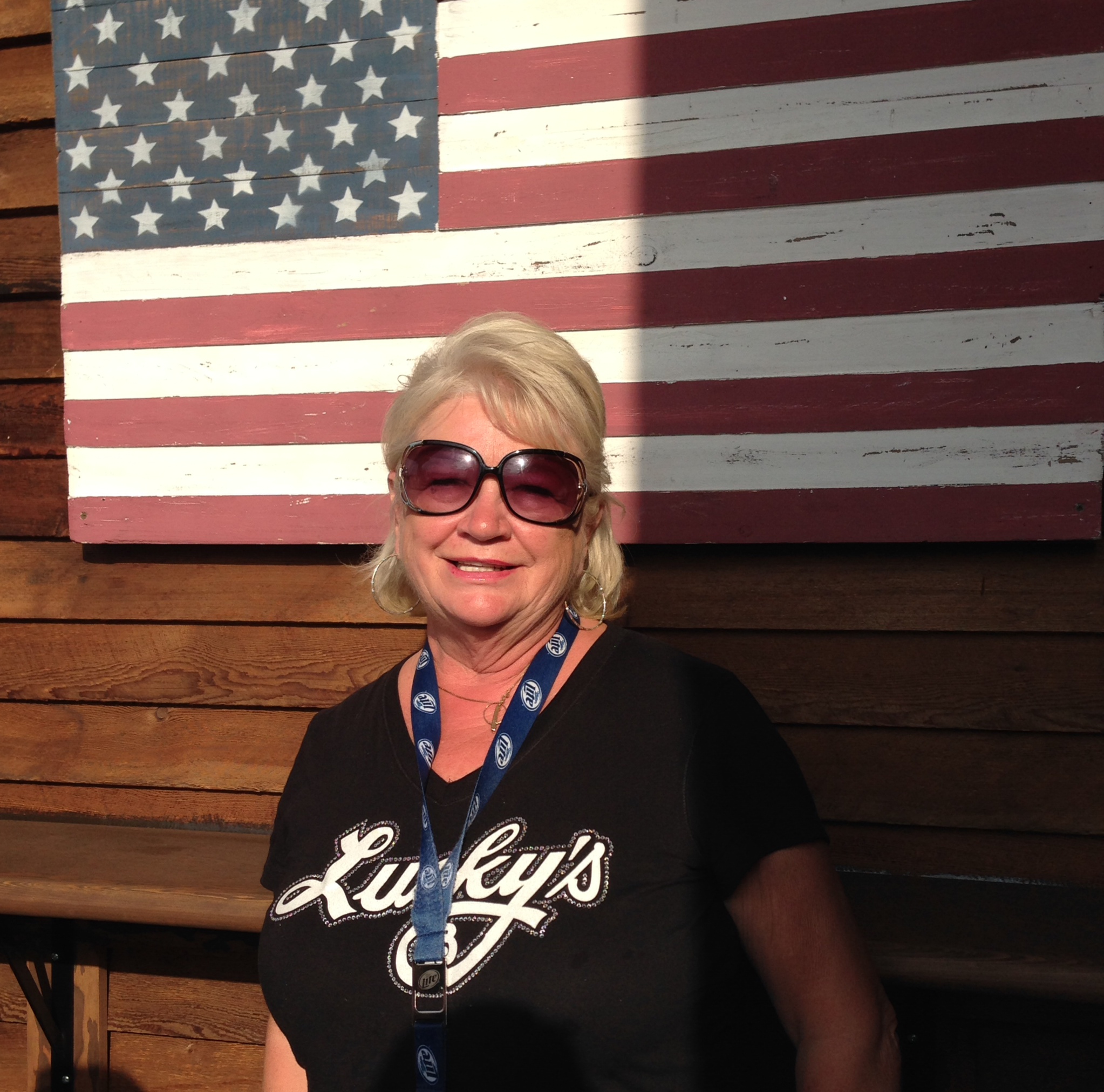
We had the distinct pleasure of meeting Lulu — the owner of Lulu’s Public House — and snapping the photo (above and to the right) two nights ago.

The Lulu we met is anything but the way described, she is charming, and seems to be a real and authentic sweetheart who wears the American flag quite well, by the way.

Oh, and did I mention, her name is Lulu? I’m thinking that quiets at least the motive behind selecting the name Lulu’s Public House.

So, we’ll be following this case closely, stay tuned dear readers.

–Ben Kwan, Attorney

I can’t even say the word!  Don’t worry, I’ll have to eventually.  Let’s just say the folks at CBS are likely pretty steamed up over getting hauled into court on a smelly copyright suit involving a noisy character from its popular NCIS show.

The California designer, developer, and manufacturer of the original “Bert the Farting Hippo” is suing CBS as well as a host of others including the online retailer authorized by CBS to operate and sell goods in the CBS Store.  The copyright infringement suit alleges that the retailer went rogue in 2012, opting to source the copyright-protected plush and popular noisemaker in China rather than the California company that developed the original, Folkmanis, Inc.

As of this morning, Bert the Farting Hippo appears to be pulled from the virtual shelves of the CBS Store.  Earlier this week, The Hollywood Reporter noted that the hippo was still for sale at 53% off.

According to the Folkmanis complaint filed Monday in the Northern District of California, Bert’s first appearance on television came back in 2003 when the producers of NCIS acquired a silent version of the stuffed hippopotamus for use on the show.  When the hippo appeared on the show, the complaint alleges, “it was often accompanied by a dubbed sound effect of a fart attributable to the Hippo 1 puppet, and the show puppet was referred to and came to be known as ‘Bert the Farting Hippo.’”

Quick aside: I love the way lawyers write sometimes: a “fart attributable to…”  It almost hearkens to patent claim-writing parlance.  Attorney H. Michael Brucker, who filed the suit, must not be aware of the time-old rule, “you smelt it, you dealt it.”  It’s so much more conversational that way!  Then again, I see nothing about Bert’s ability to smell.  But I must admit, it’d be pretty cute if parents started to teach their children to assign blame using a more proper form of attribution.  But I digress.

The suit goes on to allege that in 2010, CBS and its online retailer-licensee “surmised that a hippo puppet would be a profitable product to offer for sale on the CBS Store.”  Folkmanis obliged, developing a version of its hippo that included “a sound box that emulates the sound of a fart.”  Emulates! Much to the chagrin of parents everywhere, of course.  In 2011, a keychain version of Bert was introduced.

Can you guess how many hippos they sold between just 2010 and 2012?  I’m not an NCIS fan so I didn’t know about Bert until I caught wind of this suit this week, so I’d never heard of this creature.  Would you believe it if I told you they sold some 30,000 farting hippos?  That’s what the complaint alleges.

Enter the presumably cheaper Chinese counterparts.  Folkmanis alleges that the online retailer operating the CBS Store started sourcing the hippos in China starting in 2012 and hasn’t purchased a single hippo or hippo keychain from Folkmanis since that time.  The lawsuit cites two copyrights, one for the stuffed animal toy, and one that’s pending that covers the keychain.

Since 2012, Folkmanis alleges that it has suffered an estimated $733,000.00 in damages.

Can you feel it? All around the country, fields are being groomed, stenciled, and painted. Tonight, the college football season begins with Georgia State taking on Abilene Christian in what could be a preview of one of hundreds of games that most of us don’t really care about. But like so many fans around the country, I’ll probably still watch it, at least for a quarter: I missed you Football.

Football certainly hasn’t been gone from the news though, as lawsuits addressing scholarships, unions, and additional antitrust violations have all made headlines. But one headline caught my attention, an article discussing the University of Southern California’s head coach Steve Sarkisian filing a U.S. Trademark Application for his moniker SARK. Sark joins a number of other college football coaches who have applied to register their names.

Just last month, we covered the University of Arkansas’s registration of the SOOOIE RAZORBACK cheer. There was also the Oregon/Oregon State CIVIL WAR, too. This got me wondering, if trademark law can protect coach names, chants, and intrastate rivalry games, what other fun ways can I think about work while watching football?

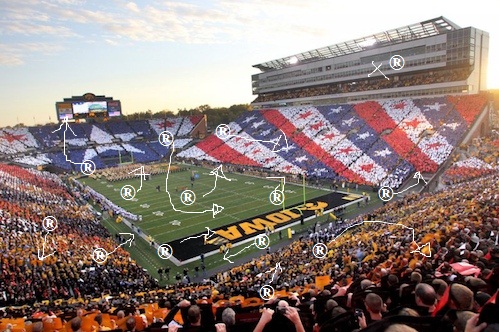
How about stadiums?

Check. Well, technically only the turf is claimed as a feature of the mark. Steve discussed this registration back in 2009. Also, the red version for Eastern Washington. Not the stadium itself. But still.

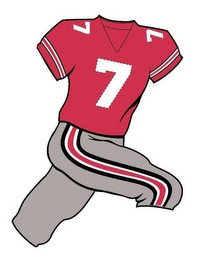
Uniforms?


Check. Oh, and better get one for the away uniforms, too.

And speaking of uniforms, if you were considering launching a business that sold perfume or deodorant in the form of a football jersey, well. Don’t. Not just because its a terrible idea, but because you might be infringing on the trademark registration below:


And since we’re on the subject of product trade dress, don’t forget about football shaped brownies:


And you definitely won’t want to forget about your football shaped “alcoholic beverages except beers:”


And let’s see if you can guess what kind of goods or services this is a trademark for:

Yes, it’s a kicking tee. And yes, it’s registered on the Principal Register in connection with kicking tees.  How? Well, apparently, the texture on the tee is so unique that it has acquired distinctiveness in the minds of consumers as identifying a particular source. Right.

There’s even a trademark registration for this logo:


Which is apparently in no way associated with this registered trademark of Nike:


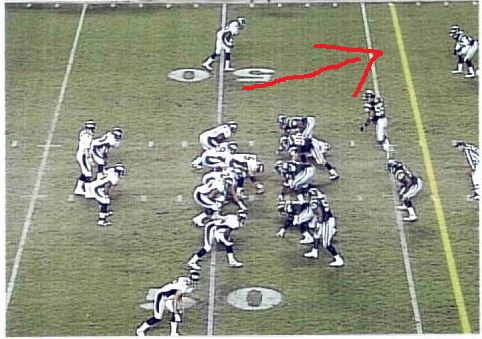
Or how about this trademark:

Yep, that yellow line is a trademark of Sportsvision. Martha covered that here around Super Bowl time – Oh, sorry Roger –  The Big Game time.

And if you’re attending a game at Texas A&M, not only will you be surrounded by trademarks, but you will BE a trademark, way to go 12TH MAN®!

There are certainly many more that we could cover, but I think it is pretty clear that this Saturday, whether you’re in the stadium, on the LA-Z-BOY® at home, or at the BLUE 42 SPORTS GRILL in Winter Garden Florida, you will be surrounded by trademarks. And football. Glorious, but possibly not-very-competitive, football. Enjoy it! – I know I will (GO HAWKS!!).

It’s that time of year again, the Minnesota State Fair is here, and trademark issues abound, again.

We’re actually not covering the trademark fair issue we planned to cover today because we just caught wind of a lulu of a trademark infringement case filed on Friday of last week against a brand new 2014 fair vendor: Lulu’s Public House.

This particular Lulu has been getting some nice press on their food offerings and on sporting the fair’s first rooftop patio, and in doing so, has gained the attention of another Lulu, and not the lemon, or the “wanna be” bed & breakfast, much less any of these federally-registered or published, peacefully-coexisting, apparently-unrelated Lulu’s eating establishments:


No, none other than LuLu’s Food Market & Deli Inc., d/b/a LuLu’s Market & Deli filed suit against The Firefly Group Inc., d/b/a Lulu’s Public House August 22, 2014 — the second day into the 2014 Minnesota State Fair, and at least two months after Lulu’s Public House was announced as a new 2014 fair vendor, to be located in the newly remodeled West End.

The Pioneer Press coverage of the story highlights the instances of confusion alleged in the complaint: “Lulu’s Market & Deli has been contacted by several well-wishers and job-seekers who confused it for the Lulu’s at the state fair.” It also focuses on similar menu items:

“In addition to the shared name, the complaint points out that both restaurants offer ‘Jucy Lucy’-style menu items — Lulu’s Public House sells a breakfast sandwich called the ‘Breakfast Juicy LuLu,’ while Lulu’s Market & Deli sells a cheeseburger called the ‘Fair Lucy’ — and taco menu items — Lulu’s Public House sells a prime rib taco, while Lulu’s Market & Deli sells a fish taco. The complaint says this too is likely to cause confusion among consumers.”

Notwithstanding the potential for confusion, given the timing and the delay in filing suit and failure to seek emergency injunctive relief before the opening day of the fair will likely weigh against the court taking action in time to affect any name and signage changes, at least for this year at the fair. Having said that, this case was filed in Ramsey County Minnesota State Court, not the typical federal court where most trademark infringement actions are heard, so we’ll have to wait and see what happens — but I’ll go out on a limb and predict no name changes, this year anyway, given the very heavy burden when seeking emergency injunctive relief.

Whether a name change is required between now and next year likely will depend on how the evidence develops over the course of the next year, and whether LuLu’s Public House has the stamina to defend itself, any predictions on either?

I’m so intrigued by this case, Lulu’s Market & Deli isn’t at the fair, but for more than two years the home page of their website features a jucy lucy burger called “The Fair” — honestly, what are the odds they find themselves in the present pickle of a trademark infringement action against a vendor located only at the fair?

Bottom line: Do you think the addition of “Public House” to Lulu’s at the Minnesota State Fair is enough to distinguish it from Lulu’s Market & Deli on Selby in St. Paul?

Matt Kucharski, Executive Vice President, PadillaCRT

At PadillaCRT we’ve had numerous clients and prospects – both in the for-profit and not-for-profit world – ask us about the magic that is the ALS Ice Bucket Challenge. More specifically, they want to know how they can make their cause “go viral” in the same manner.

The short (and glib) answer is “you can’t.”

I mean, let’s be real. When has there EVER been a social media phenomenon that has generated participation from as wide a segment of the population as this one? Whether it’s Bill Gates accepting the challenge from Mark Zuckerberg, Neil Patrick Harris accepting the challenge from Ben Affleck, or me accepting the challenge from a colleague, this campaign has raised money – and more importantly raised awareness – like no other, and I really don’t see any organization being successful if they try to directly replicate it.

Now for the silver lining. Organizations can and will continue to be successful building their reputations and brands and expanding their network of advocates in social media, and they can learn some very important lessons from the ALS phenomenon.

In a previous guest post I wrote for Duets last year, I outlined the 3 reasons people refer brands in social media – Helping Others, Validation and Perks. Those three certainly apply to referring causes like ALS as well. Here’s a quick recap:

– Helping Others: While there are certainly diseases that have taken more lives, there are few as nasty as ALS. Research toward a cure is under-funded, and it’s a worthy cause.

– Validation: This one cuts two ways. People who are called out in the challenge are called out publicly. If they fulfill the challenge without actually posting the evidence online, there is no validation they did it. In addition, they want others to know that they did a good (and somewhat silly) thing because, well, it makes it just a little bit less silly.

– Perks: In this sense, it’s not free stuff, but instead it’s entertainment. It forces us not to take ourselves too seriously, it makes people smile, and nobody gets hurt in the process.

And let’s face it – isn’t there someone that YOU would like to see get a bucket of ice water dumped on their head?

Although once illegal in the United States, absinthe can now be consumed in your local bars.  It was a favorite drink of writers and artists such as Ernest Hemmingway, Vincent van Gogh, Oscar Wilde and Pablo Picasso.  Unfortunately, this green anise-flavored spirit did not fare so well in Swiss Court last week.  The Swiss court blocked reservation of “absinthe.”  It was found to be a generic term along with “La Bleue,” or “Fée verte” (translated as “The Green Fairy”) which also describe the popular drink.

These three terms had previously been registered as trademarks in Switzerland in 2010.  However, numerous objections were filed against these registrations.  They were ultimately defeated last week.  We will have to see if this defeat sticks or if there is an appeal to Switzerland’s Federal Supreme Court.

Trying to obtain the term “absinthe” for the popular alcoholic beverage would likely suffer a similar fate in the United States.  However, I found an intent-to-use application for the clever mark ABSINTHE MINDED for beer containing absinthe flavoring on the Principal Register.  It would likely be a hit for Saint Patrick’s Day. 

I wonder if Oscar Wilde was drinking absinthe when he penned the quote “Anyone who lives within their means suffers from a lack of imagination.”