As our friend John Welch reported last week, the place to be on March 10, 2015, is Washington, D.C., at the 25th Annual “PTO Day,” sponsored by the Intellectual Property Owners Association:

PTODay

John will be part of the panel update on TTAB practice, and I’ll be providing the overview of Section 2(a) of the Lanham Act, that pesky provision of the federal trademark statute that bars registration of certain types of marks that violate public policy, including any trademark that “[c]onsists of or comprises immoral . . . or scandalous matter; or matter which may disparage . . . persons, living or dead, institutions, beliefs, or national symbols, or bring them into contempt, or disrepute . . . .”

The “scandalous” prong of Section 2(a) has barred registration of vulgar marks like 1-800-JACK-OFF, MOMSBANGTEENS, SEX ROD, and BULLSHIT, to name a few.

The “may disparage” prong of Section 2(a) has been invoked to refuse registration of racially-slurring marks like THE SLANTS, HEEB, and SQUAW, and to revoke registration of the R-Word, as disparaging to Native Americans, because it was found to be improperly issued.

No doubt, there are critics of Section 2(a) that question the constitutionality of these statutory bars to registration — I’m alright withholding registration and use of ® — the federal registration symbol — next to those words, because doing so doesn’t prevent their commercial use.

I’m looking forward to hearing Ron Coleman’s perspective on Section 2(a), as counsel for The Slants, a case currently on appeal to the Court of Appeals for the Federal Circuit, and Jesse Witten, as counsel for Amanda Blackhorse and other Native American petitioners who prevailed against the Washington R*dskins last June.

Ron has provided a preview of his thoughts on his Likelihood of Confusion blog, in a three-part series scandalously titled “Indian givers” (parts 1, 2, and 3), suggesting the USPTO assumed this role in ordering the cancellation of the R-Word trademarks of the NFL professional football franchise located in the nation’s capital.

From my perspective, scandal aside, the title of Ron’s series is a misnomer, since the evidence of record in Harjo and Blackhorse showed that the R-Word was improperly granted registration in the first place, so I’m thinking, it looks far more like a windfall to the team than a taking.

In any event, sympathy for the team and other Section 2(a) losers is also unwarranted given the law for some seventy-five years: “The field is almost limitless from which to select words for use as trade-marks, and one who uses debatable marks does so at the peril that his mark may not be entitled to registration.”

Do you think that the registration prohibitions of Section 2(a) will withstand constitutional scrutiny? The Justice Department intends to see to it.
– Draeke Weseman, Weseman Law Office, PLLC

Now the dilemma…what to name the place. Simple. What else brings a gleam to men’s eyes everywhere besides beer, chicken wings and an occasional winning football season? Hence the name Hooters. Supposedly they were into owls. Strange.

Hooters

 This NFL season, civil rights advocates continue to make significant progress exposing the racism inherent in the Washington Redskins team name. DuetsBlog has covered the topic on numerous occasions, including here, here, and here. In June, the Trademark Trial and Appeal Board of the United States Patent and Trademark Office finally ruled that Washington’s trademark registrations must be cancelled because the term “Redskins” is disparaging to Native Americans.

To my knowledge, the Trademark Trial and Appeal Board has not yet been asked to review a registered mark for cancellation on the grounds that it is inherently sexist and, therefore, disparaging to women. But given the success in the Washington case, perhaps some registrations are due for a challenge. In my opinion, one candidate for cancellation is the registration afforded to Hooters, the mainstream restaurant chain that puts women’s breasts on display to sell chicken wings.

Let’s begin with the following tongue-in-cheek statement from the Hooters’ website:

Hooters is proud to have created a globally recognized icon. Obviously we’re talking about the owl in our logo.

We all know that Hooters is a euphemism for breasts, and at first glance, this humorous play on words seems harmless enough. Hooters whimsically calls its brand personality “[d]elightfully tacky, yet unrefined.” Nothing wrong with a good joke, right? Well, research suggests otherwise:

Sexist humor is not simply benign amusement. It can affect men’s perceptions of their immediate social surroundings and allow them to feel comfortable with behavioral expressions of sexism without the fear of disapproval of their peers.

With that in mind, should we laugh at the following excerpt from Hooters’ company history?

While Ed arranged the photo shoot for Hooters’ first billboard, Gil indoctrinated Lynne [The bikini-contest-winning first Hooters Girl] by making her clean out the refrigerator and scrub the floors.

Hooters takes it one step further in its employee handbook, which requires employees to acknowledge that they “do not find [their] job duties, uniform requirements, or work environment to be offensive, intimidating, hostile or unwelcome” and that “the Hooters concept is based on female sex appeal and the work environment is one in which joking and innuendo based on female sex appeal is commonplace.”

What happens to the joke when we consider that the disparagement of women through their sexual objectification in commercial advertising may have serious consequences, including an increase in the acceptance of sexual aggression against women and rape myth acceptance (the belief that “no” really means “yes”)?

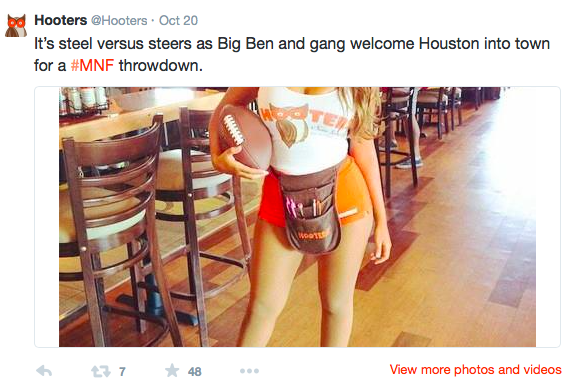
Consider the relationship between Hooters and football, and all of the domestic violence issues the NFL is facing after a video showed running back Ray Rice punching his girlfriend unconscious on an elevator. With that in mind, can we stomach social media posts like this one? (I guess Hooters missed the part of Ben Roethlisberger’s career where, on two separate occasions, he was accused of sexual assault?):

Of course, the “sex sells” brand proposition has been a maxim of the advertising industry for a long time, and sexual objectification – where a person is viewed primarily in terms of sexual appeal or as a source of sexual gratification – occurs regularly in television commercials featuring women. Such advertising, like in this Hooters commercial, encourages a disparaging cultural attitude toward women by reducing the woman’s value to her ability to be sexually arousing – what she is saying isn’t nearly as important as how she is saying it and what she looks like. What’s more, when seen through a lens sensitive to sexism, Hooter’s charitable causes look like nothing more than an apparent exploitation of breast cancer awareness and military service to sell calendars:


Thus, the truth as I see it is that when we look past the surface-level Hooters pun and really look at the Hooters brand, we see a brand that at its core is committed to and perpetuates a sexist culture that objectifies women for commercial gain. This is disparaging to women, whether we as a society find it amusing or not.

Following the Washington Redskins case, it’s difficult to see how the United States Patent and Trademark Office can allow sexist trademarks like Hooters to continue to receive protection as registered trademarks when the law clearly provides an absolute bar against scandalous and disparaging marks.

Under Section 2(a) of the Lanham Act, a mark that “[c]onsists of or comprises immoral, deceptive, or scandalous matter; or matter which may disparage . . . persons, living or dead” is ineligible for trademark registration. The word “scandalous” in the statute includes matter that is vulgar, lacking in taste, indelicate, or morally crude. Generally, the scandalous nature of a mark must be perceived by a substantial portion of the general public in the context of contemporary attitudes and the relevant marketplace. Humor is not a defense, nor does it matter if the mark has an alternative meaning.

Disparagement, on the other hand, looks at the issue not from the view of the general public, but from the view of the targeted group. The test is a two-part inquiry: (1) what is the meaning of the term in question as it appears in the mark and as the mark is used in connection with the identified goods and services?, and (2) does the meaning of the mark disparage the target group, as determined by the views of a substantial composite of that group? That substantial composite need not be a majority.

While we wait and see if marks like Hooters will ever be challenged under either of these tests, other countries are taking the lead on this issue in different ways. Norway and Denmark both ban sexual objectification in advertising, while tolerating nudity. According to the head of one leading ad agency “Naked people are wonderful, of course, but they have to be relevant to the product. You could have a naked person advertising shower gel or a cream, but not a woman in a bikini draped across a car.” Is it a coincidence that the countries considering this issue also have some of the lowest gender pay gaps and best parental leave programs in the world?

So, when will American’s stop believing that sexism is ok, just because it’s funny? Speaking of funny, will Americans ever embrace another f-word in support of equality?

Should the USPTO continue to allow trademarks like Hooters to be registered? Or by doing so, does the USPTO perpetuate sexism in branding?

What about marks like the one below for Camel Towing? (The picture was taken in a local parking lot.) Should the USPTO allow it to be registered, if the company behind the mark ever applies?

It’s no secret that the NFL is facing a reputation crisis, on a variety of fronts. With 2013 being called “a very bad year” for the NFL, words will be difficult to describe how badly 2014 ends (reputationally), if the league continues on its current path of self-destruction.

A common thread to the concussion crisis and domestic assault crisis involves physical injury — and the league’s failure to act (contrary to its significant short term financial interest).

In the midst of the current crisis, much has been said about protecting the shield — yeah, the one to the right. As Mike Lupica wrote for the Daily News:

“We all get why these guys protect ‘the shield’ at all costs. But if that shield can’t properly protect its own players, or the women in their lives — or the children — what does it stand for, really?”

Kent Hollenbeck of The Holmes Report has offered some sensible advice:

“[I]f the NFL wants to bring any measure of authenticity back to itself – they could begin by stopping their self-inflicted harm of the shield, and begin repairing it. “

At the risk of piling on to the monumental opportunities in reputation-rebuilding for the NFL to consider, I’m thinking it is long past due to extend beyond the NFL’s forced focus on physical harm to include a focus on psychological harm too, starting with the harm the league perpetuates against Native Americans.

How much longer before the league takes responsibility for its ongoing use and protection of a racial slur as the name for the NFL franchise located in our nation’s capital? Did Mr. Snyder ever read and take to heart, “Enough — An Open Letter to Dan Snyder,” by David Zirin of Grantland?

Apparently not, but the league can and should take action before the USPTO’s decision to revoke the R-word federal registrations becomes final, and before its failure to act on this issue is more widely ridiculed.

The Daily Show’s piece entitled “The Redskins Name — Catching Racism,” was brilliant in highlighting the ridiculousness of Snyder’s steadfast refusal to face the facts while he clings to the past. Perhaps the Jon Stewart and Jason Jones piece and other recent comedic pieces like South Park’s “Go Fund Yourself” will help to inform those who still don’t get it — and to help shrink the sad disconnect among those who recognize the inappropriate nature of the R-word yet don’t want the team to change its name.

Seth Godin’s blog post from yesterday could be applied to the NFL’s current crisis, it seems to me: Failure “is almost always the result of missed opportunities, a series of bad choices and the rust that comes from things gradually getting worse. Things don’t usually explode. They melt.”

So, will the NFL use the present crisis as an opportunity to drop kick or simply retire the R-word?

Or, will it continue to measure short term profits while it watches the shield continue to melt?

July 4th weekend usually makes me think of three things:  the cabin, my favorite random historical facts about Presidents (did you know this?), and the Declaration of Independence.  In fact, I always encourage people on July 4th to read the Declaration of Independence, which includes one of the first usages of one of the most famous marks in the world, UNITED STATES OF AMERICA, and one of my favorite passages about government:

We hold these truths to be self-evident, that all men are created equal, that they are endowed by their Creator with certain unalienable Rights, that among these are Life, Liberty and the pursuit of Happiness.  That to secure these rights, Governments are instituted among Men, deriving their just powers from the consent of the governed.  That whenever any Form of Government becomes destructive of these ends, it is the Right of the People to alter or to abolish it, and to institute new Government, laying its foundation on such principles and organizing its powers in such form, as to them shall seem most likely to effect their Safety and Happiness.

What if the founders, after establishing the Patent & Trademark Office, would have filed for the trademark UNITED STATES OF AMERICA?  As we have seen recently with the mark MORMON, trademark protection for UNITED STATES OF AMERICA may have had a chance – even many years after its initial use.

It’s a generally fair assumption that the first use date for  UNITED STATES OF AMERICA as an indicator of source of governing and protective services was 07/04/1776, in the Declaration of Independence.  However, some evidence suggests that the phrase was first used to refer to the states as a collective authoritative unit in newspaper writings earlier in 1776 by someone known only as Planter.  The specimen of use could have been the Declaration of Independence, signage, or some marketing materials bearing the mark in connection with governing and protective services.  The owner could have been listed as a federal agency with the president as the signatory.

But have no fear, Section 2(b) of the Lanham Act is here.  Section 2(b) prohibits federal trademark protection for marks that “comprises the flag or coat of arms or other insignia of the United States, or of any State or municipality, or of any foreign nation, or any simulation thereof.”  Still, this doesn’t prevent people from trying to protect marks related to America or government organizations, and often slang derivations thereof. Your best bet may be using ‘MERICA.

This logo was allowed, but unfortunately the owner failed to provide a suitable specimen of use.


However, often times these filings incorporating government related marks and insignias are met with a 2(b) refusal by the Trademark Office, and  in the case of the logo below, a refusal for disparagement under 2(a).  If this is considered disparaging by the USPTO, surely the Redskins mark should be.

So don’t plan on getting a federal trademark registration using any government insignias anytime soon, and enjoy your bar-b-que and your fireworks this weekend.  ‘MERICA!


My father-daughter time was wonderful in London when the news hit about the USPTO ordering cancellation of the six “Washington Redskins” trademarks as disparaging to Native Americans.

Thanks for your patience in waiting for my perspective on the subject — you know I’m thrilled if you know me well, if you know of my involvement in the first successful challenge, or if you’ve read any of my writing here on the topic:

Because so much has been written already on the decision over the past two days, instead of me summarizing or explaining the decision here in detail, I’d suggest you take a look at John Welch’s or Susan Neuberger Weller’s solid coverage of the decision.

What I will say quite happily is that the decision is tight, focused, well-reasoned, and built to withstand the team’s promised appeal.

What I can’t explain is why the team continues to deny what has become so obvious to so many people: The R-Word must go.

Let’s start the countdown now, and don’t forget my prediction from November 2009:

“Some day, I don’t know when, justice will prevail, and some talented branding guru will make a tidy sum re-naming and re-branding this offensive NFL franchise name that could have and should have been re-named long ago.”

So, justice has prevailed (again), and now we’re hopefully getting closer to the second part of my prediction, the re-naming part . . . .

There has been quite a bit of interest in how this trademark dispute started. If you’re interested in the origin of this trademark challege and how it was inspired, here is a New York Times piece from last Fall, and even more recently, here is a piece from the Wall Street Journal:

Next target? How about the registered trademark comprising the visual equivalent of the R-Word?

As many anxiously await the Trademark Trial and Appeal Board’s (TTAB) decision in Blackhorse v. Pro Football, Inc., a trademark cancellation action seeking to revoke six federal service mark registrations containing the R-Word (issued between 1967 and 1990), the pressure is mounting for the NFL team located near our Nation’s Capital to stop postponing the inevitable: A name change.

Change would be good. It is worth noting the team has enjoyed only six winning seasons since the original trademark challenge on disparagement grounds was filed more than twenty years ago, on September 10, 1992, in Harjo v. Pro Football, Inc.

Although he has vowed otherwise, more and more are realizing the time is long overdue for the current owner of the Washington Redskins to engage a naming firm and creative design team to retire the racial slur and craft a new name and visual identity for the football club. In addition to the mountain of evidence before the TTAB demonstrating the offensiveness of the name, earlier this year ten members of Congress introduced legislation and called for a name change, as did the Oneida Indian Nation, and several prominent writers will no longer use the term when reporting about the team.

Most recently, President Obama weighed in on the issue last Friday, indicating if he owned the team, he’d “think about changing the name,” since the name offends “a sizable group of people.”

The Blackhorse decision could be rendered any day, week, or month now, as oral argument at the final hearing was completed on March 7, 2103, more than 8 months ago. Bloomberg recently posted the video of an informative interview with counsel for the Native American petitioners, explaining the details of what is at issue in the case.

What has not gotten any attention — that I’ve seen anyway — is the quiet behind the scenes activity at the USPTO, demonstrating the USPTO’s consistent (and in my view, correct) position that the term REDSKIN (in singular or plural form) is not suitable subject matter for federal registration as it “may disparage Native American persons” in violation of Section 2(a) of the Lanham Act, as illustrated by this excerpt from a 2011 registration refusal of the term in connection with computer software:

“The  attached dictionary evidence shows that “REDSKIN” is a disparaging slang term  for a Native American.  The American Heritage® Dictionary of the English  Language (2009) defines “REDSKIN” as “offensive slang” that is “[u]sed as a  disparaging term for a Native American”; Webster’s  New World College Dictionary (4th ed. 2010) defines “REDSKIN” as  “an American Indian: now considered by many to be an offensive term”  (see attachments from http://education.yahoo.com/reference/dictionary/entry/redskin and http://www.yourdictionary.com/redskin).”

The only exceptions made to this rule understandably have been when the context of the use relates to peanuts, potatoes, or beans — not Native Americans or Native American imagery.

Indeed, every one of the Washington football team’s applications (containing the R-Word) filed since the original challenge in 1992 have been refused on the same disparagement ground, and the team either has elected to voluntarily drop them or have them suspended pending a final outcome in the pending cancellation action.

For example, back in August 1992, about a month before I filed the original Petition to Cancel in the Harjo case, contesting all of the team’s then-existing federal registrations for marks containing the racial slur, the team filed a new application to cover goods as opposed to services, for the first time. It sought registration of WASHINGTON REDSKINS for all kinds of clothing in Int’l Class 25 and “trading cards, posters, magazines and books regarding football, postcards, calendars, wrapping paper, paper gift boxes, paper stickers, paper napkins, paper towels, posterbooks, notepads, paper hats and greeting cards” in Int’l Class 16.

Then, in August 1999, the team filed an application to register the REDSKINS BROADCAST NEWORK logo for “production and broadcast of radio and television sports and human interest programs.” Both of these applications were refused registration under Section 2(a), both had a Letter of Protest granted with nearly 500 pages of evidence showing the offensiveness of the term, yet both were suspended under Harjo and remain suspended pending the outcome in Blackhorse.

Even the NFL’s application to federally-register a vintage Boston Redskins logo suffered the same refusal, but the application remains suspended pending a final outcome in Blackhorse. And, as was the case in the two team applications referenced above, a successful Letter of Protest also was granted back in 2010, as to the Boston Redskins logo, providing over 500 pages of evidence as to the disparaging nature of the R-Word.

So, if the Examining Corps at the USPTO already has made up its mind on the issue, you might ask, why have those refused applications been allowed suspension for years pending a final outcome in the Harjo and Blackhorse cancellation proceedings? After all, the Blackhorse cancellation proceeding will answer the question of whether the evidence shows that the team’s marks containing the R-Word were in violation of Section 2(a) at the times of their registration — between 1967 and 1990.

To the extent the NFL and the Washington Redskins football club believe that “kicking the can down the road” — on the initially refused but pending and suspended applications — was or is a good strategy, the growing support for a name change would seem to indicate otherwise. Even in the unlikely event the TTAB declines to order cancellation of the registrations containing the R-Word, and all appeals are exhausted leaving the same result, such a result would not preclude the USPTO from finding the R-Word inappropriate for federal registration today and tomorrow, and the next day.

And, in the unlikely event the USPTO were to be somehow persuaded by the team or the NFL to eventually publish those marks for opposition, they certainly would be opposed, and those opposition proceedings would not require any historical evidence (e.g., in the 1967 – 1990 time frame), because the issue would be: Do the marks consist of or comprise matter that may disparage Native American persons? Now, not then.

So, where do you come down on this issue?

Do you have any creative naming ideas for the team’s inevitable name change?

For prior coverage of this issue on DuetsBlog, see:

UPDATE: Bob Costas of NBC Sports on R-Word (Sunday Night Football, October 13): “It’s an insult, a slur.” See also: http://www.nbcsports.com/nickname.

ADDITIONAL UPDATE: David Gregory of “Meet the Press” on Monday morning’s Today Show (October 14): On changing the R-Word  team name, “it may be just a matter of time.”

– Anjali Shankar, Attorney –

During my years at the University of Illinois – Urbana Champaign as an undergraduate student, the student body became embroiled in a heated debate about the continued viability of our team’s mascot. Our mascot was the “Fighting Illini,” which was portrayed by a student that dressed up as American Indian “Chief Illiniwek.” Chief Illiniwek is a fictional character and not based on any actual American Indian chief. Chief Illiniwek and the accompanying logo are trademarks of the University of Illinois.

Supporters of the mascot argued that it represented a long, continued tradition of the school (the mascot had been around since 1926) and that it celebrated the Native American heritage of Illinois. Opponents argued that it was offensive and culturally insensitive. Mounting pressure from opponents and sanctions by the NCAA, which had considered the mascot an “offensive use of American Indian imagery,” led the University to abandon the mascot in 2007.

 Chief Illiniwek Mascot

Professional athletic teams are no stranger to this controversy. The Washington Redskins mascot has been under fire for many years as well, for many of the same reasons that the Illinois mascot was. Recently, members from the U.S. House of Representatives introduced a bill that would prohibit the use of the term “Redskins” from being trademarked. Del. Eni Faleomavaega from American Samoa authored the Non-Disparagement of American Indians in Trademark Registrations Act of 2013, which would cancel existing trademarks referencing “Redskins” and prohibit future use of the term as well. While there is no certainty that the bill will move forward, its introduction comes at a time when the controversy is fresh. Earlier this month, a 3-judge panel in Alexandria heard arguments about whether the term was a slur and thus should not be protected by trademark.

The future of Native American mascots is uncertain. What is clear is that we will likely continue to see these issued debated and litigated in the coming years.

Any recent graduate of trademark grammar school knows, at least, the following twenty facts (perhaps there is, at least, one opinion among them):

  1. A trademark identifies, distinguishes, and indicates the origin of goods;
  2. A trademark should be searched and cleared before adoption and first use;
  3. A trademark needs a trademark attorney to take a position on availability;
  4. A trademark is one form of intellectual property;
  5. A trademark can be federally registered;
  6. A trademark is not a patent;
  7. A trademark is not a copyright;
  8. A trademark is not limited to distinctive words and symbols, but includes devices too.
  9. A trademark cannot be composed of functional subject matter.
  10. A trademark can offend.
  11. A trademark sometimes can be truncated.
  12. A trademark can cause a likelihood of confusion;
  13. A trademark can be infringed and even diluted (if famous);
  14. A trademark can be misused as the overreaching weapon of a trademark bully.
  15. A trademark that is suggestive is inherently better than a descriptive one.
  16. A trademark sometimes can become generic and available for anyone to use.
  17. A trademark is an adjective that modifies a noun, i.e., Rollerblade in-line skates.
  18. The word “trademark” has both noun and verb meanings (making some unhappy);
  19. Best to avoid the d-word when explaining the genesis of your trademark.
  20. Dated trademark advice is dangerous.

Could you graduate from trademark grammar school?

Your GPA? Any surprises here?

–Dan Kelly, Attorney

Last week, the North Dakota Supreme Court issued an opinion in a suit relating to the University of North Dakota’s use of the name FIGHTING SIOUX and related imagery.  This opinion was the latest installment in a long-running matter, the history of which I will not get into in detail–the opinion recites most of the relevant facts.  In light of the decision, the North Dakota Board of Higher Education is moving forward with plans to retire the Fighting Sioux nickname and related imagery by August of this year.

As Steve’s previous posts on the Redskins case and the Chief Wahoo logo have demonstrated, there can be good public policy reasons for prohibiting the use of trademarks that are or can be perceived as offensive.  Interestingly, one of the important facts that distinguishes the Sioux case from the Redskins case, though, is that the push to change the Fighting Sioux nickname and imagery is coming from the NCAA and the North Dakota Board of Higher Education.  The two Sioux tribes in North Dakota, the Spirit Lake Tribe and the Standing Rock Sioux Tribe, by all appearances actually support the University of North Dakota’s use of the nickname and imagery.  This is ironic.

While understandably well intended, I have reservations about the NCAA’s “Native American Mascot Policy” (a dated list is here).  I am not alone.  The NCAA policy has met resistance at many of the colleges affected, including Florida State and the University of Illinois.  The NCAA’s logic would support going after other mascots and nicknames.  I personally know someone for whom Notre Dame’s “Fighting Irish” mascot and imagery are mildly offensive, as it arguably perpetuates a negative stereotype of people of Irish heritage.  Others that can be legitimately questioned:  Demon Deacons, Fighting Scots (and here and here), Paladins, Hoosiers, Ragin Cajuns, Pygmies, and the numerous colleges that use Crusaders.  (An exhaustive list of college nicknames is here.)  This doesn’t even touch on mascots whose names and attributes often play on bellicose stereotypes.  In my opinion, these things either need to be enforced across all cultures and races, or (better) left to the stakeholders to address as needed, as many schools have proactively done with respect to Native American nicknames and mascots.

On the positive side, we now have front row seats for UND’s process for selecting a new nickname and logo.  Best of luck to all involved!