Every now and then I see an advertising campaign that really takes me by surprise and compels me to gush over it publicly.  While I suppose there is no particular recipe for the campaigns that really draw me in, I have noticed a strong emotional component and a conscious effort to sell the company, rather than the company’s products.  A prime example is the Chevy Run’s Deep campaign from several years ago that included the blank check commercial; a commercial I still can’t watch without getting chills.

Into the fold jumps Dick’s Sporting Goods with it’s Sports Matter campaign.  The campaign includes several one minute long commercials which do a great job of demonstrating exactly why sports matter.  One shows a high school baseball player coping with the death of his grandfather.  One shows a high school lacrosse player using sports as a respite from her demanding life chock full of adult responsibilities.  And another shows a high school basketball player learning how to be a better teammate and not such an a-hole.  It seems that the contemporary public perception of sports is set by professional sports and “big money” NCAA events.  But those things do not represent the true value of sports.  Having been fortunate enough to participate in sports at both the high school and Division II college level, I can confidently say that these commercials do as good of a job as you can do in one minute demonstrating why sports (an activity that Dick’s happens to sell products for) are important to the development of young people.  Sports at that level (i.e. where 99.5% of athletes participate) are not about fame and dollars.  They’re about self-improvement, friendship, dedication, and perseverance; all things that are transferable to other aspects of life.

I think this is an ingenious campagain.  Sports as a whole kind of has an image problem right now with overpaid athletes repeatedly getting themselves into legal trouble, the NFL concussion scandal, PED’s, and many other things that I can’t rattle off right now.  Rather than going down the tired old road of athlete endorsements, Dicks’ takes a different tack and shoots for the heart and soul of the ordinary athlete.  Although I’ve watched a lot of TV commercials, I’m having difficulty recalling anything that captures the spirit of sport as well as this campaign.  I think the closest was probably the “find your greatness” campaign by Nike which included this gem.  But that’s still a level below what Dick’s is doing right now.
–Ben Kwan, Attorney

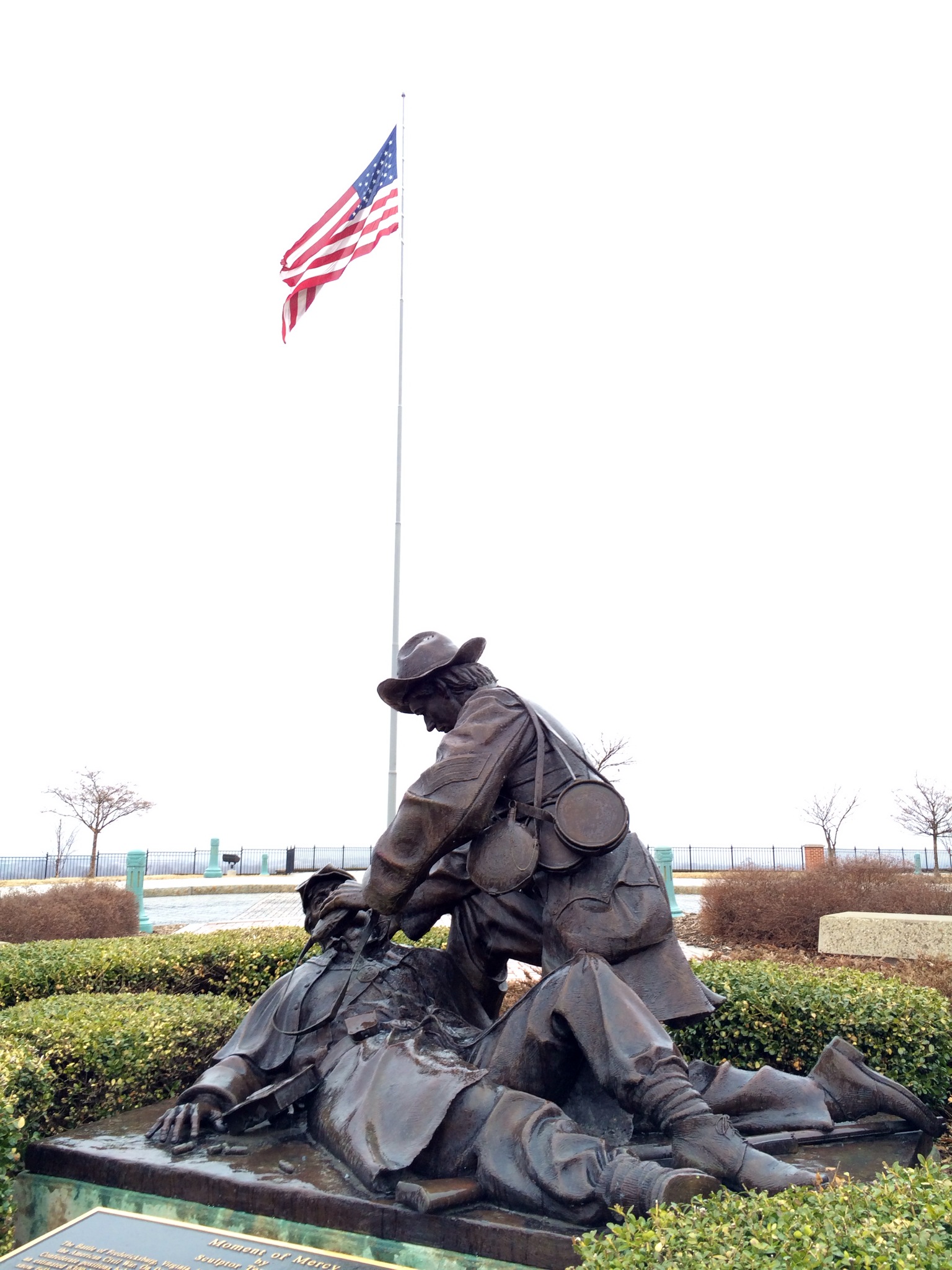
Work brought me to Harrisburg, Pa. during the first part of this week.  Two colleagues and I finished with our business early Wednesday, so we took in the sights at the National Civil War Museum, which sits atop a marvelous hill overlooking the Susquehanna River Valley.  If you ever have occasion to be in Harrisburg, the museum is definitely worth a stop.  The presentation and curation of artifacts is top-notch, recounting compellingly the perilous divide that almost broke our Union.

A statute outside the National Civil War Museum in Harrisburg, Pa.

The museum captured the Civil War’s history so well by maintaining the feeling of opposition throughout.  Opposing ideas, opposing personalities, opposing economics, etc.  So, while neither curious nor necessarily suspect, I find it at least interesting that the USPTO this week has granted a Notice of Allowance for a new mark protecting goods and services bearing the mark “Civil War” without any opposition whatsoever.

On Tuesday, Oregon State University and the University of Oregon got a notice of Allowance from the U.S. Patent and Trademark Office that their application for the mark, “Civil War,” was well on its way to an unopposed registration.  Now, Oregon State and Oregon only need to provide the USPTO with evidence that they’re still using the mark — and official trademark registration is probably easily within sight.

And we all know that they’re still using the mark.  Oregon’s Department of Education (on behalf of the teams) is seeking the trademark protection because “The Civil War” is the colloquial name for the big rivalry game played each year by Oregon State and the Oregon Ducks.  The game was first played in 1894 — some three decades after the actual Civil War.

How is Oregon so close to laying registered claim to trademark protection for “Civil War?”  Dare I call it blasphemous?  I do on the day after taking in the sights of the National Civil War Museum.  My colleague Tim Sitzmann suggests that perhaps there remains good grounds for opposing the mark.  Tim told me this morning that the mark could be denied protection as purely ornamental — that is, a mark that does not identify the source of the goods.

What are your thoughts out there?  Yes, the college rivalry is quite the institution — but are Oregon’s and Oregon State’s gameday wares worthy of the trademark protection?

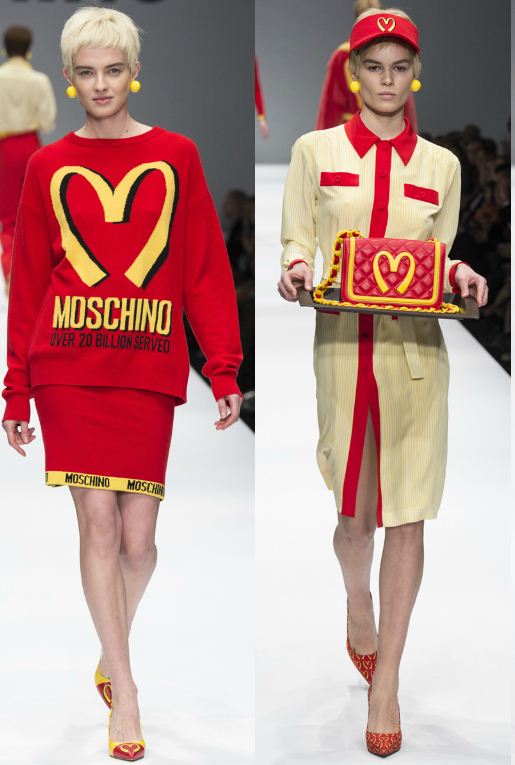
You may have previously read my post about apparel companies spoofing luxury fashion brands, but in Milan, one luxury fashion brand spoofed brands perhaps a little more familiar to the average Joe or Jane.

Moschino’s capsule collection, “Fast Fashion – Next Day After The Runway,” drew some criticism  for its treatment of some of these brands, including McDonald’s.


The purse and other items from the line have already sold out.  The belt below is still available, but it will set you back about the price of 250 McDoubles on the Dollar Menu.

While this was the debut of the fashion house’s new creative director Jeremy Scott, this  irreverant style isn’t new for Moschino, which has earned a reputation as a playful fashion house that likes to poke fun at brands.  It has taken jabs at competitors like Chanel, Versace and Prada (see “Pasta” shirt below), and previously spoofed McDonald’s in 1997 with a jacket that said MoSchino’s in white against a red and yellow background.   Interestingly that collection was likewise called “Fast Fashion.”


Is Moschino infringing on other’s trademark rights, particularly a mark as famous as McDonald’s?

Certainly there are arguments that could be made that the McDonald’s brand is either diluted by blurring or by tarnishment.  Under 15 U.S.C. § 1125, dilution by blurring requires an association between the famous mark and the junior mark that impairs the distinctiveness of the famous mark, and dilution by tarnishment must harm the reputation of the famous mark.   Clearly some association is intended to be made from these designs, but the threshold to show that it impairs the distinctiveness of the McDonald’s arches or harms their reputation would be difficult to overcome for a fast food chain against a Warhol-esque luxury fashion designer.

From Moschino’s perspective though, under the parody defense, the parody generally needs to simultaneously evoke the original and a contradictory and often humorous message that it is not the original so as to avoid confusion.  They evoke the original arches but in a cheeky way.  The “arches” differ in an important way from the McDonald’s arches – they form what appears to be a heart shape.

And I’m lovin’ it.

Simon Bennett, partner and Rachel Cook, associate Fox Williams LLP

Global entertainment giant Twentieth Century Fox Film Corporation recently lost its case against Comic Enterprises Limited, a UK company that runs several live entertainment venues in the UK, in what has been billed as a modern day David vs. Goliath. The subject of the dispute: Glee.

Comic Enterprises owns the UK registered figurative trade mark for “the glee club” covering various entertainment services. Fox is responsible for the television series “glee” based in a US high school about a singing club. The UK trade mark was registered in 2001 probably before the idea for “glee” was even pitched to Fox. However, since its launch in 2009 the star of glee the TV show has risen quickly, spawning DVDs, concert tours and other merchandise.

Comic Enterprises claimed that Fox’s use of glee, infringed its UK trade mark as consumers would be confused and/or Fox’s use would lead to the distinctive character of its mark being damaged.

Fox defended its action denying infringement and counter claiming for partial revocation of Comic Enterprises trade mark on the grounds of non-use and invalidity on the basis that the words “glee club” are descriptive. The Court was prepared to agree with Fox that the trade mark specification should be limited; not unusual where broad categories have been claimed. However, this was the first and last piece of good news for Fox.

In a case about a singing club, this case was very much about hitting the right note and as lawyers know in cases about confusion, nothing strikes the right tone like persuasive evidence direct from the public. Comic Enterprises was able to provide evidence that numerous members of the public had seen the registered trade mark and thought that the mark had something to do with the TV show.

In contrast, Fox was unable to persuade the Court that the term Glee was descriptive. In this respect its reliance upon evidence from choral societies at exclusive UK private schools, such as Harrow and Winchester College did not strike a chord, particularly when compared to the numerous statements from members of the public, who linked the term to the TV show.

On this basis, even with a much reduced specification, Fox’s use infringed the trade mark.

Where does this leave Fox and what is the score for glee the TV show in the UK?

Fox will certainly be banging its drum towards the Court of Appeal. If the decision stands then to retain the name glee in the UK a deal may need to be struck with Comic Enterprises and that deal is likely to have lots of zeros.

However, overturning the Judgment is likely to be difficult. UK appeal courts are very reluctant to overturn first instance findings that relate to evidence. It is generally assumed that the first instance Judge who sees and hears the evidence is in the best position to assess it and give it weight.

The strongest note for Fox may be that the Judge’s finding was strongly based on wrong way confusion, with consumers being aware of the show first and then when they saw the trade mark believing it was linked to the show. This is relatively unusual. But the Judge noted that what is required is the likelihood of confusion; not a specific kind of confusion.

As a matter of public policy, it seems unlikely that the Court will find that a subsequent user can unseat the rights of a registered trade mark proprietor, even if its reputation quickly overtakes that of the registered mark.

Months after Amazon’s recent media ploy, drones continue to capture news headlines. Hours ago, an AP story ran, suggesting that the Federal Aviation Administration’s present ban on commercial drones will result in global competitors flying right by the U.S., leaving us in their economic dust, as other countries around the globe embrace the commercial use of drones.

Last month there was even some discussion about whether we ought to call them drones or unmanned aerial vehicles — we think we know which one will survive the flight, don’t you?

By the way, are you able to identify the brand of drone shown in the photo above? Are you able to do so without employing a monotone voice to avoid boring your listeners? It’s not 200, by the way — in case you’re fixated on the only overt visible marking on the unmanned aircraft, as opposed to the external shape of it.

To the extent you think we drone on and on about non-traditional trademarks, brace yourself, here we go again. This one is pretty interesting though, it appears to be the only federal trademark registration covering the shape or configuration of a drone. Do you think it would survive litigation?

The source of the drone shown in the photo above is General Atomics Aeronautical Systems, Inc., and this particular drone is also known by the Predator word trademark. How do we know? Because the above photo is the specimen of use submitted to the USPTO in support of this federal registration for the configuration of the drone in connection with “unmanned air vehicles, namely, drones; unmanned air vehicles for surveillance, reconnaissance, and weapon delivery.”

This is how the mark is described in the registration, issued just over a month ago: “The mark consists of a three-dimensional configuration of an unmanned aerial vehicle which comprises a pronounced raised section of the upper and lower front fuselage followed by a slender fuselage. The dotted outline of the goods is intended to show the position of the mark and is not a part of the mark.”

If you’d like to see how General Atomics overcame the USPTO’s initial lack of distinctiveness refusal, see here. And, to see how it overcame the functionality refusal, see here and here.

Goodness gracious, everyone wants a piece of the drone action it appears, including some enterprising lawyers, see here (“Drone Lawyer”) and here (“Drone Practice Group” in Chicago Law Firm). And, no, although I could, today I’m not talking about the growing number of digital companies willing to file trademark applications for next to nothing. They know who they are. You know, the ones who give you just what you pay for?

How soon before the FAA allows commercial use of drones? How soon before we can order drone-delivered pizza? Will this avoid the need to tip the deliverer? If so, I’m in.

– Brent Carlson-Lee

One reason trademark rights exist is to protect brand and product identities from the ill effects of confusion in the marketplace.

So it’s hard to imagine a scenario where exclusive naming rights could in fact create confusion.

But here it is.

“As part of trade talks, the European Union wants to ban the use of European names like Parmesan, feta and Gorgonzola on cheese made in the United States.” See full article here.

Since the names have long been generic, it could lead to significant confusion among US consumers. I mean, what would that substance in the green can be called if it weren’t called Parmesan cheese?

The reality may be the collective perception of US consumers is that Parmesan cheese only comes in a can, not in blocks like this.

While the EU is hoping to boost its agricultural exports, this approach doesn’t seem likely to have a significant impact on this front. The consumer market in the US could be roughly segmented into a very large segment (typical consumers who purchase Parmesan cheese in a can) and a relatively small segment (consumers who pay a substantial premium for “real” Parmesan cheese).

Parmesan can consumers would certainly not begin to pay a premium for Parmesan cheese in block form. So the EU would be reliant upon a relatively small (but likely growing) segment of “real” Parmesan consumers to switch from American-produced Parmesan cheese to Italian-produced Parmesan cheese.

Sounds like a bunch of bologna to me.

– Anjali Shankar, Attorney –

DuetsBlog friends,

I have decided to transition to a position as an Assistant Attorney General at the Minnesota Attorney General’s Office.  I have enjoyed my time at Winthrop & Weinstine and had such a great time blogging and learning more about intellectual property law! I am sad to leave friends here at Winthrop & Weinstine, but am excited about this opportunity!

I have enjoyed being a part of this blog, including celebrating its fifth year anniversary.  I have found the posts to be informative, at times humorous, and always interesting!  I look forward to seeing the blog continue to flourish.

Many thanks to Steve Baird and the whole team for letting me be a part of this wonderful blog!

Warm regards,

Anjali Shankar


–Ben Kwan, Attorney

The other day, my better half and I were brainstorming the next great social media app.  You know, the one that would propel us from our employers’ payrolls like circus performers out of a cannon? We had the concept down — there was a social component, some cool location-based features, and a great swath of would-be users (we think, anyway).  The conversation eventually turned to the obvious:  what would we call it?

[radio silence]

[crickets]

Two of Lexicon Branding’s creations for P&G. Don’t know about you, but “swiffer” is now a verb in my household.

That was the hardest part of the little shared daydream of ours.  All the ideas reeked of mediocrity.  They were generic.  Bland.  All the makings of a battle before the folks at the USPTO for legal protection.  Good thing I have my colleagues here at the law firm.  But we wouldn’t just want trademark rights.  We want that multimillion dollar payday!  So we’d need more than a name.  We’d need an identity — the kind that leads to icon status.

Enter the company that has helped turned so many brands into BRANDS — with a capital ‘B’ — the same ‘B’ in Billion.  Billion dollar brand names don’t just appear out of thin air.  Lexicon Branding, founded in 1982, has been helping companies come up with killer names — the likes of which we all know (and often love).  BlackBerry®.  Febreze®.  Dasani®.  Some have staying power (the latter), others don’t (the former)–but all bring in the bucks (or once did).


You’ve got to wonder whether some of these companies with the super-unique names just yank Scrabble® pieces out of a hat to come up with the monikers they do.  Well they don’t — and the folks over at Fast Company have a great account of Lexicon’s process a few years ago of coming up with the name for the new Colgate® mini portable toothbrush.   Before you click on that link — do you know what it’s called now that it’s been on the market for a few years (test that brand strength)?

Lexicon uses a nice little story on its website to illustrate the importance of branding — I removed the “brand name” so you can test yourselves:

While speaking at a small scientific conference in 1969, Cambridge physicist Sir Roger Penrose announced his discovery of what he called a “gravitationally completely collapsed object.”

The world yawned.

Months later, he changed the name of his discovery to [] and the news of his discovery raced around the world.

Today, the term [] is a part of the world’s working vocabulary.

I don’t think we’re ready to hire Lexicon Branding for our app just yet — but we may need them if we’re ever going to make it big.

There’s no place like home. Just be careful where and how you say it.

It is common knowledge among lawyers that copyright protection does not normally extend to titles, words, or short phrases. Movies, politicians, and our family and friends constantly quote books, movies, and famous politicians, actors, and others. From a trademark perspective, we see famous quotes on drink caps, product labels, wrappers, and other items. It doesn’t seem likely that use of a common phrase or quote could expose anyone to trademark infringement claims. After all, as you read the first sentence of this post, did you wonder whether Turner Entertainment had endorsed, sponsored, or was in some other way affiliated or connected with this blog post?

Turner owns a number of registrations for the mark THERE’S NO PLACE LIKE HOME for use in connection with clothing, glass and ceramic goods, coffee cups, non-precious stones for garden or ornamental use, and paper goods.

On March 3, Turner filed a Notice of Opposition against NeuroQuest LLC’s application for the mark THERE’S NO PLACE LIKE HOME TO HAVE YOUR EEG ESPECIALLY SINCE WE MAKE HOUSE CALLS for use in connection with “neurodiagnostic testing, monitoring and reporting services, namely, providing ambulatory in-home electroencephalogram by order of physician.” Although likelihood of confusion is alleged, Turner did not identify with any detail how neurological testing is related to clothing, ceramic goods, or the other goods identified in Turner’s registrations. The pleading also alleges a claim of dilution.

The first use I can find of “Home Sweet Home” is a line from a song from an 1823 opera written by John Howard Payne (thanks Wikipedia, although I suspect there is likely historical and literary use of the phrase prior). It is also a line from L. Frank Baum’s book The Wonderful Wizard of Oz from 1900, and the subsequently produced movie starring Judy Garland. Turner acquired its rights based on its ownership of the Wizard of Oz movie.  You may also recall the well known There’s No Place Like Home for the Holidays song from the 1950s (apologies if it is stuck in your head now).

The Trademark Manual of Examining Procedure Rule 1202.17 prevents registrations of “universal symbols,” which the TTAB relied upon to affirm an Examining Attorney’s refusal of Craigslist’s application to register its purple peace symbol. More recently, the TTAB has refused each and every attempt to register the mark BOSTON STRONG. The supplied reasoning is that these phrases or symbols are so well-known and used that they are ubiquitous and that the public has been extensively exposed to such use. Because of this exposure, these phrase or symbols are unable to signify one particular source and fail to function as a mark.

Setting aside the unrelatedness of the goods and services and the extensive differences in the marks (sorry NeuroQuest, but your applied-for mark is unlikely to be the next NIKE…), can THERE’S NO PLACE LIKE HOME even function as a mark? While the use of the phrase may cause consumers to remember or recall the Wizard of Oz, that is not the test for a likelihood of confusion, instead, there must be some confusion as to the source, sponsorship, endorsement, or licensing of the goods. Absent any additional indicia, such as a picture of a scarecrow, Dorothy, or a yellow brick road, I think it is a stretch to claim that a consumer would think that Turner had begun licensing its intellectual property to a neurological testing service.

But hey, what do I know. I’m just a man hiding behind the curtain of a blog, pay no attention to me…


–  James E. Lukaszewski, ABC, APR, Fellow PRSA

Much as I admire Dov Seidman, the founder of LRN, his recent call for an “apology ceasefire” is precisely what self-forgiving, mistake-prone, could-care-less-about-victims executives are looking for: an officially sanctioned get-off-the-hook excuse.

The very things that make us recoil at some of the silly, foolish, naïve and arrogant apology attempts should spur us on to require even more rigor when an empathy/apology strategy is attempted.

There is a technique I’ve developed and have used over the years to actually screen potential crisis clients, including very large, well-known companies and very large, recognizable organizations. Crisis consultants are approached by all kinds of people and organizations looking for ways more to escape the consequences of their bad decisions, deeds, and statements rather than, understand what’s happened, the damage they’ve caused, and to move toward a compassionate, helpful and honorable resolution. That is, of course, until the lawsuits start and the bad headlines explode again, or the FBI shows up.

I call the technique “Seeking Forgiveness.” In fact, when companies and organizations call me, this is the discussion we have initially to give me an indication of whether or not they’re serious about resolving their issues and dealing with the problems they’ve created for victims. It’s also to give anyone who calls a preview of what the community, the public, victims and survivors will ultimately require for the bad news to go away and the reputation restoration process to begin.

Sometimes callers are simply looking for public relations assistance to defer, delay, deny or divert attention from the problems they are currently causing and experiencing. Or worse, they’re actually looking for assistance in demeaning, disrespecting and discrediting victims. I share a forecast of the fate of these perpetrators, too. It’s quite a different list. Continue Reading Seeking Forgiveness: Time to Set a Much Higher Standard