— Jessica Gutierrez Alm, Attorney

Happy 2016! I hope everyone had a fun and festive New Year celebration.

As for me, I’ll be spending my three-day weekend tinkering with this:

Thanks to my thoughtful husband and the rapidly increasing availability and affordability of these products, I am the proud new owner of a 3-D printer.  It’s basically been running nonstop since I first turned it on.

The computer builds an object by extruding hot plastic into a series of 2-D layers.  The software converts a 3-dimensional design file, like a CAD drafting file, into a series of these layers, and converts the design into a format that the printer can understand.

Here are a few of the things I’ve printed so far:

image1

image2

image3

It’s incredible that 3-D printers have nearly reached a level of plug-and-play availability.  This printer requires some occasional calibration and maintenance, and the objects take hours to print. But it’s generally easy to use, and the software is surprisingly user-friendly.

Some of our guest authors have written before about the impending intellectual property implications of 3-D printing. See here, here, here, and here.  In 2012, Jason Voiovich even predicted such 3-D printing accessibility.

I didn’t design the files for the objects I printed.  Someone else designed them and uploaded them on the Internet for others to freely use.  Websites like Thingiverse and Shapeways allow users to upload their designs.

It wasn’t until I made that baby Groot (Guardians of the Galaxy character) figurine that I started thinking about the intellectual property implications.

This technology allows people to create just about any physical object.  An individual could reproduce a copyrighted work or an item covered by a product configuration trademark or design patent.  An individual could even produce components for a functioning device covered by a utility patent.

There are a couple pathways to infringement here.  First, there’s the designer who creates the drawing file of baby Groot.  Secondly, there’s the individual who downloads the design file and physically prints out the baby Groot object (in this case, me).

Toy company Hasbro had the forethought to partner with Shapeways to license design files for printing Hasbro characters.  Hasbro is even allowing individuals to sell the objects they print.

Other IP holders have taken a different approach.  Thingiverse and Shapeways have both received Digital Millennium Copyright Act (DMCA) takedown notices.  There were 3-D print files for the Penrose triangle, and remember Katy Perry’s left shark?  The DMCA allows copyright holders to alert a website of infringing content so that the site can remove the content in an effort to avoid liability.  However, the DMCA does not provide a remedy for trademark or patent holders.

Is 3-D printing going to become the next Napster?  It’s unclear at this point, but we’re surely headed toward a clash between existing IP laws and this emerging technology.


-Wes Anderson, Attorney

Just as the Minnesota Vikings exceed expectations this year and push into the NFL playoffs, the Vikings’ still-unfinished new stadium is producing some interesting (if not expected) branding-related litigation.
Attachment

A major topic of conversation here in the Twin Cities is the 2016 opening of U.S. Bank Stadium, the Vikings’ new home built on the site of the not-so-dearly departed Metrodome, and the accompanying outgrowth of buildings in the “Downtown East” area it occupies. Watching this hulking behemoth of angled glass and metal rise over the last two years, I’m happily anticipating the prospect of habitable indoor weather for the next Chicago Bears appearance in town (but probably not the game itself).

I probably should have anticipated the wealth of lawsuits that have arrived well ahead of the stadium’s ribbon-cutting. The latest example has two large banks’ logos a bit too close for comfort.

U.S. Bank paid an estimated $220 million for the naming rights to the new stadium, and its name will be emblazoned everywhere on its exterior. But just last week, the entity behind the stadium’s development (we’ll call it the “Vikings” for simplicity’s sake) brought a lawsuit in Minnesota claiming that Wells Fargo, another locally-based bank, is trying to steal some branding thunder and “permanently photobomb the image of the iconic U.S. Bank Stadium.”

While Wells Fargo doesn’t have its moniker adorning the new stadium, it happens to own a pair of buildings just across the street, and Wells Fargo looks keen to offset the exposure of its competitor’s name. According to the Vikings’ complaint, Wells Fargo plans to put its red-and-yellow logo mark both on the top floor of the building (facing out) and on a raised, illuminated platform (facing the sky). This means that those helicopter night shots of the new stadium and the Minneapolis skyline will also remind viewers of that other big bank in town, as shown in this rendering featured in the Vikings’ complaint:

Screen Shot 2015-12-30 at 5.16.50 PM

The Vikings — and, I assume, U.S. Bank — take umbrage to the plans for a brightly-lit WELLS FARGO sign, and allege that Wells Fargo previously agreed that the rooftop logo would not be raised or illuminated, just painted. The suit was just removed from Minnesota state court to federal court, and as work continues on the signs (likely as you read this), expedited hearings are in the works to attempt to halt further construction by Wells Fargo. Given so many millions of dollars pouring into both the stadium and Downtown East, this messy dispute likely won’t be going away anytime soon. In the meantime, you can see the progress of both the new stadium and the Wells Fargo signs using the “aerial” webcam at the Vikings’ website.

Screen Shot 2015-12-30 at 5.24.55 PM

It goes to show that stadium naming rights don’t also give an automatic zone of exclusion for crafty competitor branding. Branding can be found in every nook and cranny. I am reminded of the big red rooftop that used to be visible on TV in left field at Wrigley Field in Chicago. It quickly became a lucrative advertising prospect for Budweiser and the building’s owner (much to the consternation of the Chicago Cubs, which has since renovated the field and largely obscured the view of the surrounding rooftops).

Football is the premier sport in the U.S. thanks in large part to the advertising dollars that funnel into the game and its media coverage. The amount of famous brands willing to pay top dollar for NFL-related branding is legion. Arguably the most famous commercial of all time, Apple’s “1984” ad introducing the Macintosh, aired just once – during the Super Bowl. It stands to reason that stadium naming rights may not give a great return on investment if a competitor can swoop in and “photobomb” its way into similar media attention. And indeed, commentators have pondered whether it’s really worth all that money to have Al Michaels refer to the Vikings’ gridiron as “U.S. Bank Stadium.”

It seems both sides have a point – Wells Fargo seeks only to brand its own building, while US Bank and the Vikings can point what is ostensibly a breach of a prior arrangement between the parties. But contract dispute aside, who’s to say brand owners shouldn’t be like crafty NFL general managers, striving for maximum benefit at minimum cost?


-Martha Engel, Attorney

One of the hottest toys during the 2015 holiday season was the hoverboard, and doesn’t that seem about right for this year.   I saw my first hoverboard earlier this summer — a guy was walking and holding hands with his girlfriend, as she glided alongside him on the hoverboard.  If I were to make a top 10 list of the oddest things I encountered in 2015, that would certainly be on the list.

As of Wednesday, October 21, 2015 at 4:29 pm, hoverboards were certain to be owned by every Marty McFly there was.  But perhaps, what was not anticipated by the Back to the Future film along with the failure of the Chicago Cubs to win a World Series, were the fires (bringing new meaning to the “hottest” toy), the injuries, the lawsuits, and the legislation that would soon accompany these popular gifts.  As one article in the Washington Post stated, “thanks for ruining Christmas, hoverboards”.

Not only are some of these devices fraught with product liability issues — in particular, the cheaper knockoffs — they also are presenting some patent issues and may be the focus of the next great patent war.   Razor sells the product above for $600, but some knockoff hoverboards can be purchased for around $200 (the ones that seem to catch fire the most).  Earlier this Christmas season, Razor sued Segway for patent infringement regarding the popular holiday gift, but they aren’t the only lawsuit.  The number of lawsuits between different companies over these devices is enough to make your wheels spin.   The Wall Street Journal recently published an article about these lawsuits &  transactions involving hoverboard technology, and according to that article, Inventist (founded by Shane Chen) licensed patent applications to Razor.  Segway sued the Chinese company Ninebot, then Ninebot bought Segway. Inventist sued Ninebot over some of its patents, and then Ninebot sued Inventist for some of Segway’s older patents.

The article suggests these lawsuits as evidence that the patent system has done its job – allowing someone to profit from inventions with costly R&D but easy to copy once made.  But the purpose or job of the patent system is not the ability to make a device or even to profit from your invention, it is to have inventors make a public, enabling disclosure of their invention in exchange for the right to exclude others from making, using, or selling the claimed invention for a limited period of time.   This is an exclusionary right, which is rare for legal rights (think of the way this is worded as opposed to your First Amendment rights). It confers no right on the inventor to themselves make, use, or sell product covered by the claimed invention – just to exclude others from doing so.  It’s not intended on rewarding an inventor; it’s purpose is public disclosure.

The WSJ piece essentially blames the commoditization of patents for, according to the drop head, “why the creator of this year’s hottest Christmas gift is struggling to make money on his invention.”

Amassing a patent trove, lining up a large manufacturing partner and buying a well-known brand sure sounds like a plan for world hoverboard domination. And if it works, a couple of Chinese companies simultaneously will have leveraged the very different patent systems of the U.S., where intellectual property has what some say is too much protection, and China, where in practice it has almost none at all.

Meanwhile, the man with the best claim to have invented the technology in dispute, Shane Chen, will have to settle for whatever hoverboards Razor and his own company can sell until his devices are driven out of the market by cheaper Chinese models or crushed by patent litigation. And that, I think, should make us all wonder whether our patent system is still up to the task of rewarding those who create original but eminently copyable inventions.

Without the patents though, Inventist wouldn’t have the property assets that would be attractive to a larger company like Razor, with more resources to exclude others from selling the devices, greater manufacturing capabilities, and a well-tested distribution set up.  Many of these things, a startup like Inventist would have to develop from scratch – and that can be a costly endeavor.  Presumably by licensing its patent rights to someone like Razor, it ultimately will create a stronger market for its hoverboards and reap some handsome royalties as a result.  Additionally, if they hadn’t obtained patent protection, they would not be able to use U.S. Customs to prevent copycat products under different brand names from coming into the U.S. (although if it had a non-traditional product configuration trademark registration, that might help too).  Further, the U.S. International Trade Commission can rely on patent rights to prevent infringing products from entering the U.S.  Maybe I’m missing the point here, but wouldn’t Shane Chen be driven out even earlier if the U.S. patent system didn’t provide him with protection?  Regardless, a patent does not grant the inventor the right to actually make, use or sell his invention – which may be precluded at least in part by the inventions of others.  I’m just unclear what the desired “fix” is here.

Incidentally, since my brain’s always looking at all IP aspects of products like this, there is a trademark registration for HOVERBOARD for “electrically powered two wheeled scooter for terrestrial human transportation” owned by The Patmont Revocable Trust.   I’ll bet there’s a lawsuit hovering somewhere over there too.

In any event, clearly some of Chen’s marketshare is being usurped by knockoff manufacturers of the devices.  But these devices are often shoddy and potentially combustible.  I don’t see this as the patent system being broken – I see it as at least a chance for Inventist to have some claim to the market before being rolled over by cheaper Chinese models.   I’m hoping we travel like the Jetsons by then.

–  James E. Lukaszewski, ABC, Fellow IABC, APR, Fellow PRSA, PRSA BEPS Emeritus

If you are an attorney, work with or have attorneys in litigation, here’s an interesting, relevant, recent story you can relate to. This is also a story about leadership.

A couple months ago, I was asked by a local religious organization to help them figure out how to help prepare for some pretty nasty publicity. A lawsuit was filed months before, just after the Minnesota Legislature passed a law (in 2014) extending the statutes of limitation on child sex crimes in the state until June 2016. This law triggered dozens of sexual assault cases being refiled after the cases were previously dropped or stopped by former statutes of limitation. New cases also were filed.

This lawsuit was well underway, but failed after 14 months of legal work when the first major milestone, a motion to dismiss, was denied. Litigators were now working on a motion for summary judgment. My client was fearful that bad publicity could break at any time.

Please understand, while I am not an attorney, for nearly 40 years much of my Crisis Management practice has involved litigation, civil and criminal, as well as working with inside and outside counsel.

When I met with the pastor in preparation for a briefing on the status of the case with the attorneys, I asked whether settlement talks were under way. Because I am frequently brought in to these matters late, this is usually my first question of the client and of the attorneys.

I was told the litigators felt it was “premature” for settlement talks. My response was that in view of having lost the motion to dismiss, the likelihood – already very tenuous – of a successful motion for summary judgment was close to zero. The motion to dismiss failure had consumed 14 months. The motion for summary judgment would likely end in failure and consume another 13 to 15 months.

All this while, the victim who was assaulted at age 15 for three years by an assistant pastor (50 years ago), would be forced to suffer another three long years before any thought of a settlement would occur.

If you want a real insight into the reputational difficulty of lawyers, this case is a good example. It was being conducted as a legal procedural, rather than on empathy and victim sensitivity.

Put yourself in her shoes. From her perspective, every day of her suffering is worth say, $10 to $25,000, maybe more. That’s what her husband thought.

As with other victim cases like this one, I recommended that the pastor seriously consider immediately hiring a second law firm, independent of the litigators, to begin meeting with the victim, her lawyers and the victim’s family to get settlement started.

It is re-victimization that drives my thinking here.

Understand that approximately 95% of cases filed, civil or criminal, are ended before getting to trial.  In criminal cases, more than 90% never go to trial, as most are settled with a pre-trial guilty plea.  Cases can be settled, tossed out, go into arbitration, mitigation, mediation or are abandoned. Our legal system is designed to resolve legal matters far ahead of the actual trial. This is another justification for my aggressively recommending settlement talks promptly and early. The odds of any of these cases ever getting to trial is very low. Why subject the victim to five additional years of suffering, fear and doubt, to find out what? The case will never reach a courtroom.

A few days later, on the day of my briefing, to my surprise, the pastor surfaced the separate counsel idea all on his own. The litigator was flabbergasted, saying, “I’ve never heard of that.”

A very predictable discussion followed: “We are in the middle of preparing our next motions . . .” “It’s really premature for settlement talks.” “We haven’t completed our investigation of the plaintiff.” (I’ll get back to this.) And for a second time, “I have never heard of this approach before.”

When it became obvious that the pastor was serious, the litigator, in a sensible turnaround, volunteered to take on the additional responsibility, “at the right time.” The pastor responded, “How about by this Friday.” It was Tuesday when this conversation occurred.

Late Thursday, the litigator called the pastor to tell him that, a couple of hours after his first contact with the victim’s lawyer, the lawyer responded that they would take nothing less than a very low six figures. This was an extremely important development. We were just looking to get discussions going and the plaintiff responded with a remarkably affordable number.

Church leadership had been sleepless for months, fearful that a settlement or verdict would be in the multimillion dollar range. I suggested that they respond to the victim’s attorney with a check for the full amount within 24 hours.

The pastor and I then had a wonderful discussion about the beauty of simply writing a check and helping end the lifelong suffering of this woman without the usual haggling that always accompanies these processes and repeatedly re-victimizes. The pastor agreed and I thought that was it. But wait.

It turned out that the church’s attorneys immediately opposed paying anything until there was a thorough investigation of the victim’s health status and how much she’d spent directly on treating her victimization.

When I heard this I was dumbfounded. We had a settlement amount that was literally a heavenly gift, yet the litigating attorneys insisted on demeaning, disparaging, discrediting and seriously re-victimizing the woman. What’s with these people?

Had I been present for this discussion my response would have been, “Are you nuts? What’s the point? What does it matter?” Believe it or not, there was a serious discussion by these attorneys about hiring an investigator to find this stuff out. Actually, I felt it was kind of on the sick side of things. I would have urged again that the church write a check and get it to the victim’s attorneys, notifying the court of the settlement, and forget any kind of investigation.

A few days later I found out that the church settled for high five figures. Our litigator adamantly opposed simply “giving in” and convinced the pastor to respond with a lower offer. The victim immediately accepted. I guess the attorney was fearful that his buddies or the insurance company would call him a sissy or a coward for paying the face amount of the victim’s response.

Sadly, I thought the church missed an opportunity to live up to its own belief system of finding forgiveness through generosity, charity and kindness. The lawyer lived up to his reputation of getting in the first punch and a last punch, even when no punch was required.

No public communication was ever needed and the only internal communication simply stated that the case had been settled and the entire matter sealed.

When you think about it, this case was actually settled in 72 hours after more than a year of legal jerking around, plus the prospect of jerking around for another 15 months on another failed major motion.

The point is, right now, the settlement timing is generally the litigator’s call, unless the judge gets impatient and starts asking questions. The lesson is, even in this case, litigators get to litigate and pugitate. It will scare the pants off the litigator, but I always urge that the settlement process begins coincident with or even before the litigation begins in the context of reducing the victim’s suffering.

The truth is only a handful of my clients have taken this approach . . . but I am batting 1000 so far. About 72 hours from start to finish.

Once litigation begins, there is tons of testosterosis banging around, which ignores the human factors in favor of legal process.

The major pushback question from the legal side is: How can you start settlement talks when you know so little about the situation?

This is an excellent, rational question that fails to recognize the irrational nature of victimization. But how many settlements have you seen that are actually rational? How many victimizations are rational? The question settlement answers for the victim is: “How can we put your suffering to rest?”

The process is easy. Your settlement counsel arranges to meet with the victim and or their attorney. They introduce themselves and the settlement counsel asks a very simple question, “What will you need to get your life back to normal? Or to start moving toward a better life?”

Three powerful lessons some quickly to mind:

  1. The check you write today is the smallest check you will ever write.
  2. If you enter the negotiations with, “No way,” as your guiding principle, you will eventually write a very, very big check.
  3. No one that matters is keeping score. Rapid settlement is in the interest of a calmer conscience for the lawyers and perpetrators and peace of mind for the victim. What if the victim was your daughter, son, father or mother?


Let’s hope not, for a variety of reasons.

In other words, let’s hope the Supreme Court straightens out the unfortunate ruling last week that the federal government is powerless to deny requests to federally register marks on grounds that they consist of or comprise racial slurs or other matter that may disparage persons.

The CAFC previously agreed with the USPTO and TTAB that THE SLANTS mark for “entertainment in the nature of live performances by a musical band,” may disparage persons of Asian descent, in violation of Section 2(a) of the Lanham Act, so it affirmed the registration refusal. Then this.

The decision stirring up the most recent discussion is the en banc majority decision from the CAFC that now purports to invalidate the nearly 70-year old disparagement portion of Section 2(a), as a violation of Applicant Tam’s right to Free Speech.

As dissenting Circuit Judge Lourie noted in amazement:

“[O]ne wonders why a statute that dates back nearly seventy years — one that has been continuously applied — is suddenly unconstitutional as violating the First Amendment. Is there no such thing as settled law, normally referred to as stare decisis? Since the inception of the federal trademark registration program in 1905, the federal government has declined to issue registrations of disparaging marks. The Trademark Act of 1905 provided specific authority to refuse to register immoral or scandalous marks; the USPTO refused to register disparaging marks on those grounds before the Lanham Act of 1946 was enacted, which explicitly incorporated a disparagement proscription. The USPTO’s authority to refuse to issue trademark registrations with certain offensive content has thus existed in U.S. law for over one hundred years.” (citations omitted)

The majority decision explicitly reinstated the previous “holding that Mr. Tam’s mark is disparaging,” but it went on to declare the disparagement portion of Section 2(a) unconstitutional, and then believing the federal government powerless to deny registration on disparagement grounds, it appeared to lament or at least “recognize that invalidating this provision may lead to the wider registration of marks that offend vulnerable communities.”

I’m believing that Congress has the power to direct the USPTO to withhold registration and the issuance of a Certificate of Registration if the subject matter consists of or comprises matter that may disparage persons or bring them into contempt or disrepute.

After all (and in addition to the valid points raised by dissenting Circuit Judge Lourie about publication in the Official Gazette), Section 7 of the Lanham Act explicitly confirms that a Certificate of Registration is issued in the “name of the United States of America” and has the federal government’s fingerprints all over it:

“Certificates of registration of marks registered upon the principal register shall be issued in the name of the United States of America, under the seal of the United States Patent and Trademark Office, and shall be signed by the Director or have his signature placed thereon, and a record thereof shall be kept in the United States Patent and Trademark Office.” (emphasis added)

As I’ve cautioned before, conflating the federal government’s act of approving registration and issuing a Certificate of Registration with the Applicant’s underlying trademark is an improper analysis of the First Amendment question:

“There is no question that a trademark communicates information about an underlying brand, but the Certificate of Registration communicates something quite different — the piece of heavy stock paper with the words in fancy script “United States of America” and “United States Patent and Trademark Office,” across the top, and the golden Official Seal of the USPTO (including a reference to the Department of Commerce) located in the lower left hand corner of the Certificate of Registration, also appearing above the signature of the Director of the USPTO (who is also Under Secretary of Commerce for Intellectual Property), an employee of the federal government and principal advisor to the President of the United States — what this valuable piece of paper communicates is an official act of the federal government that it has examined and approved the trademark for federal registration and exclusive protection in United States commerce.”

Dissenting Circuit Judge Lourie said it even better this way:

“[F]ederally registered trademarks can be identified with two message contexts: one from the provider of goods or services, who has chosen to use a certain mark to link its product or services to itself, and one from the government, which has deemed the mark qualified for the federal registration program. The evaluation of disparagement is not based on the government’s moral judgment, despite any distaste expressed in its briefing for cancelled or applied-for marks; a mark is disqualified based only on evidence of its perception by the affected persons. The government action does not include a judgment on the worthiness or the effectiveness of the mark; if it did, it might — but not necessarily — venture into viewpoint-discrimination territory. And while a trademark alone, as a word placed on private property, is not government speech, once it claims that federally registered status, it becomes more than the private owner’s speech. It is not simply private speech as is the holding of a placard in a parade.”

There is so much more to say, but just to make sure the context of the Tam case is crystal clear in the meantime, exactly whose signature would appear on THE SLANTS Certificate of Registration, if the majority of the CAFC viewpoint prevails?

Well, the current Director of the USPTO is a very accomplished woman named Michelle K. Lee, who happens to be “a first generation Chinese-American” (as reported by AllGov):

USPTODirectorLeeLast, at least for now, and more to the point about the majority’s recognition that (if their ruling is upheld) even more registrations are likely to issue for offensive marks, let’s hope that the USPTO’s power outage that commenced on December 22, the same day the CAFC issued its en banc ruling in In Re Tam, was a complete coincidence and not triggered by a flood of trademark filings for other racial slurs.

– Nicola Hill, Browne Jacobson

Season’s Greetings one and all! Welcome to the Christmas Day DuetsBlog, where you can find a spot of light-hearted IP cheer being brought to you direct from the fireside in the United Kingdom.

Now, I hope that Father Christmas has been good to all of our readers this year and that you have received everything you hoped for. I also wonder whether any of you actually encountered the red-suited fellow last night, or whether, once again he was elusive, leaving only his tell-tale empty glass and a few cookie crumbs behind?

If, like me, you are yet to spot Saint Nick as he emerges from the chimney and deposits his gifts, fear not, because I think I have found the answer… We can all be on stand-by, prepared and ready for next year, as I have discovered the patented device we all need in our homes for Christmas Eve 2016:

SANTA CLAUSE DETECTOR

 Santa Patent


US Patent 5523741

“A children’s Christmas Stocking device useful for visually signalling the arrival of Santa Claus by illuminating an externally visible light source having a power source located within said device.”


Now, one cannot doubt the novelty of this invention, (if there was ever a ‘novelty’ product on the market, this is surely it). The USPTO clearly thought it patentable subject matter too, and who could blame them – I am not sure that any invention before it has so boldly asserted that it can ‘visually signal the arrival of Santa Claus’ by means of a Santa-sensor.

In terms of the other tests for patentability, the usefulness of this invention is beyond doubt. I have already alluded to the fact that there are hundreds of us out there hanging out (their stockings) in the hope of a glimpse of that white beard. But, I hear you cry, isn’t it obvious? Well, sure, with the benefit of hindsight, but hey, as the old adage goes, ‘why has no-one done it before?’

What would Santa himself think of this invention, however? It is, after all, a bit of a spoiler don’t you think? Off he goes, down the chimney when suddenly the lights from all of the kids’ santa clause detectors blare out at him, causing temporarily blindness and sending him into confused disorientation. Cue the kids jumping out from behind the sofa: Santa’s cover well and truly blown, the magic of Christmas lost forever.

When put like that, perhaps it doesn’t seem such a great invention after all… On second thoughts, I think we can do without the Santa detector in our house for another year!

I would just like to take this opportunity to thank you for taking the time to read the DuetsBlog, particularly on Christmas Day. All that remains is for me to wish you a Merry Christmas one and all, and here’s to a very happy, productive and IP-filled 2016!

Disclaimer: Please note: The US clearly take xmas MUCH more seriously that the UK because we found no similar such patent this side of the pond – but please feel free to email us if you do find any!

— Jessica Gutierrez Alm, Attorney

One principal requirement for obtaining a utility patent is that the invention be useful.  “Whoever invents or discovers any new and useful process, machine, manufacture, or composition of matter, or any new and useful improvement thereof, may obtain a patent therefor.” 35 U.S.C. 101.  The usefulness requirement has roots in the Constitutional grant of power for issuing patents, providing that “Congress shall have power . . . To promote the progress of science and the useful arts.” Art. I, Sec. 8, Cl. 8.

To meet the usefulness requirement, patented inventions often aim to solve a particular problem.

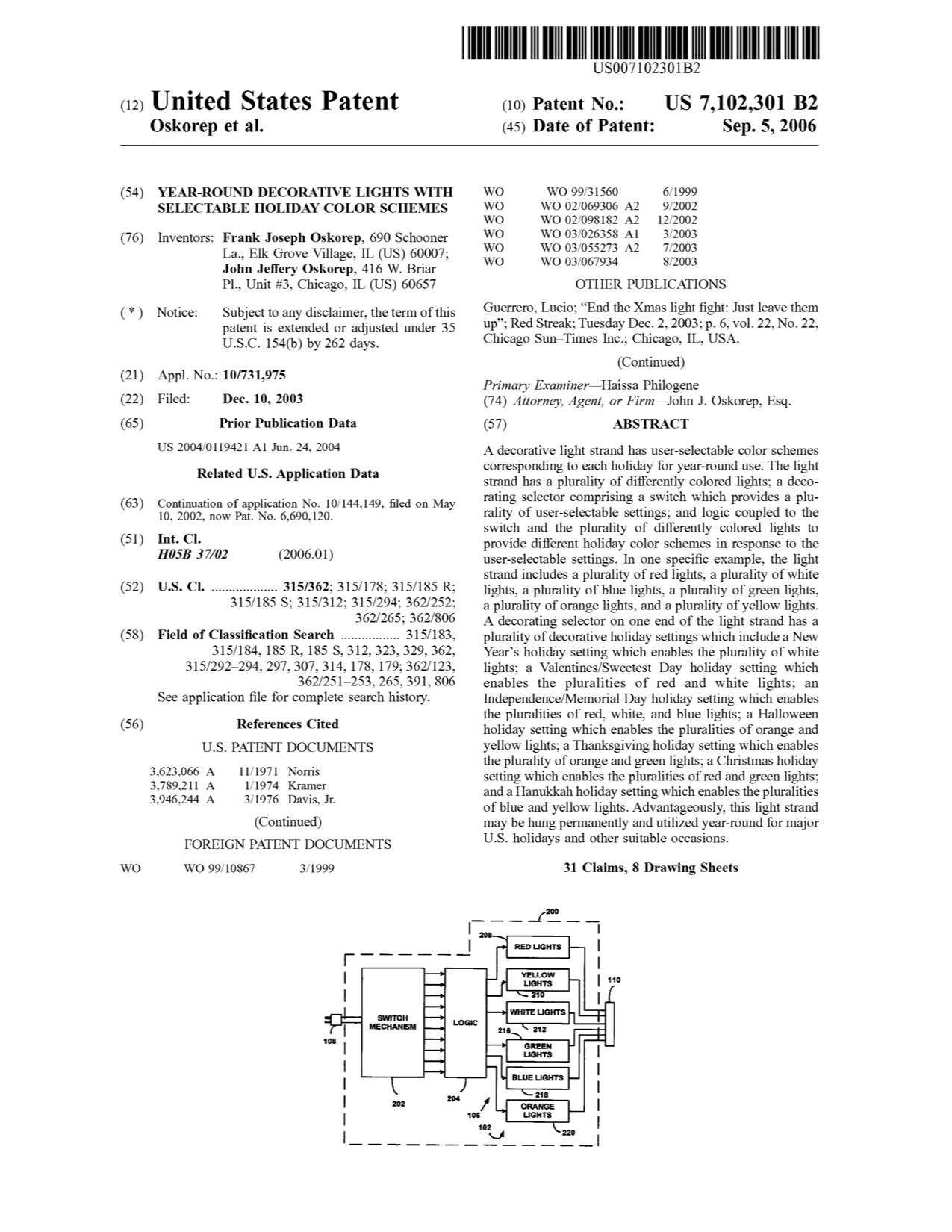
For example, this seasonably appropriate invention seeks to provide a solution for those who have a tendency to leave their Christmas lights up year-round:

lights1lights2

Oskorep et al. provide for a light strand with a plurality of different colored lights, allowing a user to choose which colors to display at a particular time of year or for a particular holiday.  The light strand even has pre-set holiday settings for Valentine’s Day, Independence Day, and others.  Very useful.


Or if you’re like me with an adventurous cat who loves to scale the Christmas tree, you might find this invention useful this time of year:

pets1pets2

As stated in the Background of the Ross patent, “pets, such as cats, like to climb up the branches of a Christmas tree. Oftentimes this will result in knocking some of the ornaments off such tree. These ornaments may be broken as a result of hitting something, such as the tree stand, as they fall.”  Yep, I’ve lost a few ornaments that way.  To solve this problem, Ross’s patent is directed toward a screen apparatus that affixes to the bottom of a Christmas tree to prevent pets from climbing the tree.  I’ll be waiting for this one to go into production.


Here’s a useful holiday invention for parents seeking to properly convinece their children of a recent visit from Santa:

santa1santa2

santa3

The Colak Santa Kit includes a package of glitter, a boot print stencil, and a letter “profess[ing] to be from Santa.”  The Santa Kit also includes an engaging diorama.

As we can see, each invention may meet the usefulness requirement in its own way.

Happy holidays!

Yesterday the Federal Circuit issued its decision in In re Tam, an appeal filed by a musician whose application to register the mark THE SLANTS had been refused registration on the ground that it was disparaging to Asian Americans. The Trademark Trial and Appeal Board (TTAB) relied on the same provision to cancel the registrations for the REDSKINS trademarks owned by the Washington D.C. NFL franchise.  The applicant in Tam appealed, arguing that the provision violated the First Amendment. The Federal Circuit agreed and struck down the provision as unconstitutional.

The specific provision at issue is Section 2(a) of the Lanham Act, codified at 15 U.S.C. Section 1052. The provision provides, in pertinent part:

No trademark by which the goods of the applicant may be distinguished from the goods of others shall be refused registration on the principal register on account of its nature unless it [c]onsists of or comprises immoral, deceptive, or scandalous matter; or matter which may disparage . . . persons, living or dead, institutions, beliefs, or national symbols, or bring them into contempt, or disrepute[.]

The decision – all 105 pages – presents a number of interesting legal issues to explore. We’ll analyze the substance of the decision in the coming days, weeks, and months. However, the most interesting aspect is not what the decision says, but where the decision may go. The In re Tam decision directly conflicts with the Eastern District of Virginia ruling in Pro-Football v. Blackhorse, which upheld the TTAB’s ruling cancelling the REDSKINS trademark.

In Blackhorse, the court concluded that the provision did not implicate the First Amendment because a lack of registration does “not burden, restrict, or prohibit  [the] ability to use the marks.” However, the Federal Circuit disagreed. It concluded that the denial of a registration “creates a serious disincentive to adopt a mark which the government may deem offensive or disparaging.” The Blackhorse court also found that the registration of trademarks constituted government speech, making it exempt from First Amendment challenges. The court reasoned that, in denying registration to disparaging marks, the Trademark Office is “exercising editorial discretion.” The Federal Circuit disagreed, instead concluding that the issuance of registrations was merely a regulatory activity: processing trademark applications into registrations. The Washington Redskins have appealed the district court’s decision to the Fourth Circuit.

Given that the Tam decision invalidates a federal statute, there is a good chance that the Supreme Court will decide to review the decision. However, a review will be all but guaranteed if the Fourth Circuit upholds the District Court’s decision, resulting in a circuit split.  That case is still in the briefing stage and no oral arguments have yet been scheduled. As a result we’re not likely to have a decision until the fall of 2016 at the earliest.  It’s going to be harder that waiting to open Christmas presents…

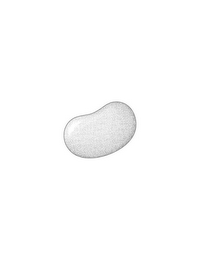
Jelly Belly_Template.inddLast week Jelly Belly Candy Company filed a non-traditional trademark application with the USPTO to federally register the shape of its Jelly Belly candies. The claimed mark is drawn like this:

JellyBellyDrawingAnd, described like this: “The mark consists of a candy having a rounded squat kidney-like shape, with one longer side being a continuous arc and the opposite side have a slight depression or dimple in its arc, the center diameter and height of the candy being approximately half its length.”

The application claims use since July 15, 1976, and asserts acquired distinctiveness based on “substantially exclusive and continuous use of the mark in commerce that the U.S. Congress may lawfully regulate for at least the five years immediately before the date of this statement.”

As robust as the Jelly Belly trademark portfolio is shown to be on the USPTO database, the application referenced above surprisingly doesn’t claim prior existing registrations owned by Jelly Belly that appear to reinforce the distinctiveness of the shape. Can you say, look for?

The most obvious ones involve the Jelly Belly logo registrations depicting the candy shape in two dimensions. But, what I was really surprised to find is that Jelly Belly has already run around the non-traditional trademark track a few times with other configuration trademark registrations that reinforce the shape of the Jelly Belly candy on packaging and several other non-candy food products (burger and sandwich buns; meat patties; and pizza):

JellyBellyCafe

To the extent the USPTO wants more evidence of acquired distinctiveness than a mere five year substantially exclusive use claim, those little gems ought to help.

Any predictions on how sweet the Jelly Belly configuration trademark application will turn out to be for candy? Stay tuned, the application should be examined in about 3-4 months.

sidebysideoxytmobile

Techdirt is crying foul (again) and this time, wrapping the “trademark bully” mantle around the magenta-colored neck of the T-Mobile brand for enforcing its color trademark against OXY.

While I certainly don’t have the details of the dispute (and it appears Techdirt doesn’t either), and OXY hasn’t produced the actual demand correspondence, given the distinctiveness of T-Mobile’s identity and branding, it’s not surprising it’s viewed as an asset worthy of protection.

T-MobileMapWhat is surprising (to me) is that I was unable to find any single color trademark registrations for “magenta” on the USPTO’s Principal Register owned by Deutsche Telekom, the parent company of the T-Mobile brand — only a pair of Supplemental Registrations (here and here).

With more than a dozen years of prominent use of its “magenta” branding, you’d think it is long past due for an upgrade to the Principal Register. It also seems to me that having a Principal Registration for a claimed mark should go a long way to quieting trademark bullying skeptics.

Then again, maybe not. Some view the ownership of a single color as a trademark as ridiculous, dumb, and silly. So, having the USPTO validate such a claim with registration would probably not quiet the concerns of those folks.

Admittedly, sometimes the single color registration issued by the USPTO needs trimming, but single color trademarks have been legally validated for more than three decades now (ask Owens Corning what pink means to their consumers). Color trademarks aren’t going away any time soon, so long as they perform the three critical purposes of a trademark: (1) Identifying the goods or services at issue; (2) distinguishing the goods or services from those of others; and (3) indicating the source of the goods or services.

As I’ve said before and written before here, while so-called trademark bullying does exist, it is frequently a misunderstood and misapplied pejorative label, based on a heavy dose of skepticism and belief of what the law should be, not what the law actually protects.

According to Techdirt:

“What moves the needle on most of these stories from ‘trademark-gone-too-far’ to ‘trademark bullying’ is that these actions tend to be brought against other groups that aren’t even operating within the same industry as the offended. That’s key in trademark disputes where, in most cases, the two parties must be competing with one another for infringement to occur.”

As loyal DuetsBlog readers appreciate, for trademark infringement, i.e., likelihood of confusion to exist, it is black-letter-law that no competition between the parties is required, only likelihood of confusion (based on a balancing of multiple factors) — and not only likely confusion as to source, but also as to sponsorship, approval, affiliation, or some other sort of connection.

So, the lack of direct competition is not determinative of a likelihood of confusion analysis. And, Techdirt and OXY’s focus on the lack of direct competition actually misses the point and oversimplifies the analysis: “We are making a smartwatch – nothing that would eventually compete with Telekom’s products and services.”

OXY’s own marketing materials admit the complementary nature of their smart watch to a smart phone: “OXY is an Android running Smartwatch that is fully customizable and works with virtually any phone.” T-Mobile sells lots of smart phones, and I’d expect that selling smart watches is well within their natural zone of expansion. If so, it’s hard to blame T-Mobile for its concern.

My hope for 2016 is that we’ll see fewer trademark color calamity cliches; the so-called “trademark bullying” mantle will be much more carefully draped; and uninformed skepticism about the validity of trademark rights in single colors will subside.

Instead, hopefully we’ll see much more well-informed focus on the virtually unlimited subject matter of trademarks that identify, distinguish and indicate source, and we’ll look forward to seeing an intelligent application of the likelihood of confusion factors and standard.

How about you, what do you hope for in 2016?