-Wes Anderson, Attorney

A common refrain: “There must be a way to protect this idea, either by trademark or copyright.” Regrettably, in many instances, the answer is “none of the above.” Take, for example, the humble chicken sandwich.

Late last week, a three-judge panel at the Court of Appeals for the First Circuit upheld a granted motion to dismiss with a holding worthy of a double take: “the district court properly determined that a chicken sandwich is not eligible for copyright protection.”
CK7xJWqWwAAk3kN

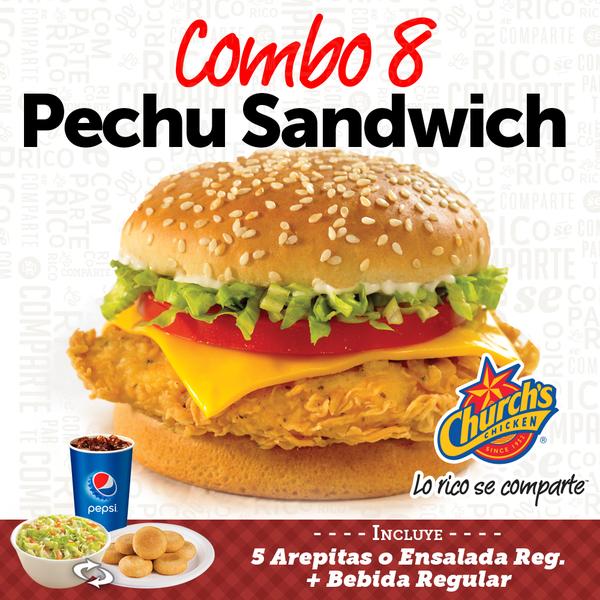
The plaintiff, Norberto Colón Lorenzana, was a former employee of South American Restaurant Corporation (“SARCO”), a franchisee of Church’s Chicken in Puerto Rico. During his employment as a manager, Lorenzana came up with “the concept for a new chicken sandwich that could be included on Church’s menu.” As alleged in Lorenzana’s complaint, the concept was a hit, and SARCO/Church’s began offering the new sandwich – dubbed the “Pechu Sandwich.” SARCO eventually obtained a federal trademark registration for the mark PECHUSANDWICH in 2006, though SARCO did not file a five-year declaration under Section 8, and so the registration was cancelled in 2013.

Lorenzana’s relationship with SARCO and Church’s soured from there, and Lorenzana brought suit in the District of Puerto Rico, alleging that SARCO “received economic benefits from plaintiff’s creation” without compensating him, and that SARCO “intentionally, willfully, fraudulently, and maliciously procured the registration of Plaintiff’s creation in the Patent and Trademark Office without his consent and proper compensation” — essentially a claim for fraud on the PTO. Lorenzana sought “no less than $10,000,000.00 as damages.” (You can read the full complaint here)

SARCO quickly moved to dismiss Lorenzana’s complaint, asserting that it did not state sufficient facts to allege fraud on the PTO. Ruling on the motion, the District Court for the District of Puerto Rico agreed and dismissed the claim. The court then generously read in a claim for copyright infringement (the complaint made no specific reference to copyright protection or the Copyright Act), but summarily dismissed that claim as well, holding “Neither plaintiff’s idea for the chicken sandwich recipe or the name ‘Pechu Sandwich’ is subject to copyright protection.”

Lorenzana appealed to the First Circuit, which unsurprisingly affirmed the District Court. As a quick refresher, according to Section 102 of the Copyright Act, there are eight categories of creative works eligible for copyright protection:

(1) literary works; (2) musical works, including any accompanying words; (3) dramatic works, including any accompanying music; (4) pantomimes and choreographic works; (5) pictorial, graphic, and sculptural works; (6) motion pictures and other audiovisual works; (7) sound recordings; and (8) architectural works.

Those categories make no room for recipes, which are functional directions to achieve a result rather than a creative work. Therefore, the First Circuit concluded that “[a] recipe — or any instructions — listing the combination of chicken, lettuce, tomato, cheese, and mayonnaise on a bun to create a sandwich is quite plainly not a copyrightable work.”

From there, the First Circuit turned “to the meat of [the] allegations” (pun presumably intended) and held that Lorenzana failed to sufficiently allege “that any false statement exists” that would constitute fraud on the PTO. So while the name PECHUSANDWICH is certainly eligible for trademark protection as evidenced by the registration, Lorenzana did not sufficiently allege factual grounds for fraud. Lorenzana did not claim ownership of or priority to the PECHUSANDWICH mark, presumably because SARCO, not Lorenzana, was the party to actually use the mark in commerce.

While Lorenzana is left uncompensated for his sandwich, we at least have the comfort of knowing that chicken sandwiches remain above the copyright infringement fray.

Lauren Millward, Solicitor, Browne Jacobson LLP

In recent times trade mark law in the UK has developed to comply with the fundamental principles of the EU including the free movement of goods and services within the EU. The decision of the Court of Appeal in the UK in Speciality European Pharma Ltd v Doncaster Pharmaceuticals Group Ltd is important in this respect and relates to parallel importing of pharmaceutical products within the EU.

Speciality European Pharma (SEP) sold a drug (tropsium chloride) in the UK, under an exclusive licence. The drug was sold under the trade mark REGURIN in the UK, CERIS in France and URIVESC in Germany.

Doncaster, a parallel importer of pharmaceutical drugs had, for many years, imported CERIS from France but over-stickered the box with the name of the drugs’ active ingredient, tropsium chloride.

Shortly after expiry of the patent in the drug, generics manufacturers entered the market in the UK. Doncaster, as a parallel importer, could not compete on price with those generics manufacturers and instead began importing the drugs CERIS from France and URIVESC from Germany into the UK and re-branding those drugs with the UK trade mark REGURIN.

SEP argued that Doncaster’s rebranding in these circumstances infringed SEP’s trade mark in the REGURIN mark.

The Trade Mark Directive deals with exhaustion of the rights of the trade mark owner at Article 7, however it doesn’t precisely apply in this case as it relates to the use of a trade mark where goods have been put on the market in the EU under that mark. The drug in these circumstances had been put on the market under the CERIS and URIVESC marks respectively but the claim related to use of the REGERIN mark.

The court therefore looked outside of the provisions of the Trade Mark Directive at the Treaty on the Functioning of the EU. In particular, Article 34 prohibits between Member States quantitative restrictions on imports and all measures having equivalent effect. There is an exception to this in Article 36 where prohibitions or restrictions on imports are justified on grounds of the protection of industrial and commercial property (such as trade marks). Such prohibitions or restrictions must not however constitute a means of arbitrary discrimination or a disguised restriction on trade.

The judge considered that the enforcement of a National trade mark having territorial effect in one Member State could be a measure having the effect of a prohibition on imports, however, enforcement of that trade mark would not be prevented by Article 34 where that enforcement is justified for the protection of that trade mark. The principle of free movement of goods must therefore be balanced against the protection of the relevant trade mark.

By having in place different trade marks for the same product in different Member States the court held that there was an unjustified “artificial partitioning of the market” by the trade mark owner constituting a disguised restriction on trade.

Although Article 7 didn’t apply in these circumstances, the court considered that the case law under that Article concerning re-packaging of products was relevant. The cases of Bristol-Myers Squibb v Paranova and Boehringer II in particular held that where a parallel importer re-packages goods, the following conditions must be satisfied to prevent infringement:

  1. The repacking must be objectively necessary to avoid market partitioning;
  2. The condition of the product must not be effected;
  3. The manufacturer and the importer must be clearly identified;
  4. The reputation of the mark and its owner must not be damaged; and
  5. The importer must give notice to the trade mark owner.

The court considered in particular whether the re-branding of the product from CERIS and URIVESC was objectively necessary to avoid market partitioning. Overturning the first instance decision, it was held that it was objectively necessary. Doncaster was effectively excluded from a proportion of the market where the brand REGERIN was prescribed, rather than the generic version. Although that was a small proportion of the overall market (the majority of the prescriptions were made under the generic name), that proportion was a substantial part and therefore the enforcement of the trade mark REGERIN by SEP was unlawful partitioning of the market.

This decision makes it difficult for trade mark owners to benefit from the strong brand built up under a trade mark during patent-protection. It was held that it was unreasonable to expect Doncaster to create its own brand and to compete with the trade mark owner, particularly considering the high costs of marketing and Doncaster’s lack of control as a parallel importer over its own supply chain (meaning that it is unlikely that doctors would rely on Doncaster’s brand). Re-branding to the REGURIN brand was therefore necessary in these circumstances to allow for effective access to the market.

Although each case will turn on its facts considering, this decision is in favour of parallel importers in the EU and suggests that, in the majority cases, the principles of free movement of goods will prevail over the rights of a trade mark owner.


It costs dollars to create a brand. It costs dollars to protect a brand. And, it probably costs more dollars to protect an inherently weak brand and mark over a strong one. So, choose wisely.

The resulting point of weak and narrow trademark rights was driven home on our drive home from a Canadian fishing trip last month, as we passed through International Falls, Minnesota:

DollarIntlFallsA pair of dollar stores, also known as “extreme value” retailers, can be seen competing side by side, with fairly boring names, sorry Dollar General and Family Dollar. Apparently, Dollar Tree is just across town. But, no Dollar Depot or Super Dollar there, at least yet.

It left me wondering, is there insufficient margin in this segment to warrant even a modicum of creativity, or might there be some hope out there for marketers to see dollar signs in their eyes?

When the generic name for the services being offered (dollar store) has the word DOLLAR in it, do marketing types really need or want to have DOLLAR constitute half the retailer’s brand name? Perhaps minimal creativity communicates low prices, part of the brand promise?

Well, if you’re guilty of being a slave to the almighty dollar, maybe DOLLAR DAZE won’t leave you a day late or dollar short, thanks to the alliteration and double meaning, assuming you can tolerate sound-alike Dollar Days. Better yet, and dollar for dollar, my money is on DOLLARAMA?

Yet, not to be undersold on prices or creativity, Jack’s 99 Cent Store — More Than Just a Dollar Store, appears to have a personality that is anything but boring in the heart of New York City.

It is interesting to note that neither of the original trademark registrations for the oldies (DOLLAR GENERAL and FAMILY DOLLAR) contain disclaimers of the word DOLLAR, so dollars to doughnuts, over the last forty plus years, the dollar store segment was recognized as a generic category.

You can bet your bottom dollar that Dollar Tree did not disclaim “dollar” in 1993, but it did as early as 1998, as did Dollar Fare, Dollar Side, and Mighty Dollar in 2005, and Dollar Smart and Super Dollar — both in 2009, Cheaper By The Dollar a year later, Dollar Max in 2011, and Country Dollar in 2012, but most recently, Dollar House had to disclaim the word “dollar” from its USPTO intent-to-use application, leaving me to wonder what’s left in the house? Same with Dollar Station, begging the similar question of what is left when the Dollar has left the Station?

You’re wondering what the $64 Question is, right? How about, does this crowded field of DOLLAR brand names for dollar stores confirm yet another meaning to the phrase weak dollar?

Or, to ask the question slightly differently, would you pay top dollar for any of these DOLLAR brand names, or would you start from scratch with something fresh? Hello, Ollie’s Bargain Outlet.

— Jessica Gutierrez Alm, Attorney

Everyone has a brand.  Through every interaction and impression we leave in the minds of others, each of us builds on our own personal brand.  In the Internet age, and particularly with the advent of social media, our personal brands are more definable than ever.  Googling anyone but the most stalwart off-the-grid enthusiast will usually provide at least a small window into the individual’s life.  For this very reason, countless articles have been written about how to protect or modify one’s personal brand online.  However, we can’t always control what others write about us, and online content has an unfortunate tendency to linger.

The “Right to be Forgotten” refers to a right that emerged in Europe after a European Court of Justice ruling.  The court held that individuals have a right to have certain information about them removed from Google’s (or another search engine’s) search results.  In Europe, a private person can fill out a form to request information that “appear[s] to be inadequate, irrelevant or no longer relevant or excessive . . . in the light of the time . . . elapsed” be removed from search results.  As it currently exists in the European Union, the Right to be Forgotten does not provide for removal of the original content.  It merely creates a pathway for removing the content from online search results, rendering it virtually inaccessible.  To date, Google has received close to one million requests.

Recently, a ruling from a French court required Google to remove search results not only from its European search sites, such as google.fr, but from all of its sites worldwide, including the American site, google.com.  The particular case related to a European citizen’s request to remove online content related to an old criminal conviction.  Citing censorship concerns, Google stated that it would not comply with the ruling.  (Interestingly, in a meta-gaming twist, Google has now also been ordered to remove links to news articles discussing Google’s refusal to remove the original links from its worldwide sites.)

Censorship and privacy aside for the moment, the Right to be Forgotten has major implications for personal branding.  The core concept allows an individual to choose which events, posts, and opinions from the past will follow her.  Consider the Oklahoma University students who were expelled after a video of their racist chant was posted online.  As those students grow into adulthood and perhaps begin families and careers, articles about their misguided act will still be floating around the Web.  No matter how they may grow and change, their personal brands will be tarnished for life if those articles continue to surface in a Google search.  Providing those students the right to someday, as adults when the story is no longer “relevant,” remove such articles from search results, would give back a substantial power of personal branding.

Individuals born today will have their entire lives documented online—their newborn photos, their embarrassing toddler moments, their unbridled teenage angst—and without the Right to be Forgotten or something similar, that documentation will forever affect the individuals’ personal brands.

The Right to be Forgotten does not currently exist in the United States, but as we can see, European courts or other entities may seek to expand its reach to the U.S.  While we watch Google struggle with the law abroad and debate potential privacy versus censorship concerns here in the States, perhaps we should also consider the right to control one’s personal brand.

As I was looking at a photo of the fish my nephew caught this weekend, I wondered if my brother and my sister-in-law would be inviting me to a fish fry.

nephewIndeed, a fish fry was on my mind after having just read the Federal Circuit’s recent decision. In that case, Louisiana Fish Fry Products, Ltd. (“the Company”) sought to overturn the Trademark Trial and Appeal Board’s (“Board”) refusal to register the mark:

“LOUISIANA FISH FRY PRODUCTS BRING THE TASTE OF LOUISIANA HOME”

The Company sought to use the mark with various sauces, marinade and Cayenne pepper. I am getting hungry just reading this as these are all good fish toppings.

In appealing, the Company argued that “FISH FRY” and “PRODUCTS” were not generic and had acquired distinctiveness. As an aside, a generic trademark is synonymous for a class of product that is commonly used. For example, aspirin, thermos, yo-yo and escalator, have been declared generic by United States courts.

The Federal Circuit disagreed with the Company. Instead, the Federal Circuit found that a disclaimer was needed for “FISH FRY PRODUCTS” and it had not acquired distinctiveness.

The Federal Circuit found that there was substantial evidence supporting the Board’s determination that the company had failed to show that “FISH FRY PRODUCTS” had acquired distinctiveness. To establish distinctiveness, the Company would have had to show that “in the minds of the public, the primary significance of a product feature or term is to identify the source of the product, rather than the product itself.” The Federal Circuit found that it had not done so. Because of the failure to provide substantial evidence of distinctiveness, the Federal Circuit did not reach the issue of genericness.

You may ask what would have been needed to establish acquired distinctiveness. In the Fish Fry majority opinion, the Federal Circuit relied on a prior decision involving the accessible luxury product manufacturer Coach Services Inc. (“the Coach Store”). (Yes, I must admit I still own a now-battered small black Coach purse that I bought many years ago). In that decision, the applicant Triumph used the COACH Mark with its books and software that helped people prepare for standardized tests. The Coach Store argued that there was no evidence that Triumph’s descriptive COACH marks had acquired distinctiveness. The Board had found that the COACH Mark was merely descriptive of Triumph’s educational materials because it immediately conveyed to purchasers the purpose of the materials. In other words, they coached people on how to succeed on the standardized tests. However, the mark could be registered because it had acquired distinctiveness based on: (1) Triumph being the largest publisher of these types of materials; (2) impressive advertising expenditures and revenues over a number of years; and (3) Triumph’s promotion of the COACH Mark with its books since at least 1989.

Although agreeing on the outcome of the case, Judge Pauline Newman disagreed on the basis for the decision. In her well-reasoned concurrence, Judge Newman explained that “[g]eneric terms and common descriptive names cannot acquire trademark status, and evidence purporting to show acquired distinctiveness of secondary meaning is irrelevant.” She further explained that “[w]hen a term is the common descriptive or generic name of the goods, evidence of secondary meaning cannot change the result.” Generic terms by default are not capable of indicating a unique source. Because “Fish Fry Products” is a generic and common descriptive name for these products, Judge Newman concluded that registration of the application was properly denied by the Board.

Whose analysis (the majority or Judge Newman) do you find more persuasive? Is anyone else hoping to be invited to a fish fry this weekend?

Aaron Keller, Managing Principal, Capsule

Capsule, specifically Aaron and two co-authors, have been deep in the murky waters of writing a book on the physics of brand. Yes, physics, likely the only subject matter more complex than a conversation with your trademark attorney. Yet, we’ve been giving it a consumable tone and taking our readers deep into the history of brands. At this point it isn’t reading like a harlequin novel, but it is much easier than your high school physics textbook.

One of the insights from our discussions of putting brands through the meat grinder of physics is this: brands are vessels of trust traveling through space and time. I am not going to go deep into the space and time portions, you’ll have to read the book for those meatier bits of content.

So, back to these vessels. If you go way, way back to a period when there was no need for brands, it likely looked like this. “Hi, I’d like to trade you my sheep for your goat. We know each other because you’re in the next village and I trust you have a healthy goat to trade.” Brands were invented to be the vessel of trust as an extension of ourselves when we’re not there to say, “I trust you know how to raise a healthy goat.”

So, when managing a brand, consider the importance of that trusted relationship between your brand and the people who believe in you. If you break the trust, you break the relationship. If you break the relationship, you’ve broken the brand. And, you know what they say, “you break it, you own it.”

More on goats, vessels and physics in our upcoming book, “The Physics of Brand.” Co-authored by Renee Marino, Dan Wallace and myself.

goats

LingLouieMenuPreparing to send off to college my two oldest sons, led us to Ling & Louie’s Asian Bar & Grill’s rooftop patio on Minneapolis’ Nicollet Mall last week, and we found an interesting menu item.

Under the Sandwiches category: “Smashed Burger,” is treated generically as a type of sandwich burger, along with “Kobe Beef” and “Spicy Chicken” sliders, and “Red Snapper” and “Chicken” sandwiches. So, does SmashBurger have a case, where burgers are still “smashed fresh“?

Under normal circumstances, I’d say yes, but SmashBurger is that brand owner who refuses to heed marketing pitfall warnings, inviting others to treat “Smashed Burgers” as a type of burger, not as an indication of who is making and/or selling the smashed burger.

A while back we asked, can anyone smash a burger? Ling & Louie’s appears to believe so, and given SmashBurger’s misuse, it’s hard to argue otherwise. Perhaps SmashBurger plans to take solace in inventing the generic category name?

My preference would be to protect and respect the brand as a trademark, and encourage the marketing types to come up with a generic category name for public use, for that inevitable day when the brand owner has started something special and others want to join in and compete.

If you represented Ling & Louie’s, as a marketing type, how comfortable would you be to call a sandwich menu item, a “Smashed Burger”?

Trademark types, if you represented Ling & Louie’s, and you were asked to respond to a cease and desist letter, would you tell SmashBurger to pound sand?

-Wes Anderson, Attorney

Here’s another fascinating pending application for the file of non-traditional product configuration marks — this time, an application from Sony for the configuration of an all-in-one lens/camera:Sony Lens

The drawing may look like an ordinary camera lens – cylindrical, familiar, and generally seen affixed to a fancy DSLR. But the application identifies “Digital cameras” in Class 9, not camera lenses. And the mark description reads: “The mark consists of the three dimensional configuration of a digital camera.” That’s no mistake — by my estimation, this drawing doesn’t depict an everyday lens, but Sony’s QX100 camera, a so-called “lens-style” camera that integrates a Carl Zeiss lens and digital sensor into one compact package. It has no LCD screen, viewfinder, our readout of its own — the camera is operated exclusively via a smartphone. It’s certainly a novel step in the evolution of digital photography, where smartphones have skyrocketed in popularity and have all but replaced the entry-level point-and-shoot cameras of the 2000s.

qx100_lifestyle-001

As so many other companies do with new products in the technology sector, Sony has sought to protect the uniqueness of its product through intellectual property. But trademark protection can be especially tricky for product configurations — and here, Sony has sought to protect the entirety of its product by filing its application with the above drawing. The lack of any dotted lines indicates a claim for trademark protection for the entire product – the lens opening, the shutter release, the on/off switch, the zoom slider, and the focus ring are all claimed as part of the mark, at least according to the drawing.

The PTO subsequently issued an office action for the mark (and later another office action continuing many of the cited issues). Aside from informalities regarding the identified goods, it has all the bells and whistles you could ask for in a product configuration refusal, and sheds some additional light on pitfalls to avoid in filing configuration trademark applications:

  • Drawing. The PTO quickly cited the dearth of dotted lines in the above drawing and requested that Sony provide an amended drawing that “features functional matter dotted out, such as the lens opening, the shutter, the buttons, the charge port.” This in and of itself seems extremely problematic for purposes of this application – nearly every groove, circle, and crevice on the lens has a function. Once it’s all dotted out, that leaves…a cylinder?
  • Nondistinctive Product Design.  As with every product design trademark, it is required to show some modicum of acquired distinctiveness to obtain registration on the Principal Register. According to the examiner, “consumers are aware that such designs are intended to render the goods more useful or appealing rather than identify their source.” Sony attempted to submit evidence in a response to support acquired distinctiveness under Section 2(f), consisting of advertising materials, sales figures, and a declaration. The PTO quickly deemed this evidence insufficient, stating that “applicant’s evidence shows nothing more than that the mark is the shape of the camera, which may have become a generic shape for cameras.” The examiner also sleuthed out a competing “lens-style” camera sold by Kodak to support its refusal.
  • Functionality / Request for Information. Finally, and perhaps most damningly, the examining attorney issued an advisory suggesting that the mark — or what’s left of it once an amended drawing is provided — may consist of unregistrable, functional matter (which we cover in spades on this blog). It’s only an advisory for now, because the office actions also contain a request for information. These requests are hardly benign – they mirror the Morton-Norwich factors for determining functionality. It’s akin to the police asking “Do you know how fast you were going?”

(1)       A written statement as to whether the applied-for mark, or any feature(s) thereof, is or has been the subject of a design or utility patent or patent application, including expired patents and abandoned patent applications. Applicant must also provide copies of the patent and/or patent application documentation.

(2)       Advertising, promotional, and/or explanatory materials concerning the applied-for configuration mark, particularly materials specifically related to the design feature(s) embodied in the applied-for mark.

(3)       A written explanation and any evidence as to whether there are alternative designs available for the feature(s) embodied in the applied-for mark, and whether such alternative designs are equally efficient and/or competitive. Applicant must also provide a written explanation and any documentation concerning similar designs used by competitors.

(4)       A written statement as to whether the product design or packaging design at issue results from a comparatively simple or inexpensive method of manufacture in relation to alternative designs for the product/container. Applicant must also provide information regarding the method and/or cost of manufacture relating to applicant’s goods.

(5)       Any other evidence that applicant considers relevant to the registrability of the applied-for configuration mark.

(6)       A written explanation of what, specifically, applicant has applied to trademark.

Sony’s first office action response addressed only the Section 2(f) issue and amended the identification of goods. And, perhaps charitably, the examining attorney continued the other refusals as non-final, rather than heading straight for a final office action. I’d keep an eye on this one for potentially some novel arguments in Sony’s favor, but it appears to be a tough road ahead.

So what do you think? Does Sony have a pathway to registration, or has the public already been overexposed to generic, functional cylinder-style cameras?

[Apologies for that last pun.]

HefeWheaties Tableau

Yesterday General Mills announced that it had partnered with Fulton Brewery to create HefeWheaties: a limited edition brew. The beer is a Hefeweizen, which is traditionally a wheat-based beer, making it a perfect canvas for the Wheaties brand.

Normally when these situations arise, it is because one party is complaining (For example, Lucasfilms’ objection to STRIKES BOCK beer). Not this time. Instead, we have two companies that appear to be on the verge of launching a very successful co-branding venture (just check out the press already, here, herehere ).

Aside from the fact that I’m excited to try this beer, the news provides a number of insights into how to co-brand a product. The craft beer industry in particular lends itself to these experiments: craft breweries regularly create limited run products (aka seasonal beers). They also have a loyal fan base that is active on social media (free advertising!). Also, beer can tie in just about any product either through imitation of flavor, or finding a clever name and pairing it with eye-catching packaging. Yet the lessons that can be gleaned from the HefeWheaties announcement aren’t limited to breweries. Instead, the announcement provides insight for any business considering co-branding.

First, there should be a basis for the partnership. Fulton’s founder and a number of its employees are former General Mills employees. The companies have been connected long before this idea arose. As a result, there was a level of trust and collaboration that is difficult to create without a prior relationship. This doesn’t mean that you can only co-brand with current contacts; it just helps. If you don’t have an established relationship, build one! Collaborate on the co-branding idea rather than simply creating it yourself and then handing it off.

Second (or if you’ve failed lesson one above), the product should feel authentic. With HefeWheaties, consumers want to like the product: both companies are based out of Minneapolis; the wheat connection makes sense; and the past history between the employees and management all contribute to a feeling that the product is an idea, not a scheme. Plus, even though I never ate Wheaties as a kid, I feel some nostalgia for it (kudos to you, General Mills marketing team).

Third, make sure you consider the effect of the co-branding on your original market. We haven’t seen this play out yet with HefeWheaties, but there are appreciable (or at least vocal) numbers of people who don’t like seeing brands they purchase associated with alcohol. For example, Ben & Jerry’s announced earlier this year that it would be partnering with New Belgium Brewing to release a Salted Carmel Brownie Brown Ale. I can’t wait to try it when its released this fall. But Bruce Livingston, CEO of Alcohol Justice had a different view, calling it

[a] crass, corporate greedy move to put a brand name like Ben & Jerry’s on a beer. It’s bad for children — who will start looking at beer as the next step after ice cream.

For our purposes, the merits of the characterization of “ice cream” as a gateway drug are unimportant. A company that co-brands should be aware that its brand and company will be associated with the partnering company, its products, and its industry. Give some consideration as to whether there is any potential for the co-branding to impact your public image and, if so, think about how you’ll respond.

Fourth, and finally, get the legal side taken care of in advance. You’ll likely need a trademark license. Decide whether royalties should be involved and, if so, when and how much. Carefully define the time frame for the license and renewal (or termination) options for both parties. These types of arrangements don’t need to be complicated. However, they became much more complicated after you begin selling product.

Yes, I know, Lesson Number One is work with someone you trust and like. However, business can affect that relationship. The parties’ memories may be a bit fuzzy months or years after you agree to start working together. It is much easier to avoid a dispute if the terms are in writing.

Co-branding doesn’t work for everyone, but it seems like it may work for HefeWheaties. The beer is set to be released on August 26, so perhaps we won’t have to wait long to gauge its success. But what’s really on my mind now is which cereal is next? I think a Peanut Butter Crunch stout could be good. Or maybe a Frosted Flakes porter. If anyone out there can make either of those happen, get a hold of me and let’s figure this thing out.