We’ve been stalking Kevin O’Leary’s nutty Mr. Wonderful trademark application, for a while now.

In April, we thought the USPTO would refuse registration of Mr. Wonderful for nuts, based on this:

In June, we were shocked to see the USPTO missed issuing the obvious refusal, and in August, we noted and reported that The Wonderful Company LLC had filed an Extension of Time to Oppose.

Just last month, O’Leary’s trademark counsel filed a Request for Express Abandonment of the Mr. Wonderful trademark application, and the USPTO promptly issued a Notice of Abandonment.

One of O’Leary’s most famous lines from Shark Tank seems to fit this very moment, as we mourn the loss of O’Leary’s Mr. Wonderful trademark application for roasted nuts, with a popular meme:

– Mark Prus, Principal, NameFlash

Last year I wrote a “Change Your Name Already” blog post about Overstock.com on DuetsBlog which described the painful way that Overstock.com was trying to communicate that their name did not fit what they were doing as a business…”we are so much more!” My response was to politely suggest that they call me to help them find a new name that did fit their business model.

Recently MailChimp launched an ad campaign that approached the “our name does not fit our business model” issue from a different angle. In this effort, they celebrate the fact that they have outgrown their name and tell prospective customers that they would like to help them do the same thing.

Brilliant…simply brilliant. Both Overstock.com and MailChimp have outgrown their names, but Overstock.com communicates it in a way that makes the potential customer feel stupid (“you thought we only sold overstock items but you are stupid…we actually do more!”). MailChimp admits they do more than what their name implies and desire to have the same impact on the prospective customer’s business, thereby leaving prospective customers feeling hopeful. Big difference.

So the CEO of Overstock.com should still call me to initiate a name development project…but the CEO of MailChimp can just take a bow!

We’ve been down this road before, some themes intersect, and trademark value is filtered out:

The intersecting themes on tap for the day are: Zero, Branding, Trademarks, and Loss of Rights.

ZEROWATER is a perfectly suggestive, inherently distinctive, and federally-registered trademark with “incontestable” status as a source-identifier for “water filtering units for household use.”

Judging from the specimens in the file history at the USPTO, the brand owner appears to have done a nice job leaving consumers to imagine the connection between the mark and the goods.

Branding ZEROWATER with taglines like “For water that’s only water,” “Get more out of your water,”  “If it isn’t zero, zero, zero, it isn’t just water” “If it’s not 000, it’s not ZeroWater,” and “If it’s not all zeros, it’s not ZeroWater,” all help to block Zero from pure and mere descriptiveness:

On the other hand, as the top image of the retail endcap shows (click the image to enlarge), the current packaging and product description adds blunt force to the now obvious meaning of ZERO:

“LEAVES ZERO DISSOLVED SOLIDS BEHIND”

Had this purely descriptive use of ZERO been present at filing, then ZEROWATER easily could have been refused as merely descriptive — why add it now? Especially with this far better existing copy:

“REMOVES VIRTUALLY ALL DISSOLVED SOLIDS”

While ZEROWATER can no longer be challenged as merely descriptive for “water filtering units for household use,” what about future applications having slightly different descriptions of goods?

Given all that Coca-Cola has done to turn ZERO generic in the soft drink category (meaning ZERO Sugars and/or Calories), shouldn’t ZEROWATER remove virtually all opportunities for genericness?

When a brand owner migrates toward descriptiveness with its copy, leaving the consumer with zero need to exercise any imagination as to meaning, there just might be “nothing” left to protect.

Happy Halloween from DuetsBlog! I write today regarding a scary subject: unregistered intellectual property. The horror! Ask any IP professional about registration, and you’re likely to hear that registration is one of the most important steps in protecting IP. Whether it is a patent, trademark, or copyright, registering IP often provides the IP owner greater rights than if the IP was unregistered. There is sometimes an exception for trade secrets, but that’s for another time…

A scary place for some; credit: Gen. Progress

Registering IP, specifically copyrights, may become even more crucial in the future. One of the most important upcoming U.S. Supreme Court cases this term–which begins in October (coincidental?)–is Fourth Estate Public Benefit Corp. v. Wall-Street.com, LLC. The appeal addresses the question of whether the creator of an unregistered work may sue for copyright infringement so long as the creator has applied for a copyright on the work, rather than requiring the creator to wait for the Copyright Office to register the work. The dispute comes down to 17 U.S.C. § 411(a), which provides that:

no civil action for infringement of the copyright in any United States work shall be instituted until preregistration or registration of the copyright claim has been made in accordance with this title.

Currently, the Fifth and Ninth Circuit Courts of Appeal have held that creators may sue for infringement as soon as they file the appropriate paperwork and fees for registration. Importantly, the Ninth Circuit encompasses Hollywood, providing greater protection to many of the nation’s creators. I ran into this issue myself on a case in these venues, and thankfully the law in these jurisdictions supported bringing a claim for copyright infringement without awaiting registration.

The Tenth and Eleventh Circuits have held that filing for registration is insufficient; a creator must have obtained preregistration or actual registration to sue for infringement. It’s the stuff of nightmares for procrastinating creators in Wyoming, Utah, Colorado, Kansas, New Mexico, Oklahoma, Alabama, Georgia, and Florida!

But creators around the country, especially in Hollywood, let out a collective shriek when the federal Government filed a brief in support of the Tenth and Eleventh Circuits, arguing that “a copyright-infringement suit may not be filed until the Register of Copyrights has either approved or refused registration of the work.” Beyond the statutory arguments in support of this position, the Government argued that  “although…the registration requirement may temporarily prevent copyright owners from enforcing their rights, that is the intended result of a congressional design to encourage prompt registration for the public benefit.”

Maybe the Government is right; requiring registration will certainly encourage registration. But on the other hand, many small creators either do not have the time or resources to seek registration for every work. However, even in cases in which there is copying, a creator can file an expedited application for registration, which sometimes results in a decision in less than a week.  So perhaps the rule from the Tenth and Eleventh Circuits isn’t that scary after all. A non-expedited application can take months, though. Thus, the rule from the Fifth and Ninth Circuits provides greater protections to creators who may face copying immediately after creating a work and who do not have the ability to file an expedited application. We’ll see what’s in the Supreme Court’s candy bowl this term. To be continued…

There’s been a major update in the trademark infringement lawsuit brought by the Museum of Modern Art (“MoMA”) against the cafe and art gallery, MoMaCha in New York City.

MoMA’s motion for a preliminary injunction was recently granted by Judge Louis Stanton of the Southern District of New York. As we discussed previously, the infringement allegations by MoMA were compelling, and it appears the court agrees that MoMA is likely to succeed on its claims, based primarily on the similarity of the marks and the relatedness of the parties’ goods/services in the same city (both parties display works of art along with offering cafe services). The court was particularly persuaded by the similarity of the vertical use of “MoMaCha,” as seen on the coffee cup above, with MoMA’s similar vertical use on the museum building signage above. (See Order at p. 18.)

The court’s preliminary injunction bars MoMaCha from continuing to use its name, logo, and the momacha.com domain name, at least while the legal proceedings are pending. As of today, the previous website, www.momacha.com is no longer accessible.

Instead, it appears that MoMaCha has already rebranded to a slightly different name, by changing one letter: MaMaCha, with a new website already available here: www.mamacha.nyc

Unfortunately, that probably won’t be sufficient to satisfy MoMA’s trademark infringement concerns. Indeed, the New York Times reported that MoMA has already sent a letter to “MaMaCha” regarding the new name and demanding that they cease use. The demand letter closes by stating:

Changing the ‘O’ in MOMACHA to an ‘A’ merely indicates your clients’ continued contempt for MoMA’s trademark rights. Your clients’ decision to change to a mark of such an infringing nature will be done at their peril.

As discussed in my last post, in the midst of trademark infringement allegations, extra caution is warranted. Just as one should be cautious with business expansion under an alleged infringing mark to mitigate damages, extra care is also warranted in selecting a new or modified mark (whether voluntarily or by court order) to avoid similar or further infringement claims, as there will be extra scrutiny and potentially over-aggressive enforcement by the opponent in the present dispute.

And as a practical matter, if one has to expend the effort and resources to re-brand, it may be more cost-effective to make a more significant, lower-risk change, rather than pushing boundaries with a minor change that may again be challenged, instigating further litigation expense, and requiring another re-brand. In many cases, simply changing one letter may not sufficient. Based on these developments thus far, I’m sure there will be interesting updates to come, so stay tuned.

This is quite a collection of art pieces, inspired by some pretty recognizable candy bar brands:

The fine print reads: “Each handmade . . . sculpture is a real working whistle!” Parodies, anyone?

Here’s a question, does the functionality of these pieces make them any less expressive as art, any more likely to be confused, any more likely to dilute, any less First Amendment worthy?

Florida start-up entity BAD MOMS, LLC beat the producer of the movie with the same name to the punch! Specifically, the company sued the producer for declaratory judgment and an injunction preventing the movie producer from using the mark in connection with any of the Florida company’s goods and services or those related thereto. Both parties have pending applications for BAD MOMS and related trademarks. The lawsuit came after the movie producer sent demand letters to the Florida entity asking it to abandon its applications for BAD MOMS trademarks and cease using the mark. The movie producer brought counterclaims against the start-up company.

The Florida start-up company was founded by a single mom working her way through college and law school. The company organizes and hosts events for single-moms to share experiences, provide education and create a network. In addition, the company sells wines and spirits under the BAD MOMS mark.

Earlier this month, the dispute heated up when the movie producer asked a federal judge to sanction the start-up company for failing to follow a discovery order. The attorney founder of the company denied that the motion is warranted and asked for an extension of time to respond to the motion. The Court granted her request. The hearing on the motion is scheduled for Monday, October 29, 2018.

I have not seen the “BAD MOMS” movie but it was popular enough to spawn a sequel. Many of my friends told me it is a fun movie to watch, even if it is predictable. I heard that the following movie scenes were hysterical:  (1) grocery store scene; (2) limping dog scene and (3) the meeting to discuss the school board.

We will have to wait to see who wins the lawsuit and if the trademark dispute spurs more interest in the movies and/or the Florida company’s events and products.

It’s not every day you’re presented with the unique opportunity of seeing and hearing the Chief Justice of the United States Supreme Court live in your own backyard, thanks very much Caleb!

Tuesday was that day, Chief Justice John G. Roberts, Jr. was here in Minneapolis for the 2018 Stein Lecture at the University of Minnesota’s Northrup Auditorium, as the Star Tribune reported.

SCOTUSBlog had this to say about the Chief Justice’s remarks. To listen to a recording of the event, to a sell out crowd of 2,700, check out MPR’s coverage, here.

Others reporting on this event don’t appear to care about trademarks as much as we do, so this may be the only place you’ll learn about Justice Roberts’ remarks relating to trademarks.

As you can imagine, knowing the vast body of legal subject matter confronted by the Supreme Court, clearly my ears perked up in hearing Justice Roberts utter the word “trademark” five times!

Moderator Robert Stein, former University of Minnesota Law School Dean, asked Chief Justice Roberts whether any highly technical subject matter might be unsuited for the Court to decide.

My mind went to the creation of the CAFC in 1982, specifically designed to hear all federal district court patent appeals, yet the Supreme Court has repeatedly reversed the CAFC since 2005.

Justice Roberts never mentioned the CAFC, instead he waxed a bit about trademark expertise:

“My answer, I think is, no, because usually no matter how complex and involved the legal issue, the case may seem, it implicates a broader legal question about, you know, the statute may be complicated, but the question is going to be, well, how do you go about reading the statute, what sources do you look at in a particular case. We don’t take technical legal cases because we like technical legal cases. They’re usually because they implicate a broader question. When I was practicing law, this is a speech I gave a lot of times, because I was not an expert in any area of the law. I like to think of myself as somebody who was good arguing in a particular court, in the Supreme Court, and so I’d have to, you know, convince someone who comes in with an important trademark case, who could hire the world’s leading expert in trademark law, or me.  And, I would tell them, look, the Supreme Court does not think your case is a big deal for trademark law. It thinks your case is a big deal for how regulations relate to the statute, how particular provisions in the statute should be read. So, you need somebody who, you know, can look at it in that broader perspective that the justices do, and you know, I would say, half of the time, they would say, well, I actually want somebody who knows something about trademark law, and that was understandable, but, then it would be, and, you know, they would get there in front of the Court, and they’re too expert in trademark law, and the justices just aren’t that interested in a lot of those nuances, and sometimes they would just be speaking over each other.”

My ears also perked up with Justice Roberts’ remarks about the Court’s fewer decisions:

“We have particular criteria for the cases we want to take. Obviously, if any court finds an Act of Congress unconstitutional, we will take it, we think as a matter of comity to the branches across the street, we should be the ones to say that, if any court is . . . .”

Do you see where I’m going with that remark, dear readers? I’m thinking about Erik Brunetti.

As you will recall, presently before the Supreme Court, is whether to hear the Brunetti case, and the issue presented in Brunetti is:

“Whether Section 2(a) of the Lanham Act’s prohibition on the federal registration of ‘immoral’ or ‘scandalous’ marks is facially invalid under the free speech clause of the First Amendment.”

Given the clarity of Justice Roberts’ statement, “if any court finds an Act of Congress unconstitutional, we will take it,” I’ll be amending my prediction otherwise, since the CAFC did just that, in Brunetti.

There are plenty of good reasons for the Court to decide the constitutionality of the “scandalous” and “immoral” language, separate and apart from the disparagement language found to violate the First Amendment in Tam (here, here, here, here, here, and here).

If the Court does hear Brunetti, let’s hope Section 7 of the Lanham Act — the provision expressly noting that federal registrations are issued “in the name of the United States of America” — won’t be some uninteresting and ignored “nuance” of trademark law to the justices.

Welcome to another edition of trademark stories that are inspired by billboard advertisements:

This one was captured for obvious reasons, if you’re familiar with our interest in brandverbing:

Putting aside whether early October is too early to be promoting holiday wine shopping without a hint of a Halloween theme (there’s Stellaween for that), thoughts about the Stellabrate verbing?

Does Stellabrate make you want to throw a party? Hamm it up? Tanqueray? Or, count bottles?

Stella Rosa (Star Rose) has poured itself an overflowing glass of Stella-trademarks (Stellabrate, StellabrationStellaweenStella Peach, Stella Berry, Stella RedStella Pink, Stella Gold, Stella PlatinumStella BiancoStella Babies, Stella Moscato, Stella Rosso, Stella Rose, It’s Stella Time, and Stella Gets Around), but it does not own the six-letter, one-word, star of the trademark show:

If the actual Stella trademark was in Stella Rosa’s constellation of trademark rights, it likely wouldn’t need to be coexisting or peacefully orbiting with the likes of these other wine “star” marks: StellaGrey, Stella Bella, Stella MaePoggio Stella, AquaStella, and Buona Stella.

While Stella Rosa can continue to brandverb with Stellabrate, and grow its constellation of Stella-trademarks, without Stella, becoming a really bright trademark star isn’t likely in this wine galaxy.

Much less in a beer garden:

Video games offer a melting pot of intellectual property: trademark law, copyright law, and even patent law all come together in a delicious mix of intangible property. However, not all video game franchises are equal. Few can claim the same level of longevity, success, and nostalgia as Nintendo’s Mario Brothers series.

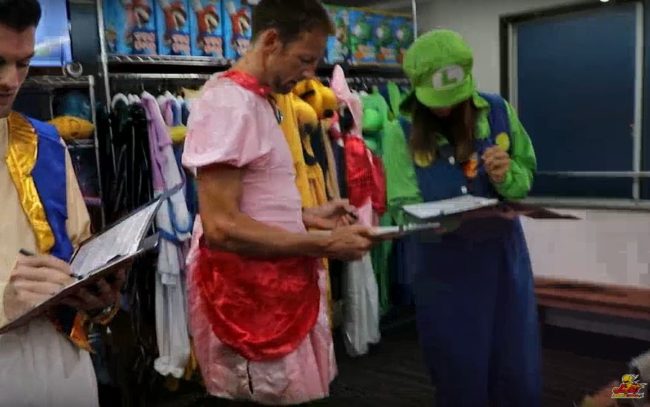
Among the most popular titles of the franchise is Mario Kart, a game in which characters from the franchise race each other in go karts. The characters repeat catch phrases, seek out power ups (invincibility, speed, etc.) and cartoonish weapons (banana peels, turtle shells, etc.), all with the singular goal of being atop the podium at the end of race. Over its 25+ years of existence, the game has resulted in significant sales, widespread nostalgia, and, unsurprisingly, numerous attempts from others trying to make money off of the characters. But a recent lawsuit in Japan brought media exposure to what might have been the greatest attempt yet to profit off the franchise: real life go-karting in Mario Brothers costumes in the streets of Tokyo.

How fun is that? From what I can tell, riders aren’t allowed to throw things at each other (thanks a lot, safety laws), but this tour would still be great. The attraction even attracted professional race car drivers. You don’t even need to provide your own costume, they’ve got a ton for you to choose from.

Race car drivers weren’t the only people to discover the tour. Nintendo’s lawyers did, too. I’d like to imagine they participated at least once before suing them, if only under the pretense of “fact development.” Nintendo sued and ultimately prevailed on claims of copyright infringement. The company has to pay Nintendo 10 million yen (about US$89,000) and can no longer hand out Mario Brothers character costumes.

It’s hard to quibble with Nintendo’s actions here. The MariCar company intentionally distributed character costumes in order to attract customers.

But what are Mario Kart fans supposed to do now? Well, there will be an official Super Nintendo World opening at Universal Studios Japan ahead of the 2020 Tokyo Olympics. The theme park will include a Super Mario World featuring Bowser’s castle, Peach’s Castle, and, yes, a “Mario Kart attraction.”

But if you prefer the thrill of participating in likely infringing activities, you can check out the Australia-based MUSHROOM RALLY race event purportedly coming to Denver, soon. Participants will have a chance to battle it out in Las Vegas for the championship race. Ticket prices are yet to be determined and are limited to just 600 participants. I suggest you read the fine print on the refund policy though – just a hunch…