As Chick-fil-A enters the Twin Cities market, it has begun another creative billboard campaign touting the “End of Burgerz — Koming Soon,” with no sign of the “Eat Mor Chikin” campaign, as of yet anyway. Bo Muller-Moore of Vermont — owner of the “Eat More Kale” trademark — probably would prefer that the billboards read: “The End of Trademark Bullying — Koming Soon!”

As you know, we’ve been writing about the highly publicized trademark bullying allegations associated with Chick-fil-A’s unrelenting pursuit of Vermont-Native Bo Muller-Moore’s “Eat More Kale” trademark, for a couple of years now:

I’m on record as viewing the “Eat Mor Chikin” v. “Eat More Kale” trademark enforcement claim as baseless and an example of overreaching, yet Chick-fil-A has succeeded in obtaining the USPTO’s powerful assistance in preventing registration of the Eat More Kale trademark. First, with the granting of a dubious Letter of Protest, then with a registration refusal being made by the Examining Attorney who had previously seen no trademark conflict, and most recently with the Managing Attorney at the USPTO taking over the file to reinforce the likelihood of confusion refusal and add even more substantive bases for refusal.

Given those developments, it’s presently looking like a tough road at the USPTO, so I’ve been wondering outloud whether Mr. Muller-Moore will ask a federal district court judge to declare that the “Eat More Kale” mark is not infringing or diluting Chick-fil-A’s “Eat Mor Chikin” mark, since a federal court decision declaring no likelihood of confusion would compel the USPTO to withdraw the likelihood of confusion refusal based on Chick-fil-A’s “Eat Mor Chikin” mark. Doing so also could provide a forum where monetary relief could be awarded to Bo if Chick-fil-A’s claim are found baseless and overreaching.

A couple of weeks ago Bo Muller-Moore updated his trademark counsel of record information at the USPTO to add Ashlyn J. Lembree of the University of New Hampshire IP & Transaction Clinic.

The current USPTO prosecution file shows that Mr. Muller-Moore has a September 7, 2013 deadline to respond to the Managing Attorney’s latest bases for registration refusal, so we’ll know soon enough whether Muller-Moore suspends his pending application to bring a declaratory judgment action in federal district court in search of a more friendly forum or whether he tries once more at the USPTO with his newly expanded legal team.

Where do you come down on the “Eat Mor Chikin” v. “Eat More Kale” trademark dispute? And, what action would you recommend to Bo?
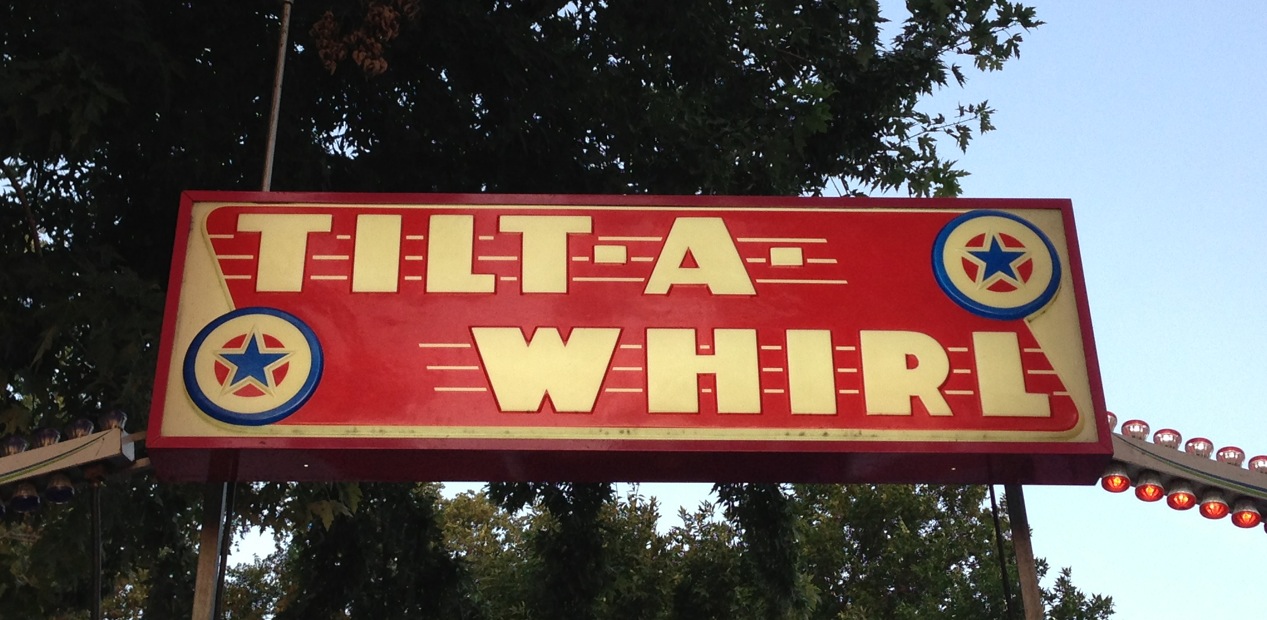

It is State Fair time again in Minnesota, so let’s examine the Tilt-a-Whirl brand.

The brand originated in Minnesota almost 90 years ago, after the amusement park ride was invented by Herbert Sellner of Faribault, Minnesota. Since 2011 the Tilt-a-Whirl brand and trademark has been owned by J&S Rides, d/b/a Larson International out of Plainview, Texas.

The first federal trademark registration for the Tilt-a-Whirl mark issued December 14, 1926, covering “merry-go-round or carrousel” in Int’l Class 28 (generally covering games and sporting goods), which sounds a little tame and perhaps even a bit misdescriptive, since the ride is well-known to cause nausea.

The second federal trademark registration for the Tilt-a-Whirl mark issued on December 5, 1995, covering more broadly “carnival and amusement park rides” in Int’l Class 22. This strikes me as an odd classification for this expensive piece of equipment, since Int’l Class 22 covers such unrelated and eclectic products as:

“Alpaca hair, bailing twine, bungee cords, clotheslines, down feathers, hammocks, laundry bags, plastic twist ties, human hair for stuffing and padding purposes, tents, unfitted spa covers, vehicle rescue apparatus, namely, rope cables used to affix between vehicles to pull a jammed or stuck door of one of the vehicles, and waterproof bags, namely, wet bags for temporary storage of wet and/or soiled cloth diapers.”

Perhaps it was incorrectly classified in Int’l Class 22, less for what the Tilt-a-Whirl is and does, and more for what you might need before or after experiencing a ride on one. I experienced my last ride a couple of years ago, so my daughter has been since, and is on her own this go round.

Here’s an interesting question to ponder: Why no coverage for Tilt-A-Whirl entertainment services? The registrations only cover the product, a very expensive piece of manufactured equipment, costing more than $300,000. So, the consumers of the Tilt-a-Whirl branded product are those who operate amusement parks and rides, not those who buy tickets to ride on them.

It seems to me that to create service mark rights in Int’l Class 41 under the Tilt-a-Whirl brand for “entertainment in the nature of an amusement park ride,” the brand owner would have to operate the equipment itself to provide the entertainment service, or at least license another to do so.

To the extent the brand owner thought this one through, I’m thinking the risk of controlling independent carnival operators as trademark licensees and the resulting potential liability for any operational mishaps far outweighs the additional benefit of owning technical service mark rights in the Tilt-a-Whirl brand and mark. But, what do you think?

– Anjali Shankar, Attorney –

Protection of a business’s trade secrets may prove more difficult with the rise of social media and the recent debates surrounding the use of non-compete agreements. Social media, while a great tool for expanding networks, carries certain risks for businesses, such as ownership of social media accounts (including any “followers” on that site) and potential inadvertent disclosure of trade secrets.

There has been discussion in the Minnesota legislature recently about the continued viability of non-compete agreements. In February 2013, a Minnesota House of Representatives member introduced a bill that would void most non-compete agreements. To date, there has not been further action taken on this bill. Nevertheless, it has prompted debate about the continued use of non-competes by businesses. While they are considered partial restraints of trade, non-compete agreements can be an integral part of a business’s ability to protect confidential information and trade secrets. Non-compete agreements are generally upheld in Minnesota, so long as the restrictions are reasonable and the agreements were executed in exchange for adequate consideration.

The issues surrounding protection of trade secrets were recently brought to light by a case involving two major competitors, Seagate Technology LLC and Western Digital Corporation.  Seagate Tech., LLC v. W. Digital Corp., A12-1944 (Minn. Ct. App. July 22, 2013). Seagate, a hard-drive manufacturer, employed Sining Mao until October 2006, when Mao left to accept employment with Seagate’s competitor, Western Digital. Mao had an employment agreement that contained an arbitration clause. After Mao joined Western Digital, Seagate commenced suit in district court seeking to prevent Mao from disclosing Seagate’s trade secrets. Because of the arbitration clause in Mao’s employment agreement, Western Digital moved to compel arbitration and the motion was granted by the district court.

The prehearing preparation spanned four years and included discovery amassing 14,000 pages of documents.  The arbitration hearing was held over the course of 34 days. At issue were claims against Mao and Western Digital for misappropriation of trade secrets, claims against Mao for breach of contract and breach of fiduciary duty, and a claim against Western Digital for tortious interference with a contract.

The arbitrator found that Mao had fabricated documents intended to prove that certain trade secrets were publicly disclosed before he left Seagate. The arbitrator concluded that”[t]he fabrications were obvious” and that there “is no question that Western Digital had to know of the fabrications.” The arbitrator imposed sanctions on Western Digital and found in favor of Seagate on the trade secret claims, awarding Seagate damages of around $630 million. Seagate moved to confirm the arbitration award in district court, while Western Digital attempted to have it vacated. The court affirmed the award in part and vacated it in part, finding that the arbitrator lacked the authority to impose sanctions for the fabrication of evidence.

On July 22, 2013, the Minnesota Court of Appeals reversed the partial vacation and ordered that on remand, the $630 million award be reinstated.

As football season approaches, it is not surprising that star quarterbacks such as San Francisco 49er Colin Kaepernick are making the news. I read an article in Forbes magazine about “Questions Concerning Copyright of Athlete Tattoos has Companies Scrambling.” The impetus for the article was a Yahoo! Fantasy Sports advertisement with him in a tattoo artist’s chair with a tablet featuring a fantasy football app.  Who owns the copyright to the designs embodied in the tattoos all over Kaepernick’s toned body?  This issue has clearly been on the minds of intellectual property attorneys and has arisen as a topic for the NFL Players Association according to the Forbes article.

Fans of the Hangover movie may recall a dispute that arose with Mike Tyson’s tattoo artist and Warner Bros. over the use of Tyson’s face tattoo on actor Ed Helms after a wild night in Vegas with Mike Tyson’s tiger ending up in the bathroom suite.  The lawsuit was settled so the merits of the issue were not resolved in the case.   Steve Baird wrote a nice post on the case.  As Steve points out, the tattoo design may also function as a trademark or service mark, much like a logo or visual element of a brand.

Derek Allen wrote a prior blog post about a suit involving a tattoo artist and a video game maker where the game featured a giant lion tattoo on UFC fighter Carlos Condit. When I read the Forbes article, my mind jumped to media darling (and a favorite athlete of mine) David Beckham who promotes many products while shirtless thereby exposing his many tattoos.

Upon further digging, I uncovered the fact that tattoo artist Louis Molloy had threatened to sue Beckham for copyright infringement in 2005 when the tattoos would be prominently featured in the ad.  Beckham may have to start covering up his tattoos in future ads, such as his pose below.

Given the rise in popularity of The Voice host and Maroon Five lead singer Adam Levine, his tattoos may also be at the heart of a future copyright dispute.

The company using an image of a famous tattooed person is not, however, left defenseless.  A “fair use” defense could be raised.  This defense has been discussed in prior DuetsBlog posts (for example, here). In addition, the company could argue that the tattoo has become a part of the celebrity so that the celebrity could license his or her likeness when promoting products (a right of publicity).  Savvy celebrities getting new tattoos may require releases from the tattoo artist in the future.  Further, in situations such as with the Hangover, a parody defense could also be asserted.  Finally, commentators, such as in the Forbes article have raised the issue of whether the tattoo could be considered a work-for-hire and whether such agreements should be entered into with tattoo artists.

What are your thoughts on the topic?

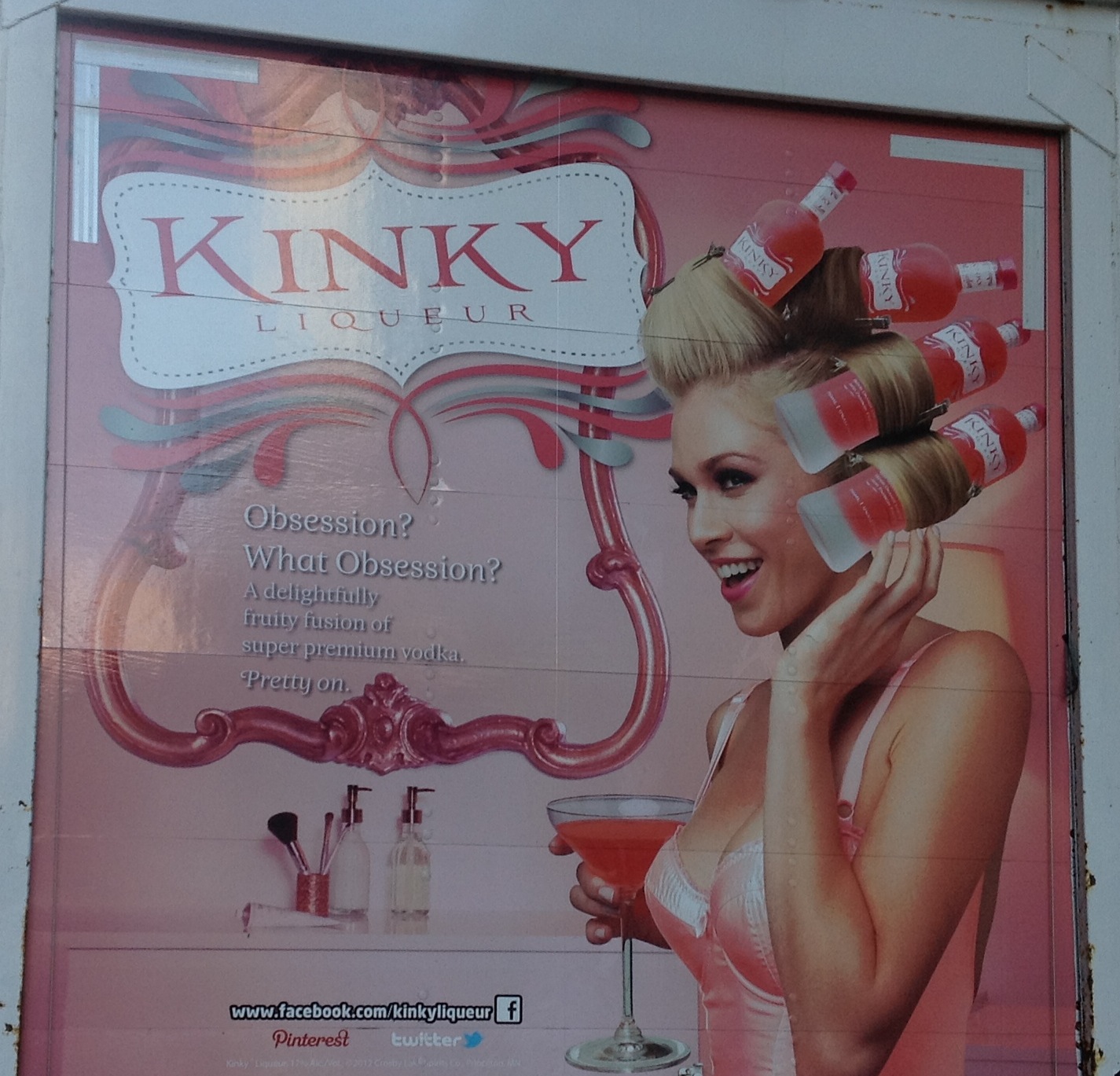
Last week I captured a few eye-popping photographs of a delivery truck parked in downtown Minneapolis promoting Kinky Liqueur, “a delightfully fruity fusion of super premium vodka“:

And my hunch — that scratching the surface of this interesting brandname would reveal a worthwhile trademark story — actually paid off.

As it turns out, Kinky Liqueur didn’t have a straight shot at federal registration with the USPTO since an Australian company already owned two federal registrations for some Kinky marks for rum: KINKYNERO RUM and KINKYLUX RUM. Not surprisingly, the USPTO found likely confusion when Kinky Liqueur sought to register KINKY for distilled spirits and liqueurs, and its weak attempt to argue otherwise was not successful.

This then led a rather determined Kinky Liqueur to file a pair of petitions to cancel the blocking registrations, on fraud grounds, see here and here. The Australian company claimed otherwise, but it ended up settling the dispute with Kinky Liqueur.

The key question to be answered when resolving these kinds of trademark disputes is: Do you want to end up with weak and narrow national rights (consent agreement) or broad and strong geographically-limited rights (concurrent use agreement)? The parties here opted — perhaps reluctantly — to water-down the strength and scope of their respective rights by choosing the former option, presumably because both have their eyes on a national market and don’t want to divide up the country into two non-overlapping geographic territories.

Trademark counsel should strongly encourage their clients to think hard about whether dividing up the country into separate markets is really not a viable option since the consequence of not doing so is significant from a trademark perspective.

In a resolution using a concurrent use agreement, the parties end up dividing the country — and the fact that no geographic overlapping use is permitted provides the basis for convincing the USPTO that there is no likelihood of confusion, and if the USPTO agrees, it can issue trademark registrations to unrelated parties for even identical marks in connection with identical goods, so long as the entire geography of the U.S. is accounted for between them and there is no overlap of geographic territory. This approach is ideal for companies who have a limited geographic market and desire broad and strong rights within that area.

In a resolution using a consent agreement, as the Kinky example illustrates, the parties publicly admit to the absence of any likely confusion, even in the case of overlapping geographic markets, which gives third parties a strong basis for pointing to the agreement (a public record now), to justify their entry into the same market under yet another Kinky brand name.

The Kinky trademark agreement is interesting in that it forbids either party from publishing the Agreement or any of the terms of the Agreement, while at the same time it permits disclosure to the assigned Examining Attorney at the USPTO — that is, by the way, how we obtained a copy from the online trademark file at the USPTO — so, it is a matter of public record, it is not confidential information. No matter how one pours the drink, giving the USPTO a copy of the agreement to overcome a registration refusal amounts to a public airing of the terms of the Kinky agreement.

The Kinky trademark agreement also appears designed to deny the natural consequences of the consent agreement option by including this provision:

“This Agreement is to operate as a resolution of the pending trademark dispute only as between the parties hereto, and it is understood that the parties expressly reserve the right to prosecute suits and claims against any and all other entities or persons that may use like or confusingly similar marks to either of the parties’ trademarks.”

Notwithstanding this provision, the significant hurdle both parties will face in future trademark enforcement efforts will be explaining to the factfinder how their target’s use of a Kinky mark for another distilled spirit product is somehow likely to confuse consumers when these coexisting Kinky marks have been admitted to not result in any likelihood of confusion:


How likely do you think it is we’ll see yet another’s Kinky spirit to pour over the rocks?


– Jason Voiovich, Director of Corporate Marketing, Logic PD

Co-Branding outside of the footwear industry helps create competitive space with Nike

My 15-year old son is learning to drive.

I guess I was more terrified by the idea of him driving than the actual practice thus far, but then again, we haven’t yet strayed from empty parking lots.  Actually, one of the more challenging early lessons has been the “foot pivot”.  It’s an automatic for most drivers – so much so, that we forget how we do it.  We apply the brake and the accelerator by pivoting on our right heel.  It avoids jerky starts and stops.  That said, not every shoe makes this easy.  His Saucony running shoes have a piece of sole that extends oddly toward past the back of the shoe.  Great for running.  Tough for pivot training.

Am I the first person who’s had this problem?  Clearly not.  Driving shoes are almost as old as cars themselves.  There’s a wonderful little history in Modern Gentlemen Magazine (yes, there is such a publication) if you’re interested.  So when I saw Steve’s article on trademarking tread patterns, it seemed like a natural brand extension.  On a recent trip to Bloomington’s Mall of America for back-to-school shopping, I learned the shoe and tire companies are way ahead of me.

Just a bit of background.  As you can probably guess, the footwear industry is remarkably competitive.  Even so, the clear juggernaut is Nike with an astounding 41% share in the athletic space.  The question is pretty simple for Adidas/Reebok (yeah, one company), Puma, New Balance, Asics, and the dozens of others: How do you differentiate?  How do you carve a space in this trendy, fickle market that is unique, ownable, and valuable?

Two footwear companies are trying to do just that by linking their product with the American love affair with the automobile.  (Which doesn’t play so well overseas, by the way, but I digress).

Let’s start with Adidas and Goodyear.  Think leather cross-trainer with a variety of goofy Goodyear tread patterns on the sole with a Goodyear logo visible from the side.  I tried some on.  Grippy, for sure, but I’m not sure these are really “snow tires” if you know what I mean.  Walking outside my office in the North Loop of Minneapolis, I could see myself sliding casually in front of November traffic with only a gentle nudge and a two-degree incline.  (Hopefully, their Goodyears could stop in time…)

Quite frankly, the Goodyear partnership didn’t really seem like it was a big deal for Adidas.  Neat shoes, but little in the way of supporting cast of clothing and accessories.  Missed opportunity, perhaps.  I say that because the Puma store was a short walk away.

And Puma takes the whole car/shoe thing very seriously.

Instead of the tread pattern and tire manufacturers, Puma hooks its wagon to Ferrari and BMW.  They’ve got a whole line of shoes in varying colors and styles, clothing, and trinkets.  (Presumably, you don’t need to own said Ferrari to buy said shoes and jackets).  And yes, they are driving shoes complete with rounded back heel, and they are outwardly marketed that way, but that’s clearly not the whole point.

Puma (and Adidas to a lesser extent) is using brand halo effect to bolster its “Sport Lifestyle” brand proposition – maybe not as “athletic” as Nike, maybe not as “everyday performance” as New Balance, but maybe just enough “sport style” to carve a defensible position in a crowded space.

Does it work?  Let’s go for some scientifically unreliable anecdotal evidence.  If my 15-year old had to pick Goodyear tire treads or a BMW logo on his shoe, which do you think he would want?  Yeah.  Good guess.

As some of you may know, the most recent installment of the Call of Duty franchise is set to hit stores later this fall–November 5 to be exact.

As usual, it appears that they are continuing to up the ante, this time tapping Academy Award winning writer Stephen Gaghan for the story.

In lesser known news, the purveyor of the above game–Activision–recently one a battle of its own when it halted a trademark infringement claim fired by NovaLogic based on the use of the term Delta Force in the Call of Duty: Modern Warfare games.  A federal court judge in the Central District of California dismissed the majority of NovaLogic’s claims on summary judgment on June 18, 2013.  The primary basis for the decision was First Amendment principles.  (Decision here).

The Court started by quoting an increasingly significant quote from the Supreme Court in Brown v. Entertainment Merchant’s Assoc., 131 S.Ct. 2179 (2011):

Like the protected books, plays, and movies that preceded them, video games communicate ideas – and even social messages – through many familiar literary devices (such as characters, dialogue, plot, and music) and through features distinctive to the medium (such as the player’s interaction with the virtual world). That suffices to confer First Amendment protection…. [W]hatever the challenges of applying the Constitution to ever-advancing technology, “the basic principles of freedom of speech and the press, like the First Amendment’s command, do not vary” when a new and different medium for communication appears.

The Court then held that the use of “Delta Force” in its expressive and descriptive, and its addition to the storyline, outweighed any potential confusion that exists.  Candidly, I may be one of the few people playing Call of Duty that recalls the Delta Force games.  I don’t believe they ever came close to attaining the level of success of the Call of Duty franchise.  This seems to me to be the correct decision, as it looks like NovaLogic was simply trying to obtain a windfall.

Earlier this week, Joseph N. DiStefano of Philly.com reported that the University of Pennsylvania filed suit in federal district court to protect its well-known federally-registered rights in the WHARTON name and mark. (Hat tip to guest blogger Dave Taylor of Taylor Brand Group).

For those who have not been paying attention to business for the past 132 years, The Wharton School is the world’s first collegiate business school, established in 1881, as part of the University of Pennsylvania. It has a remarkable reputation as one of the top business schools in the country.

It has one of the most published faculties and one of the largest and most influential alumni networks. And, we know how smart Wharton students are, as one of our talented guest bloggers, Nick Olson, is a UPenn law student who will graduate in 2014 with a J.D. and a Certificate in Business from the Wharton School. Remember his insightful blog posts on IP Valuation and Poetry in Slogans?

Not surprisingly, the lawsuit asserts pretty standard claims for federal trademark infringement, federal unfair competition, federal trademark dilution (blurring and tarnishment), federal cybersquatting (for registration in September 2012 and use of www.whartonadvisorscorp.com), Pennsylvania statutory unfair competition, and Pennsylvania common law unjust enrichment, against a financial consulting firm in New Jersey called Wharton Advisors Corp. Here is a copy of the complaint and exhibits.

The University of Pennsylvania’s Wharton School further complains that the defendant has filed for federal registration of the claimed mark WHARTON ADVISORS CORP, noting that the words ADVISORS CORP have been disclaimed, “leaving the University’s mark WHARTON as the sole distinctive element” of the defendant’s claimed mark. Surprisingly the complaint doesn’t appear to request that the court declare the mark unregistrable nor does it request that the court order the defendant to abandon it, perhaps because The Wharton School doesn’t believe the application will survive examination at the USPTO.

The untold irony, however, is that the application will most likely not survive examination, and most likely will never be published for opposition, not because of the University of Pennsylvania’s federally-registered rights in WHARTON, but because of a third party’s 1998 federally-registered rights in another WHARTON mark, namely, WHARTON CAPITAL for investment banking services apparently offered since 1977. The WHARTON CAPITAL registration has been incontestable for a decade now, so I suspect Wharton Advisors Corp may argue that this registration and the associated use of the Wharton Capital name and mark has a necessarily narrowing effect on the University of Pennsylvania’s scope of rights in WHARTON, at least when it comes to being able to reach those who provide financial services, as opposed to educational services.

In fact, the USPTO initially has refused registration of WHARTON ADVISORS CORP under Section 2(d) of the Lanham Act, based on a perceived likelihood of confusion with the WHARTON CAPITAL mark — none of the University’s WHARTON marks were cited as potential bars to registration. Interestingly, the USPTO also cited the WHARTON CAPITAL mark, and not any of the University’s WHARTON marks against this additional third party application for yet another WHARTON in the financial services world, namely, W-WHARTON FINANCIAL ADVISORS mark.

The existence of such a close third party mark, WHARTON CAPITAL, of course, renders this allegation in the University of Pennsylvania’s dilution claim, a bit awkward, to say the least:

Defendant’s “use of WHARTON, WHARTON ADVISORS, and WHARTON ADVISORS CORP to promote or sell financial consulting services is diluting and impairing the distinctive quality, uniqueness and singularity of the University’s famous “WHARTON” mark by blurring, constituting dilution by blurring.” (emphasis added)

And, since Wharton Capital had to disclaim “Capital,” in the same way Wharton Advisors Corp disclaimed “Advisors Corp,” doesn’t that also leave “the University’s mark WHARTON as the sole distinctive element” in Wharton Capital’s name and mark?

There must be a backstory on how Wharton Capital avoided a conflict or survived a conflict with Wharton School, or perhaps it is as simple as someone was asleep at the wheel back in the late 70s when the use first commenced, and then again twenty years later in the late 90s, when federal registration was sought. There is no TTAB history associated with this Wharton Capital mark.

This is not the first time the University of Pennsylvania has sought to enforce its rights in the WHARTON mark, as earlier this year it brought a federal trademark infringement action against Wharton Business Foundation, see here.

So, stay tuned for further developments in The Wharton School v. Wharton Advisors Corp — not Wharton Capital (at least for now).

Tim’s post last week on the dispute between Victoria’s Secret PINK (a women’s lingerie and loungewear line) & Thomas Pink (predominantly known for its menswear line) reminded me of a Women’s Wear Daily article that I read regarding a trademark dispute involving Kate Spade New York’s new KATE SPADE SATURDAY brand, a more casual womenswear line.

Saturdays Surf NYC was not so thrilled with that launch.  Saturdays Surf NYC is a menswear company that sells casual-wear and surfboards (surfboards…how do you get a surfboard home on the subway in New York?).  The company has a federal trademark registration for SATURDAYS SURF NYC for, among other goods and services, “clothing, namely, t-shirts, collared shirts, sweaters, sweatshirts, hooded sweatshirts, jackets, shorts, pants, slacks, trousers, swimwear, gloves, scarves, socks, and shoes” and “retail and on-line retail store services featuring clothing, clothing accessories, personal grooming products, coffee, and artwork.”  Notably, none of these goods or services are limited to clothing for men.

The  all caps stylization in a sans serif font of the Saturdays Surf NYC logo is also remarkably similar to the Kate Spade Saturday logo.  In addition both SATURDAY or SATURDAYS appear in a larger font size relative to the other words in both logos.

Kate Spade filed a complaint in the Southern District of New York seeking a declaratory judgment that its mark KATE SPADE SATURDAY did not infringe on SATURDAYS SURF NYC.  Despite evidence of some actual confusion (SATURDAYS SURF NYC clothes being returned to Kate Spade and vice versa) and evidence that Saturdays Surf NYC carries items in smaller sizes that women purchase (but unlike Kate Spade not designed for women), the court found for Kate Spade.   In concluding that Kate Spade’s mark indeed did not infringe Saturdays Surf NYC, the judge wrote:

I am particularly persuaded by the relative weakness of the word that the two marks share, the significant distance between the men’s and women’s products, and the consistent inclusion of the famous house mark, Kate Spade, in its Kate Spade Saturday mark.

Perhaps if it were JACK SPADE SATURDAY (a menswear line related to Kate Spade New York), the decision might be different.  Relying on a case from 1979, the Kate Spade court stated that there is “significant competitive distance” between the two lines based on the fact that one’s products are designed for men and the other’s products are designed for women.  Nearly 35 years later, do you think that’s true for fashion now or, as society has changed, do you think that competitive distance between men’s design and women’s design has been minimized?

Based on this Kate Spade decision, the outcome in the PINK dispute may be more favorable for Victoria’s Secret, given the seemingly greater weakness of PINK for apparel and the differences between the products, and assuming consistent inclusion of their famous house mark Victoria’s Secret.

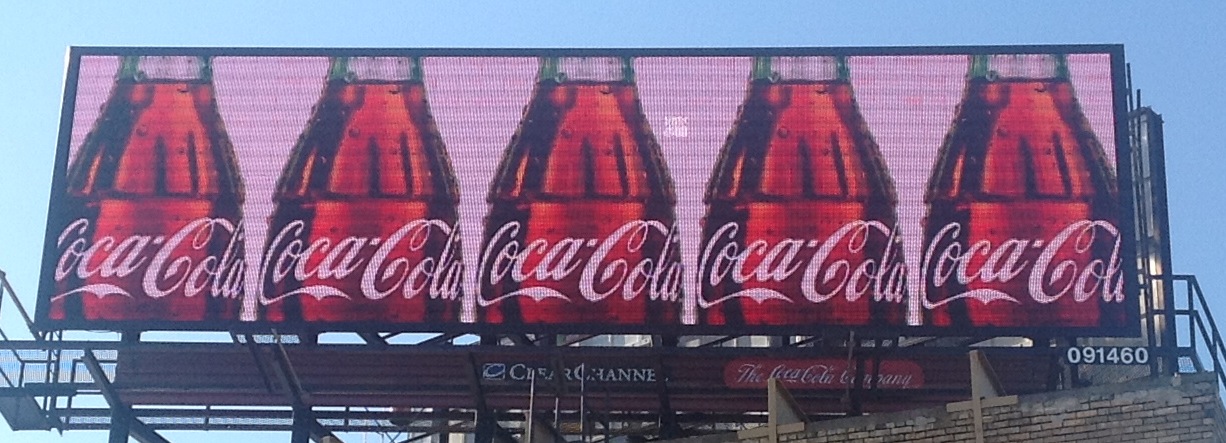
Repetition can be a beautiful thing, especially when it’s about The Real Thing:

This electronic billboard advertisement is another good example of Coca-Cola advertising that leaves certain aspects of the brand icons to the imagination, this one discloses only the middle portion of the famous contour bottle shape trademark.

And, speaking of repetition, remember these Coca-Cola gems from the DuetsBlog archives?

To the extent repetition frustrates you, keep in mind, Coca-Cola’s slogan from 1906 apparently was: “The great national temperance beverage.”