Louis Armstrong first performed “Mack the Knife” in 1956, a year later McDonald’s introduced the Big Mac, and then, Bobby Darin’s version of “Mack the Knife” became a chart-topper in 1959.

So, these events were all before my time, but I’m left wondering if there was any connection between them, back in the day, or whether they were an unrelated coincidence of events.

Either way, who could have known and who would have guessed that more than fifty years later, the Super Sized sandwich brand would be truncated to “mac” — no less in all lower case style?

Still looks big enough to require a knife though. One of the other things that intrigued me about this billboard is the federal registration symbol on the “mac” reference, because I hadn’t previously seen or noticed any use by McDonald’s of MAC or mac standing alone.

Turns out, despite my best investigative efforts in scrolling through some 123 USPTO records for McDonald’s and a multitude of third-party registrations for a wide variety of goods and services ranging all the way from hair pieces and wigs to boat seats to lip gloss, and then all the way to apparent evidence of some peaceful coexistence with Mac’s fried pork skins, all I could find for McDonald’s was a pair of abandoned MAC applications from 1994, and a few federally-registered slogan marks incorporating the “mac” term: (a) Get Your Mac On; and (b) Are You Mac Enough?

Do you suppose that the creatives behind this work of art thought the sheer size of the sandwich might double as a visual representation of the missing — or perhaps, supposed redundant word “big” — if so, the trademark types should know better, as it’s definitely not an equivalence the USPTO or the courts would recognize for purposes of Big Mac trademark use. Leaving me to wonder whether McDonald’s has gotten the memo on proper use and misuse of the federal registration symbol?

In the end, it would appear that this mac needs a knife too: It might double as one for dining and one for legal surgery to remove the errant federal registration symbol, at least for this mac.

Anyone that watches TV or reads magazine or listens to the radio or otherwise participates in the day-to-day interactions with society know that “green” marketing is a hot item right now.  Normally, I suffer silently through the endless barrage of “green” this and “eco-friendly” that, content with the knowledge that this too, shall pass.

When you get right down to it, “green” is nothing but a buzzword intended to create favorable impressions of items that have traditionally been viewed in a negative light from an environmental perspective.  Take for example my wife’s bottled water from lunch the other day:

Don’t feel bad about drinking tap water from that plastic bottle!  It’s Eco-friendly and Eco-slim!

Ugggh.  The thing that particularly irks me about this bottle is that it it uses 30% less plastic in the cap, but it still is a volume-killing ornamental bottle with further volume-killing embellishments for better grip.  (Seriously, has anyone ever felt in danger of dropping their water bottle, only to be saved by the ridges?  If so, please let me know.)  Look, if you’re going to claim to be eco-friendly, let’s show some commitment!  Come up with a bottle that approximates a sphere (i.e. the most efficient shaped vessel) or at least a cylinder with a height equal to the diameter.  At the very least, get rid of those damn ridges!

Greenwashing, as it has been called, is the phenomen wherein advertisers and promoters “mislead consumers regarding the environmental practices of a company or the environmental benefits of a product or service.”  And this practice poses mutliple risks for companies that engage in it which could include public intolerance or (drumroll please) lawsuits.  (See this Forbes article.)  For those of you considering “going green” in your marketing and advertising,  you’d be well-advised to consider the accuracy of any and all statements made in connection with your environmental performance.

Now the water-bottle above more likely poses the risks of public intolerance rather than a lawsuit.  Nothing appears outwardly deceptive about the label and this is unlikely to create the brouhaha caused by Fiji’s “Carbon Negative” water.  But at some point, people are just going to get tired of hearing that things are “green” or “eco-friendly” when they plainly are not.

In its list of 500 Greatest Albums of All Time, the Rolling Stone ranked the 1967 album The Velvet Underground & Nico at number 13 – not bad for the band’s very first album.  The album had a simple cover, some would say iconic, cover:


And get this: the banana peel was actually a sticker that you could peel off to reveal a pink pop art unpeeled banana underneath! Although, based on my baseball card experiences, I’m sure it ruined the resale value. Whether it was a marketing ploy, or just something that the band or Andy Warhol thought would be fun, I don’t know. I do know that it is a great combination of pop art with interactive/participatory art and combined with music!

I’ve owned the album (cd) for maybe 10 to 15 years. It’s good, but I admit I never listened to it frequently, and not for a long time. I do remember always being slightly confused as to the relation between Velvet Underground and Andy Warhol was. Although I was interested in the answer, the interest never lasted long enough to look it up. That is, until recently when I found out trademark law was now involved.

Based on my confidential, verified, inside sources at Wikipedia, Andy Warhol became their manager in 1965 and helped them get a record deal. The band was sort of a “house band” at Warhol’s studio, some parties, and on his traveling art tour named Exploding Plastic Inevitable. He designed the banana drawing for the cover and was listed as a producer on the album.

Back to the law. The remaining members of the band filed a lawsuit against the Andy Warhol Foundation for the Visual Arts (the Warhol Foundation) for trademark infringement and requesting declaratory judgment regarding the ownership of the copyright in the banana image. You see, the Warhol Foundation had agreed to license the banana image to Apple for use with iPhone cases. The Velvet Underground was concerned that consumers would believe that the Velvet Underground had somehow endorsed or authorized this use since, they argued, the banana image had gained secondary meaning associating the banana image with the Velvet Underground.

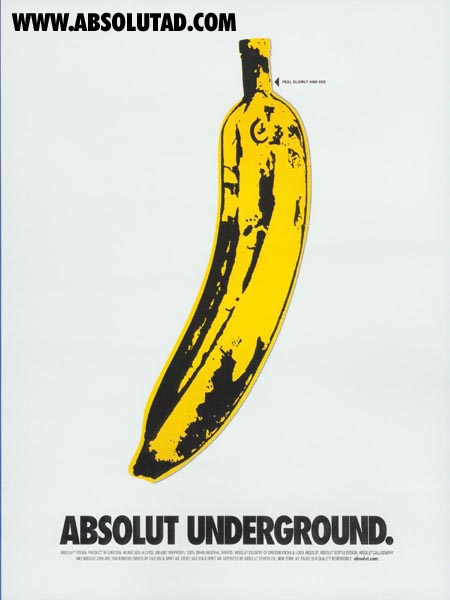
So the question becomes: who owns the copyright and what effect does that have on any trademark rights? This is an interesting situation where the Warhol Foundation could have a valid copyright in the image, but the Velvet Underground could have a valid trademark in the same image. There are many issues regarding the copyright: was there an implied license, was it a work for hire, or, in my opinion the most likely to be applicable, whether laches prevents the Foundation from pursuing any claim. The Velvet Underground continued to sell the album with the banana design, used it in promoting their tours, registered it as a trademark in 1994 (but abandoned it by failing to file a Section 8 declaration… ouch), and even licensed its use in an Absolut Vodka ad:

Note that Absolut licensed the banana image from Velvet Underground, not from the Warhol Foundation. The ad easily could have read ABSOLUT WARHOL but, for whatever reason, Absolut either believed that the band owned the rights to the image, or in fact associated the mark with the band rather than Andy Warhol. If you read the Rolling Stone link you’ll have notice this line: Rejected as nihilistic by the love crowd in ’67, the Banana Album (so named for  its Warhol-designed cover) is the most pro­phetic rock album ever made.” This reference to “the Banana Album” (capitalized, no less) and “the most prophetic rock album ever made” comment in a prominent national music magazine is pretty good evidence to support a claim of secondary meaning. Plus, it doesn’t appear that Andy Warhol ever “used” the design as a mark.

Like most cases involving fun and interesting legal issues, the parties recently settled the case. While the facts in this situation are rare, it isn’t difficult to imagine a situation more plausible. A person or company could make unauthorized use (or ambiguously authorized use) of a copyrighted image as a trademark and achieve acquired distinctiveness in a short time through extensive (and successful) marketing and advertising efforts, especially through an effective digital/social media blitz. As far as I am aware, L.A. Gear still has the fastest time at the “Secondary Meaning” combine, clocking in at a crisp 5 months (L.A. Gear Inc. v. Thom McAn Shoe Co., 988 F.2d 117 (Fed. Cir. 1993)). That is quick enough to develop secondary meaning without a competing copyright claimant to lose their rights. So can an individual obtain a valid trademark exist even though each time it is reproduced it gives rise to a claim of copyright infringement? (assuming there are no contractual issues and that the copyright owner has made no use of the mark). It certainly wouldn’t make much financial sense, but it appears legally plausible.

Please note: I am not advising anyone to “borrow” another’s copyrighted image to use as a trademark just so we can see what happens. But I promise to write about it if you do.


I have blogged before about one of my favorite graffiti artists, Banksy. Recently there has been some buzz in the ad world about another provocative work attributed to him. It involves a well-known bottle and trademark that Steve has been posting about frequently over the past several weeks. Normally I would post an image of it here, but Banksy has some choice, four-letter words for the advertising industry and IP rights. So why don’t you go ahead and check it out here.

As an intellectual property attorney who has lived and breathed advertising her whole life, as a consumer of it and countless afternoons watching the behind-the-scenes action as a daughter of an ad exec at a major ad agency — you kind of hurt my feelings, Banksy.

Banksy certainly feeds into growing anti-corporate, 99%-er sentiment about the effects on society of corporations and government monopolies like intellectual property rights. Banksy asserts that once a created work is put in the public domain, then it’s the public’s to use and manipulate and there should be no intellectual property protections. If this thought interests you, I encourage you to read articles related to the contrasting views amongst libertarians about intellectual property rights, such as the one linked here.

Let’s be honest, although Banksy spouts off on branding and intellectual property rights, he (and consumers of his art) certainly benefit from those rights and  protections. Banksy himself is a brand – that’s part of what I think is his genius. His Oscar-nominated Exit Through The Gift Shop documentary is copyrighted and registered with the U.S. Copyright Office. Countless fake Banksy works are sold on eBay for much more than a penny. Proof of his love-hate relationship with IP rights is right on his website:

(It may be hard to see, but it says “You’re welcome to download whatever you wish from this site for personal use. However, making your own art or merchandise and passing it off as ‘official’ or authentic Banksy artwork is very bad and wrong.”)

I have to say that, in some respects, he has a point. Unless you are living off the grid, we are constantly bombarded every day with images of how we should look, dress, eat, drink, live. We often fail to acknowledge how pervasive marketing is in our lives. However, as we know, branding and marketing help us make choices about a good or service and to distinguish sources of goods. Marketing provides the consumer with an expectation of quality, particular characteristics, or an experience associated with a particular good or service. Setting aside his rhetoric, maybe the message of Banksy’s advertising diatribe is to be better stewards of that important responsibility.

It’s OK, Banksy. You can make up for my hurt feelings by sending me two Lady Di tenners and a signed print of your message-in-a-bottle advertising manifesto. I’ll frame it and put it up in my office as a reminder.

– James Mahoney, Razor’s Edge Communications

Not long ago, Steve Baird posted a commentary on a colonoscopy campaign that featured attention-getting, humorous (to some) butt jokes.

I liked ‘em. Thought they were clever and effective. Beyond making me think of my guts, though, they also brought to mind a conversation I had with a mentor a long time ago.

A competitor had just launched an unexpected, fresh, humanizing and very effective campaign that broke the technical product-sell conventions of the time. When I expressed admiration for the creatives who came up with that great idea, said mentor observed, “I admire the client who had the guts to approve it.”

Part of what he meant is that practically every client says they want terrific work and breakthrough creative.  Actually, they don’t. They want predictable success. They want distinction, but only within the bounds of the big part of the bell curve.

I don’t blame them, by the way, because much of our work has a “bet the company” feel to it, or more accurately, “bet your career” for the client.  And therein lies the story of the hairy underside of this business.

Sometimes a great idea comes to you right out of the chute; most times, it reveals itself slowly, piece by piece until the one key insight falls into place. The butt folks probably went through dozens of explorations and false-starts on the creative. They probably presented one or two “safer” ideas along with this one. They might have even had one edgier than the one the client chose (and that the creatives hoped against hope would get approved).

But it was down to the client to shoot the moon, as it were. So though I think the creative work is a gas, I also give a big tip o’ the hat to the client. Try as you might to cover all the “but”s about work like this, approval still carries some risk.

Just like a colonoscopy, it takes guts.

Boys baseball occupied a fair portion of my evenings last week and this past weekend, a game where almost everyone has at least heard: The tie goes to the runner (when it comes to running the bases anyway — because when it comes to the final score the game continues until someone wins, even if it takes twenty innings, as the Marlins outlasted the Mets this past weekend).

How are ties played out when it comes to brands as compared to generic product names?

Although actual ties seem quite rare in our world of very precise measurement, the Trademark Trial and Appeal Board (TTAB) is being asked to decide who wins if there is a “statistical tie” between those relevant consumers who understand a designation as generic and those who understand it as a brand name, as part of a high-profile, four-year-long trademark dispute over registration of the “Pretzel Crisps” snack food product name: Frito-Lay North America, Inc. v. Princeton Vanguard, LLC.

The case is proceeding to trial at the TTAB because prior attempts by both parties to have the question of genericness decided on the basis of summary judgment failed. On February 9, 2011, the TTAB denied Frito-Lay’s motion for summary judgment which had sought a ruling that “pretzel crisps” is another generic name for “pretzel crackers” (pdf of decision is here), and on September 5, 2012, the TTAB denied Princeton Vanguard’s motion for summary judgment which had sought a ruling that “pretzel crisps” is not a generic name for “pretzel crackers” (pdf of decision is here).

A few months ago the trial briefing was completed and the parties now await the Board’s scheduling of oral argument. The trial briefs are a fascinating read, highly experienced and competent counsel on both sides, see for yourself: (1) Frito-Lay’s Trial Brief; (2) Princeton Vanguard’s Trial Brief; and (3) Frito-Lay’s Rebuttal Brief.

To the extent the survey evidence and testimony found credible and given weight by the TTAB shows the percentage of respondents equal and on opposite ends of the brand/generic divide, what would you consider persuasive to break the tie?

Sri Sankaran, Patent Attorney, Winthrop & Weinstine

Recent developments in executive, legislative, and judicial branches present new challenges for patent trolls (or less pejoratively “non-practicing entities” or “assertion entities”).

The White House recently outlined a series of initiatives to address the impact that patent assertion entities have on the economy.  The administration cited a report from the National Economic Council and the Council of Economic Advisers, entitled Patent Assertion and U.S. Innovation.  The report states that patent assertion entities bring 62% of all infringement suits and took in $29 billion in 2011 alone. Patent assertion entities are described in the report as not playing a role in the U.S. “invention ecosystem,” and instead focus on aggressive litigation tactics such as threatening to sue thousands of companies at once without specific evidence of infringement of any of them.  The report suggests that patent assertion entities have a negative impact on innovation and economic growth that far outweighs any benefit to the assertion entities themselves.  Pointing to a study of 14 publicly traded patent assertion entities from 2001 to 2012, the report contends that during that period the assertion entities had revenues of $7.6 billion, while during the same period patent infringement lawsuits they initiated were associated with an $87.6 billion dollar decline in the share price of the defendant companies.

The Obama administration has proposed a number of legislative and executive steps to address the economic impact of this type of litigation.  The proposed steps include: laws requiring disclosure of the real party of interest behind efforts to enforcing patents; giving courts more flexibility in awarding attorney’s fees to the prevailing party; restricting infringement actions against consumers or companies that buy a product off-the-shelf and put it to its intended use; and limiting the circumstances in which the International Trade Commission can ban imports of infringing products. The White House proposals join other initiatives already percolating in Congress.

A key issue underlying any effort in this area is whether the new rules will apply just to “trolls” and, if so, exactly how a troll is defined.  Universities, for example, may own patents but not manufacture and sell patented products.  The same could be true for individual inventors.  If production of patented products is to be the benchmark, how much production is necessary to turn a “troll” into a member in good standing of the “innovation ecosystem.”  Similarly, if the International Trade Commission’s (“ITC”) exclusion remedies are to be limited, is that limitation only for “troll” cases?  What is the justification for such a limitation when a party seeking relief in the ITC must first prove, as part of its claim, that there is a domestic industry in patented products.

Apart from these federal developments, at least one state government has also weighed in.  Spurred by a desire to facilitate “the efficient and prompt resolution of patent infringement claims,” build the local economy, and attract small and medium size internet companies to the area, Vermont recently enacted a statute prohibiting bad faith assertion of patent infringement.  The statute, 9 V.S.A. §§ 4195-99, provides that violators can be sued by the state attorney general or by the targets of the bad faith assertion.  The statute provides for equitable relief, damages, costs, and attorney’s fees.  In addition, the court can award as exemplary damages, the greater of $50,000 or three times the actual damages, costs, and attorney’s fees.

Continue Reading New Challenges for So-Called “Patent Trolls”

If you are Samuel R. Mott, founder of Mott’s LLP, apparently the answer is no.  Mott’s LLP filed applications to register “MOTT’S” for “baby foods” and “packaged combinations consisting of fresh fruit.”  (Serial Nos. 85/374,805 & 85/436,615)

The Trademark Trial and Appeal Board (“the Board”) refused to register the marks set forth in these applications because Samuel R. Mott was not famous enough to fall within the historical figure exception which allows registration of surnames as trademarks.  The Board found “Mott” to be merely a surname.


You may also want to check out fellow blogger John Welch’s post as he has also written on this surname refusal.

In determining whether a mark is a mere surname, the Board looks at:

  1. Whether the surname is rare;
  2. Whether anyone connected with the applicant has the term as a surname;
  3. Whether the term has any other recognized meaning;
  4. Whether the term has the “look and sound” of a surname; and
  5. Whether the manner in which the mark is displayed might negate any surname significance.

In re Benthin Mgmt. GmbH, 37 U.S.P.Q.2d 1332, 1332-33 (T.T.A.B. 1995).

With respect to “MOTT’S,” the Board found the surname was not rare.  Indeed, “Mott” had appeared over 5,000 times in a nationwide directory of names and over 17,000 times in United States Census Data.  Second, the company was founded by Samuel R. Motts (although no one with the surname currently worked there).  Third, “Mott” had no significance other than as a surname.  In contrast, a term such as “KING” could be a surname (e.g., Martin Luther King, Jr.) or it could signify the ruler of a country.  Fourth, “Mott” looked and sounded like a surname.  It did not look like an acronym or a unique coined term.  The Board found that the fifth factor did not apply because Mott’s LLP sought to registration of “MOTT’S” in standard character form.

To overcome the initial refusal based on being a surname, Mott argued that Samuel R. Mott is a historical figure under the exception to a surname refusal.  The Board disagreed, finding that Samuel R. Mott did not do anything extraordinary to achieve notoriety.  However, Samuel Mott is in good company.  The Board also found Ronald McDonald did not achieve notoriety to overcome a surname refusal for the mark “McDonald’s”.

Who would be considered famous by the Board?  DA VINCI fell within the historical figure exception.  The Board found that the painter Leonardo Da Vinci had achieved notoriety to allow registration of the mark.  Likewise, SOUSA was registered as a mark because John Phillips Sousa had achieved notoriety as a composer of patriotic music.

Who do you think would be considered a historic figure?  What about Mehlin & Sons?  (No.)  Pickett?  (Yes – Pickett was a Famous civil war general.)  Watson?  (No.)  McKinley?  (No, his presidency was not seen as having particular significance.)  Which Presidents do you believe the Board would say had historical significance?  Which ones did not?

I doubt that my last name Blofield has any historical significance.  I have not done enough research to know if the surname is rare.  It does, however, have significance other than as a surname—namely, as a village and civil parish in Norfolk, England.  Indeed, my relatives hale from there.  Accordingly, if I tried to register my surname the Board could also affirm a denial on the basis of it being a geographically descriptive mark (a topic for another day.)

It would be interesting to see if the Board would affirm a denial of “Blofeld” as a surname.  If the Board determined it was primarily a surname, the applicant could argue that Ernst Stavro Blofeld had achieved historical significance as a super villain from the James Bond novels and films.

My mother’s maiden name DUCHAMP has a handful of registrations.  The Duchamp Holdings Limited Company in the United Kingdom has registered the DUCHAMP mark for cuff-links, shirts, ties and scarves, among other things.  It is likely that if there had been a surname refusal (I have not studied the applications and histories so I do not know if it was argued), the French-American painter, sculptor and writer Marcel Duchamp would likely qualify for historical significance.  I saw several of his pieces of work when I was at the Guggenheim Museum in Venice (I am not sure if the one pictured below was the exact version but it was one of them).

Do you think your surname would be able to be registered as a trademark?


Nude Descending a Staircase, No. 2
French: Nu descendant un escalier n° 2


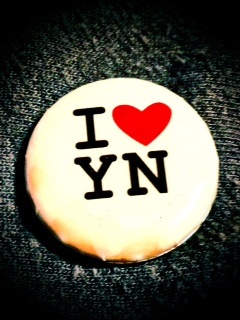
Last week I stopped at a local wine and beer store to pick up a bottle of wine to bring to a friend’s dinner party (but also couldn’t resist purchasing a 4-pack of Surly’s Bitter Brewer. I had never seen it before, but highly recommend it). As I walked back to my car I noticed a pile of buttons lying on the cement portion of the street light, right near the front end of my car. I picked one up and brought it home with me. Please excuse the slight discoloration, it had been raining that day (and just about every other day in Minneapolis during May, unless it was snowing).

I (heart) YN

Do you get it? Don’t worry if you don’t, it took me a second, too. And no, it’s not I ♥ Your Nose. Try sounding it out. No, not I ♥ Yen. Remember the location… Yeah! I ♥ Wine. Clever, no? I thought so.

Of course, beyond thinking it was an interesting slogan, I didn’t think much of it at the time. I knew that it was a reference, modification, wordplay, etc. of the I♥NY t-shirt. But not once, not even in the most dense and confused portion of my mind, was I under any impression that somehow the State of New York had sponsored this button.  In fact, I hadn’t ever even considered the I♥NY to be a trademark. A copyrighted image, sure. But not a trademark.

So imagine my surprise when I learned from a New York Times article, that just recently the New York State Department of Development (owner of registrations for the multiple I♥NY marks) sent a cease and desist letter to a local coffee shop regarding its use of the logo below:

A few preliminary matters: (1) Yes, Mr. Everyman really does have that tattoo on his knuckles; (2) these are clearly distinct goods/services; and (3) if you’re someone who tends to see trademark bullying everywhere you look, could you have picked a victim with a better name than Everyman? According to the New York Times, the Department has sent 1000s of letters over the years, with over a 100 last year alone. A quick review of the Trademark Trial and Appeal Board’s previous proceedings confirms the aggressive approach, with the Department opposing applications for: I♥WY; I♥NY BEER, I♥Chicago; among others.

Some interesting background: Milton Glaser, the man who designed the original the logo, did it for free. In his words it was intended to be “free” for everyone to use, to allow it to “permeate the culture.” And, as the Times points out, “After Sept. 11, when Mr. Glaser designed an “I ♥ NY More Than Ever” logo with a smudge on the heart, the state even threatened to (but did not) sue him.” Boy, really makes you ♥NY, huh?

There is a lot that can be unpacked from this story: while ornamental designs can be registered based on acquired distinctiveness, how much protection should we give such a basic, informational slogan? Do these practices qualify as trademark bullying? Would anyone really be confused as to whether New York was somehow affiliated with Wyoming, Chicago, San Francisco, Iowa City, your friend Ty, or anyone else that can claim a two letter moniker?

It’s certainly an iconic logo. And there should be some protection. But any font? Any style of heart? Images other than hearts, even in other colors? Anything with I♥_____, regardless of whether it is a state abreviation, other acronym, or even a full word? If that’s the case, would it be an infringement to sell shirts with these clever (at least to me) designs:

  
The answer is likely no. But, based on their history, that wouldn’t stop the Department from sending the seller a sternly worded letter. Perhaps the real lesson here is that with the right enforcement strategy, an owner can make their registered mark seem invincible.

For me, while the designer may have been thinking about rent rather than trademark law, I think the shirt below adequately summarizes the whole situation:

It should be no surprise that the famous Coca-Cola brand name is federally-registered. One of the many significant benefits of federal registration is the USPTO’s obligation to refuse registration of third party marks that are likely to confuse — most importantly, without the prompting or involvement of the prior trademark registrant.

No doubt Coca-Cola will be popping a top and opening a little happiness when it learns that it won’t have to spend the time or effort to formally oppose an entirely ridiculous intent-to-use trademark application filed earlier this year by “Harvey W. Wiley, d/b/a We The People” (apparently located in Chattanooga, Tennessee).

The application seeks to register COCA COLA, without a hyphen (as if that makes a difference), for “Colas; Non-alcoholic beverages, namely, carbonated beverages.” Last Friday, the USPTO promptly delivered to Mr. Wiley both barrels of sticky syrup in a 57-page Office Action and registration refusal. It should be safe to trust that this application will never proceed to publication, but it should leave us all wondering what on earth the Applicant is thinking.

Perhaps the whole trademark filing is a hoax, since it appears “Harvey W. Wiley” is a known historical pioneer consumer activist, as noted by the FDA. Moreover, Applicant Harvey can’t seem to make up his mind on his actual name, as he signed the application as the “Owner” — “Harvey W. Harvey,” then he signed as “General Partner” — “Harvey Wiley,” a few months later in a voluntary amendment to disclaim exclusive rights in the term COLA.

This is truly bizarre behavior. You’d think the $275 governmental filing fee would act as a sufficient deterrent for utterly wasting the time of USPTO Examining Attorneys, but apparently not for this Harvey.

And now, for the rest of the story, to quote an entirely different Harvey.

Thankfully for Coca-Cola, its portfolio of federally-registered Coca-Cola marks should avoid its need to waste any time on this one, with special thanks to the USPTO, of course.