What an honor it was to be part of the 2013 Dieline Package Design conference at HOW Design Live, last week in San Francisco, thanks again for the opportunity Andrew!

The Editor’s Choice winner for the 2013 Dieline Package Design Awards is Method’s visually stunning Ocean Plastic Dish and Hand soap container, shown to the left, and discussed this way:

“The more ocean plastic we’re able to reuse means less demand for virgin materials and a cleaner planet. We may never be able to return the ocean to its pristine state, but we can raise awareness of the importance of using the plastic that’s already here. The ocean plastic in this packaging was hand-collected on the beaches of Hawaii by method employees and local Hawaiian volunteer groups. The unique gray color is a departure from method’s usual bright pops of color.”

“The gray color is what resulted naturally after the plastic chopping, washing and pelletizing process and our creative direction was inspired by its organic feel. The inspiration for the ridges along the side of the bottle came from a sea urchin.”

Happily, no D-Words or F-Words here to explain the unique look, shape, and features of this product container, so there is serious potential for inherently distinctive non-traditional trademark protection, although I could find no pending applications filed by Method, just this one (with no ridges).

I love the choice and use of the word “inspiration” to explain the designed ridges on the bottle — in my opinion, it is very nicely suggestive (not descriptive) of the ocean plastic material making up the container, by adopting a creative interpretation of an important and protective feature of sea urchins in the package design.

Although the color of the container is probably not subject to trademark protection because it is apparently the natural result of the manufacturing process, the look, feel, and shape of the container have great potential, since those features haven’t been verbally saddled with the “grip-able” or “ergonomic” functional baggage that others unfortunately have stumbled in using to explain their product or container features.

Last, it was a distinct pleasure to present again with guest blogger Aaron Keller of Capsule on the topic of The Intersection of Design and the Law. As always, it was a lot of fun, so if you’d like a private showing of that discussion, please let us know, we’ll consider taking it on the road again, for the right crowd.

There was some news yesterday that Will.I.am of the Black Eyed Peas “sued” Pharrell Williams, one of my favorite producers and member of N.E.R.D. and The Neptunes, over the I AM OTHER brand.   If you have never heard of N.E.R.D. and are looking for some new music, seriously check out  N.E.R.D.’s first album – “In Search Of….”

I Am Other Entertainment, founded by Pharrell, applied for the mark I AM OTHER with respect to various goods and services.  Will.I.am owns several registrations for the mark WILL.I.AM,  has a registration for I AM for apparel, and has applied for the mark I AM in connection with other goods and services.  The last time I saw Will.I.am and Pharrell go head-to-head was when the Black Eyed Peas open for N.E.R.D. at The Rave in Milwaukee in 2004 (Pharrell 1, Will.I.am 0).

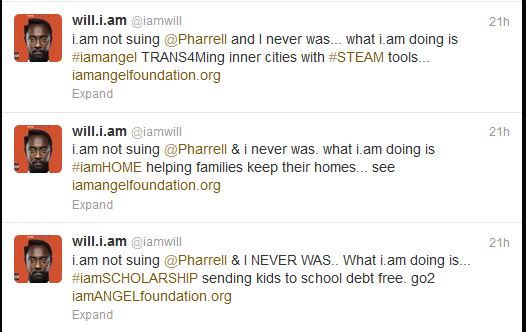
Entertainment news reports of trademark or copyright issues often present a lot of misinformation about the law.  One major music magazine claimed that Pharrell was being sued regarding his new brand name by Will.I.am for a “copyright” claim, which I suppose Will.I.Am correctly denied. Another article stated that Will.I.am was not suing Pharrell and that Will.I.am’s lawyers dismissed claims of a dispute but that it was an easily resolved trademark dispute.  How calling it a trademark dispute dismisses claims of a dispute is interesting.   Will.I.am himself has denied suing Pharrell on Twitter:


The truth, as usual, lies somewhere in between.  Even if he does not want to admit it on Twitter, Will.I.am has opposed the registration of I Am Other Entertainment’s trademarks.   Opposing registration is procedurally akin to a lawsuit, with the desire to stop the other party from registering (and using) their applied-for mark.  There is a complaint (called a “notice of opposition”), an answer, discovery, trial testimony and ultimately a decision as to whether the mark will register or be administratively abandoned.  The major difference is that an opposition proceeding occurs within the Trademark Office at the Trademark Trial and Appeal Board, while litigation usually occurs in court.

Will.I.am may not be a party to a lawsuit, he certainly can tweet #iamopposer.  We’ll see if he’ll be able to tweet #iamwinner when this comes to a conclusion.

Will.I.am does own a registration for I AM with respect to apparel, a mark which is wholly incorporated into  Pharrell’s I AM OTHER trademark, which Pharrell has applied for with respect to apparel.  But there are many registered marks that incorporate I AM for use with apparel that could be problematic for Will.I.am, including the recently registered I AM. & Design mark.  As for WILL.I.AM versus I AM OTHER, it will be tougher for Will.I.am to convince the Trademark Office there is a likelihood of confusion in the marks which differ in sight, sound and meaning.   Hopefully, with the attention given to this, the two can reach an amicable agreement.

If not, maybe next they can start another “non-dispute” over each other’s hand gestures


Do you think that asking for a person’s zip code could ever result in a privacy violation? If your answer is no and you are collecting information from a resident of the District of Columbia, think again. A lawsuit was recently filed in the United States District Court for the District of Columbia accusing of Urban Outfitters, Inc.  of asking for zip codes in a way that implied the information was required for a credit card application.  Earlier this year, the Supreme Court of Massachusetts ruled that a retailer could be sued under Massachusetts privacy laws for collecting zip codes in connection with credit card transactions.

An expectation of privacy in a person’s zip code hardly seems appropriate or a cause for concern, but these cases underscore a theme when addressing privacy concerns. Transparency will be your best defense to a claim that a company violated a person’s right to privacy. Tell the consumer what information you are collecting and how you will use it. In today’s day and age, being transparent about what would appear to be innocuous information could save a company from a lawsuit over its data collection practices.

– Derek Allen, Attorney –

Microsoft is dropping its new console, the Xbox One, just in time for Christmas this year.  The official unveiling occurred last month and reviews have been . . . mixed.  The most controversial aspects of the console were requirements that the console be able to access the internet once every 24 hours and that every user of a video game pay for a license.  The first was controversial because this requirement applied even if someone solely wanted to play single player, off-line games.  Like today’s teenagers, the machine literally wouldn’t function without a constant internet connection.  The second requirement was controversial because it made people pay for things they think should be free (or really cheap).  If I want to borrow a friend’s game right now, he gives me the disk and I’m free to play it.  The Xbox One (which, thanks to its Orwellian internet connection, would know whether I have a license for the game) would require me to buy a license to play my friend’s game, otherwise it wouldn’t work on my machine.

Predictably, fans of the current Xbox console threw a hissyfit and even the mighty Microsoft listened, changing both of these policies last week.

But while the power of the masses may have changed these policies, the same power isn’t going to work if you want to sue Microsoft over the Xbox One.  According to the console’s purchase terms, a buyer can’t sue in the regular court system (arbitration is mandatory) and agrees to waive all rights to participate in a class action lawsuit.  I come across arbitration clauses all the time and those are enforced as a general rule.  I haven’t seen a “no class action” clause before, but my (usually wrong) gut feeling is that these are likely enforced too.  So, on the off chance that your Xbox One does something that makes you want to sue Microsoft, you’re probably on your own.


For those attending the HOW Design Live Conference in San Fransisco, you may have noticed the inside cover of HOW’s Special Issue on Interactive Design and Typography, most likely penned by a nervous trademark type:


Nervous, I say, because these types of advertisements frequently are designed to help prevent unwanted genericide of a trademark. The idea generally is, let’s show and create a record that we are educating the public about our trademark rights and hopefully deterring misuses that otherwise might find their way into the public eye and influence the relevant public’s understanding of a term or symbol as being generic and part of the public domain, free for anyone to use, even competitors.

So, I suppose that Car-Freshner Corporation USA is wanting to influence designers behavior with this ad placement and disuade them from incorporating the green-colored product configuration trademark into things where it doesn’t belong.

A trademark type inclined to be nervous might also consider placing such an ad to cover the company name too. I’ll have to admit, I was quite surprised to see the trademark registration symbol next to the words Car-Freshner, but a review of the USPTO’s handy online database reveals it, in fact, is presently a federally-registered trademark for “absorbent bodies impregnated with a perfumed air deodorant.” Hmmm, might we add this one to the Genericide Watch list?

What is the generic category term for a car freshener if it isn’t Car-Freshner? I’m thinking the generic product description set forth above and found in the company’s trademark registration from 1959 hasn’t yet caught on and is not likely to catch on anytime soon.

It has too much of a feel like Rollerblade’s “boots equipped with longitudinally aligned rollers used for skating and skiing” example that pre-dated the incarnation of the more consumer-friendly generic “in-line skates” product category name.

So, which registered trademark deserves more attention to help avoid genericness, the green tree design or Car-Freshner?

Matt Kucharski, Executive Vice President, Padilla Speer Beardsley

I’m not really the kind of guy to recommend brands on social media, which is a bit ironic because that’s the ultimate goal of every marketer – to turn your customers into advocates.

But that all changed the day I discovered Dollar Shave Club, an e-commerce business that sends a month’s worth of really good shaving cartridges for a fraction of the price of what you’d pay at the store.  I was all-in and didn’t hesitate to tell my Facebook friends about it.

Soon after my smoother-than-LeBron-in-the-paint shaving AND buying experience, we had a SMERF team meeting here at Padilla.  That’s our Social Media Elite Response Force for those of you uninitiated.  We got into a great discussion about why people choose to advocate for brands, and the smart folks on the team were able to boil it down to three motivators:

1. Helping Others: There may not be an “i” in team, but there’s a “self” in selflessness.  In other words, helping someone out also makes the helper feel good.  While the DSC folks said they’d reward me with points for referrals, it’s not really motivating me.  As a relatively recent head shaver, I was really and truly annoyed at the prospect of paying $3 for a handle and $20 for a pack of 3 cartridges. Self actualization was achieved when several of my felly baldy social media friends acknowledged my post with their Likes and comments.

2. Validation: Some people do it simply because they want everyone to know that they did it.  It could be because they need validation after making a high-involvement purchase (like the more than 400,000 people who Like and post on the Toyota Prius Facebook page) or it could be simply because they want people to know what they’re doing online – like the people who let friends know that they took the Grey Poupon Society of Good Taste test and passed (yeah, I did that too).

3. Perks: Some people just want the free crap.  There’s nothing wrong with that, and I’d argue it’s the most straightforward reward that brands can offer.  My colleague and social media role model Michelle Wright is a daily deals site addict who is more than happy to tell her closest social acquaintances about her latest Groupon score if it means getting a kick-back on her next purchase with the site (so long as it’s something she thinks her friends would Like).

Don’t get me wrong – you can have more than one motivator.  The marketers for the Broadway musical Book of Mormon are using Big Door to create a program where you earn rewards for sharing information (the free crap component), and their “street team” members also are the first to receive news about this very popular, hard-to-get-into show and can share it with friends (part validation, part helping others).  We digital marketers call it “gamification.”  My mom would call it “too much time on your hands.”

So what’s this all mean?  If one of the goals for a communications campaign is to drive referrals (or in a non-marketing sense, advocacy), you need to understand which of these three motivators comes into play, and develop your content marketing strategy accordingly.

Oh, one last thing. Sharing this post via Twitter, LinkedIn or Facebook page will not only help me out, it’ll also make you feel really, really good.  Sorry, no free crap, though.

– Anjali Shankar, Attorney –

Amy Brooks, from Rochester, Minnesota, has been selling handcrafted soaps that are designed to reduce skin irritation for cancer patients going through therapy. Brooks herself is a cancer survivor and has sold this product for ten years under the name Bubbles by Brooks.

 About a year ago, Brooks became subject to a trademark infringement lawsuit by Brooks Brothers, the Connecticut-based clothier, which has fragrances and “cleansing products.” Brooks Brothers demanded that Bubbles by Brooks withdraw its trademark application with the U.S. Patent and Trademark Office, stating that while “Brooks” was Amy’s surname, it did not “give [her] the right to infringe on the Brooks Brothers trademark or otherwise compete with Brooks Brothers.”

 Brooks did an interview about a year ago, when she acknowledged that her business had grown over the past ten years mostly due to word of mouth. She noted that if she changed the name of Bubbles by Brooks, she would have to change everything, including her custom paraphernalia and website. Brooks thus became entangled in a practice sometimes called trademark bullying, wherein a small business is faced with a hefty lawsuit against a much larger corporation.

 The U.S. Patent and Trademark Office did a study in 2011 and noted that the costs of legal representation greatly impact the ability of small businesses to fight trademark challenges. The study also found that there were enough mechanisms in place to punish or deter abusive tactics, however.

Just yesterday, it was reported that after a year of legal battling, Brooks Brothers had dropped its trademark infringement action against Bubbles by Brooks. Brooks had received free legal assistance from a team of intellectual property lawyers from a Minneapolis-based law firm. The dispute was handled in the U.S. Patent and Trademark Office. While the number of smaller businesses prevailing in these types of disputes is on the rise, the smaller businesses tend to prevail in just over five percent of the time. Brooks was grateful for the representation and noted that business has been good.

Trademarks covering cheese are at the heart of two lawsuits involving Kraft Foods Group, Inc. (“Kraft”).  Kraft is the largest packaged-food company in the United States.  It is second only to Nestlé in terms of world sales.  Kraft is both a plaintiff and a defendant in pending lawsuits.

At the beginning of June, Saputo Cheese USA Inc. (“Saputo”) sued Kraft, alleging unauthorized use of the TOPPERS mark for Velveeta cheese products.

Specifically, Saputo brought the following claims against Kraft:  (1) infringement of a federally registered trademark; (2) federal unfair competition and false designation of origin; (3) federal false advertising; (4) violation of the Uniform Deceptive Trade Practices Act under Illinois law; (5) common law trademark infringement; and (6) common law unfair competition.  Saputo is one of the top three cheese manufacturers in the United States.

In another lawsuit, Kraft is the plaintiff, alleging that Cracker Barrel Old Country Store Inc. (“CBOCS”) and others intend to enter Kraft’s trade channels, and because their new, licensed food products under the CRACKER BARREL mark are highly related to Kraft’s cheese products under the identical CRACKER BARREL mark, an injunction should issue.  Specifically, Kraft brought claims against CBOCS and the other defendants, including:  (1) declaratory judgment that the CRACKER BARREL mark, if used in connection with the goods sold in retail food channels, will constitute trademark infringement; (2) declaratory judgment regarding unfair competition; and (3) unfair competition and unfair business practices contrary to the state and common laws of Illinois.  Kraft wants a marketing license agreement between CBOCS and the John Morrell Food Group to be declared void because it violates its rights to the Cracker Barrel brand.

CBOCS brought a counterclaim alleging that it has federal registrations and is the presumed owner of valid trademarks with the exclusive right to use the CRACKER BARREL OLD COUNTRY STORE® marks and the CRACKER BARREL® marks on the products and services at issue in retail locations.  Accordingly, it contends that Kraft’s complaint is without merit.

Kraft claims to have sold cheeses called “Cracker Barrel” since 1948 and has had a trademark registration with the United States Patent and Trademark Office since 1957.  Its first “Cracker Barrel” trademark application was filed in 1950.  The lawsuit arose after CBOCS announced a licensing agreement to sell “Cracker Barrel” branded items in grocery chains.  In response, CBOCS countered that Kraft has not objected to its sale of products with the mark on the packaging for decades.  Moreover, products from Cracker Barrel restaurants are now being sold in grocery stores.  Cheese is not one of those products (at least not yet).

CBOCS has filed applications for a number of trademarks related to goods such as:  a range of meat products, lemonade, muffin mix, oatmeal and fruit tea.  Kraft is likely worried that Cracker Barrel will also file an application for the mark in connection with cheese.

Do you think Kraft will win one or both lawsuits?

–Cathy Dahl, Attorney

When we aren’t playing baseball in the backyard or at little league baseball games, we watch a lot of baseball. Mostly the Twins, but it doesn’t take the M & M boys to bring us together in front of the television. The other day a friend of mine was celebrating a special birthday of a family member, and they had great seats to the Nationals vs. Twins game. So I watched in part because I wanted to see him on television. I very quickly got distracted by the big Red “W” plastered all over the Nationals’ stadium, and honestly for a moment believed that somehow Walgreen’s was sponsoring the team.

I mean look at these:

Walgreen’s Logo                                                Washington Nationals Logo


This isn’t a new discovery, by any means. But what surprised me is that the Washington Nationals have been pretty aggressive in enforcing their rights at the Trademark Trial and Appeal Board. They have opposed or sought extensions of time to oppose marks such as THE BIG “W” for radio broadcasting and internet radio broadcasting services; W & Design for “entertainment services, namely, providing a web site featuring photographic, audio, video and public affairs programming”; and W SHOES for “on-line retail store services featuring shoes, socks, hosiery, handbags, jewelry and eyeglasses.”

In the W SHOES Consolidated Opposition/Petition for Cancellation, the Washington Nationals set forth the progression of their stylized “W” (which harkens back to what does “W” mean to the Washington Nationals?):

The Opposition further states that the Washington Nationals use the stylized “W” in “connection with baseball games and exhibition services and a wide variety of goods and services, including, but not limited to on-line and retail store services; clothing, including, without limitation, shoes, socks, hosiery, slippers, jackets, caps, dresses, ties and wristbands; bags; jewelry. Amazingly, the Opposition then goes on to assert that “[a]s a result of the sales and promotion of goods and services bearing or offered in connection with Opposer’s W Marks, Opposer has built up highly valuable goodwill in Opposer’s W Marks, and said goodwill has become closely and uniquely identified and associated with Opposer.”

Which is why I guess I thought Walgreen’s was sponsoring a baseball team?

– Mark Prus, Principal, NameFlash

One of my local stores has a huge selection of “As Seen on TV” products.  In reviewing their offerings, it occurred to me that the brand names are almost all descriptive & highly functional names that make it very clear what the product does. I’m talking about names like the “Furniture Fix™” chair and cushion support, the “Perfect Pancake™” cooking system, the “Perfect Fries™” French fry cutter and the “Wax Vac™” ear cleaner.

It’s possible that a simple, descriptive name may be all that is needed for a product that is usually accompanied by a long-format infomercial.  After all, you are going to demonstrate the product and show its benefits, enabling you to elaborate on the product’s premise over and over again, so why try to deliver a name that has deep and rich meaning?  All you really want to do is get people to pull out that credit card and pick up the phone!

Actually, the “branding” in “As Seen on TV” products is part of a trend in name development.  Many clients want highly functional names because they claim not to have the money to establish a name that is not obvious to the consumer.  That is one of the few pros of a descriptive name.

However, there are many more cons to using a descriptive name.  In general, the more functional the name, the more likely it genericizes the product and destroys the potential competitive advantages of the product.  How many variants of “fast” are there in the cleaning aisle?  How do you decide which one to buy?  It also makes trademark clearance a more difficult task.  Just try to get anything with “fast” registered for a cleaning product! And if you manage to get a descriptive name registered as a trademark, it will be a weak mark at best.

Not all “As Seen on TV” brands are taking the easy way out, though.  Consider “Poo~Pourri™,” the “Before You Go Bathroom Spray.” It’s not exactly a functional name, but I’m not buying it!