Yesterday we wrote about how petitions for partial cancellation under Section 18 of the Lanham Act can be creative and powerful tools when an applicant is confronted with likelihood of confusion registration refusals under Section 2(d), based on over-broad federal registrations.

Today, we’re speaking about this important tool that should be found in any trademark practitioner’s tool box, and in case you’re not able to attend, here is a table I put together that helps me consider which tool works in which context:
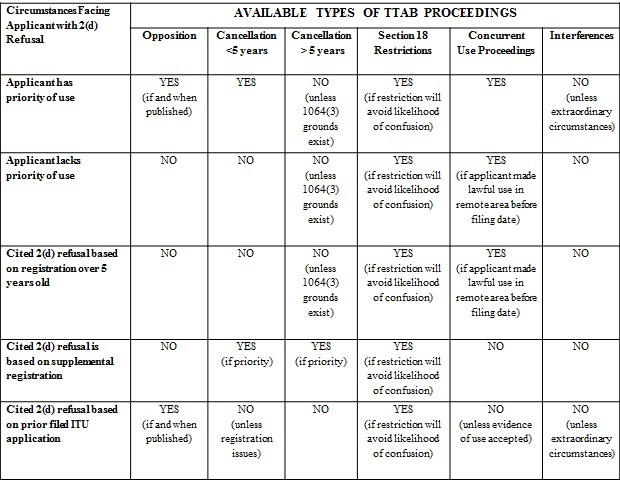
TTAB Proceedings ChartWhat do you think? Is it helpful in organizing your thoughts about the strategic use of TTAB proceedings to assist in overcoming likelihood of confusion refusals, or does it bring back bad memories of Jeopardy?

I’ll take Section 18 Restrictions for the Daily Double, how about you?

Section 2(d) of the Trademark Act is the statutory basis for refusing registration based on likelihood of confusion with another mark. It is invoked on an ex parte basis by USPTO Examining Attorneys, and it is also raised in the context of inter partes cases between adversaries.

When an applicant seeking to register its mark is refused registration based on Section 2(d), it is not uncommon for applicant’s counsel to immediately argue for coexistence, explaining all the reasons why no likelihood of confusion exists, and sometimes that strategy will work.

My preference is to pause after receiving the refusal, to assess the strength of the refusal, to examine the cited mark and registration or application, to consider the relative priority positions, and determine the real necessity for and consequences of arguing no likelihood of confusion.

For example, if it could be determined that the cited registration is actually “deadwood,” the mark no longer in use and abandoned, wouldn’t it be better to hit the pause button on the refusal while the deadwood registration is removed through the filing of a petition to cancel?

Using this approach could prevent the narrowing of applicant’s trademark rights and protect the applicant from taking public positions that could be used against it by adversaries in a future enforcement matter. This strategy is frequently used by sophisticated trademark counsel.

What if the cited prior registration is not “deadwood” though, and the applicant actually has priority of use — if so, and the cited registration is not yet five years old, then it’s fair to ask why arguing for coexistence makes any sense at all, at least as an opening strategy.

Many experienced trademark attorneys with those facts would recognize the leverage given by the refusal and, at a minimum, reach out to counsel for the owner of the cited mark to discuss the multitude of options available to applicant as the senior user of the mark in question.

A tool infrequently used by trademark counsel is the option of a petition for partial cancellation, by invoking the remedy found in Section 18 of the Trademark Act. This can be a powerful tool when an applicant lacks priority and/or the cited registration is more than 5 years old.

Under Section 18, the TTAB may modify or partially cancel a cited registration by limiting and narrowing the specified goods or services. This can be a particularly powerful tool, when an applicant’s options are otherwise quite limited, without priority, or if facing an old registration.

To properly employ this tool, applicant’s counsel must plead and prove that the proposed narrowing in the cited registration would avoid a likelihood of confusion, and that the proposed narrowing of the goods/services description is consistent with the actual marketplace usage.

Think of it as a way to narrow a blocking registration enough to allow for coexistence of applicant’s mark on the Principal Register — it is a way to cure the problem of an over-broad registration, making room for your client’s pending application, if the facts support coexistence.

Even if an applicant may not have the appetite for seeing a Section 18 petition for partial cancellation through to conclusion, it can be a powerful attention-getting device that may level the playing field and spur a dialogue between the parties to explore the possibility of consent.

On a related note, in the context of possible strategies ripe for an applicant whose mark has been opposed by a registration owner having an over-broad description of goods/services, you may recall that we wondered out loud whether Section 18 might become a creative solution:

“I’m looking more forward to hearing about what in-house, corporate trademark counsel think about the decision and how it will influence their trademark enforcement strategies. . . .

But, in the meantime, what no one seems to be talking about (yet) is how the Supreme Court’s B&B Hardware decision might impact the lingering concerns surrounding trademark bullying. (I haven’t seen anyone talking about Section 18 counterclaims as a creative response strategy either, but we’ll save that topic for another day).

Although trademark bullying concerns were not before the Supreme Court, it seems likely this decision scored a victory for those who might fall into the category of trademark bullies. And, as you may recall, a couple of years ago, the Supreme Court didn’t allow trademark bullying concerns to influence its interpretation of the laws in question there: Supreme Court Upholds Nike’s Promise to “Break the Wrist, and Walk Away”.”

To the extent you’re in the Twin Cities or can get here fast, we’ll explore this topic more in tomorrow’s continuing legal education program called “Mastering U.S. Trademark Registration Practice,” during my session at 2:35 PM session entitled: “Strategic Use of Trademark Trial and Appeal Board Proceedings to Advance Trademark Registration Goals.

We hope to see you there, for details on registration, here is the link to the Minnesota Continuing Legal Education site. If you can’t make it tomorrow, the video replay of tomorrow’s live session is Monday March 7, 2016.

-Wes Anderson, Attorney

In the world of YouTube, subscriber count is king. With over 14 million subscribers, the Fine Brothers seemed at the forefront of new media. But earlier this month, the Internet’s collective scorn for a trademark portfolio sent the Fine Brothers’ subscription count tumbling.

If you haven’t been following Benny and Rafi Fine of the Fine Brothers (during your non-work personal time, of course), they are among YouTube’s most well-known channels as purveyors of “reaction” videos, where selected people provide their immediate response to popular videos, ads, trends, games, and electronics (if you want to feel ancient I highly recommend “Teens React to Nintendo”). Their popularity steadily grew over the last five or so years, and before long the Fine Brothers built up various series of reaction videos – including “Kids React,” “Elders React,” “Teens React,” and the recursive “YouTubers React.”

Screen Shot 2016-02-12 at 6.20.26 AM

Things went south earlier this month, when the Fine Brothers posted a now-deleted video (mirrored here) announcing “React World,” a self-described “first-of-its-kind program that allows people and companies to license all of our popular shows” through a content partnership and advertisement revenue-sharing model. Rafi and Benny lamented that their shows and formats had been “blatantly stolen” by other content creators, and promoted React World as a means to create similar format videos “legally.”

react-world-fine-bros-640x415

Commentators quickly discovered that the Fine Brothers had amassed an extensive trademark portfolio relating to reaction videos, including registrations for KIDS REACT, TEENS REACT, and ELDERS REACT, each for “Entertainment services, namely, an on-going series of web site programs in the field of observing and interviewing” the applicable demographic.

It’s easy to wonder why these registrations were not deemed merely descriptive by the Patent & Trademark Office – instead, only KIDS, TEENS, and ELDERS were disclaimed as descriptive wording. What’s more, the Fine Brothers also had an approved application for the standalone wording REACT, identifying “Entertainment services, namely, providing an on-going series of programs and webisodes via the Internet in the field of observing and interviewing various groups of people.”

The YouTube community did not…”respond” well, questioning why the Fine Brothers would claim ownership over what appears to be a generic term for the genre of “reaction” videos (Kids Say the Darndest Things, for example, comes to mind as a predecessor). Other YouTube accounts also noted that the Fine Brothers had taken down their own “reaction” videos in the past based on an IP claim.
Things quickly went south for the Fine Brothers, and their subscription count dropped by hundreds of thousands as the backlash grew. The Fines attempted to explain their motives, likening the licensing program to fast-food franchising. After this only stoked the Internet’s flames of fury, they issued an online statement apologizing, terminating the React World program, and taking the bold step of abandoning and surrendering all “react” related trademark applications and registrations, saying:
The reality that trademarks like these could be used to theoretically give companies (including ours) the power to police and control online video is a valid concern, and though we can assert our intentions are pure, there’s no way to prove them.
Indeed, a quick check of the PTO records shows that the Fine Brothers have abandoned, or have filed surrender documents, for a host of applications and registrations – only an application for FINE BROTHERS ENTERTAINMENT remains live. (The Fine Brothers have filed Section 7 surrender documents for all of the registrations, but this is not yet reflected in TESS).
Screen Shot 2016-02-12 at 6.18.10 AM
If nothing else, the rise and fall of the Fine Brothers teaches that any brand owner’s audience can uncover your trademark portfolio, and one that appears to “overreach” into descriptive or generic material can generate a profoundly negative backlash, regardless of the motives behind that portfolio. Even if the PTO lets your application through, as it did for the Fine Brothers, the public may uncover your arguably descriptive mark and assume the worst of intentions.

Seeing Carlos Santana this weekend while watching the Super Bowl with friends reminded me about the recently filed copyright infringement suit against BuzzFeed. You might be thinking, “that was Chris Martin of Coldplay, not Carlos Santana, who played the Half Time show.” However, I am referring to Mr. Santana’s revamping of the theme song for the Super Bowl. This brought the 10 time GRAMMY ® Award winner, guitarist, songwriter, restaurateur and shoe designer (I am a proud owner of boots that he designed) back into the spotlight.

The lawsuit was brought by photographer Jennifer Rondinelli Reilly (“Ms. Reilly”), who asserted that BuzzFeed had used her copyrighted photo of Carlos Santana during his tour in Milwaukee.  According to the complaint, Ms. Reilly is a fine art photographer whose business is based on licensing and selling her photographs. She asserts that BuzzFeed is a social news and entertainment company that provides users a platform to share content. BuzzFeed has more than 200 million users around the world.

Ms. Reilly claimed that BuzzFeed directly infringed on her copyright, or in the alternative induced, caused, or materially contributed to the copyright infringement of its users. She seeks an injunction and damages. Further, she claimed that BuzzFeed’s continued infringement after receipt of her demand letter was willful, entitling her to an increased statutory award along with costs, including a reasonable attorney’s fee.

BuzzFeed has not yet answered, but is no stranger to lawsuits. Last month, the Viral News Agency and its founder Mr. Leidig sued BuzzFeed for defamation seeking $11 million in damages.   They claimed that BuzzFeed’s article “The King of Bullsh*t News” deliberately set out to damage their business. And in 2013, photographer Kai Eiselein sued BuzzFeed for $3.6 million related to his photograph of a soccer player heading a ball. The lawsuit settled on undisclosed terms.

BuzzFeed may assert a fair use defense to Ms. Reilly’s lawsuit. This exception to copyright infringement exists for copying of copyrighted material done for a “transformative” purpose, such as to: criticize, comment upon, parody, report the news, teach or research. Steve Baird recently posted about nominative fair use in connection with iPhone 6 packaging.

How do you think this suit will come out?

-Martha Engel, Attorney

The Super Bowl ads this year were much like the game itself – maybe one remarkable catch, a few fumbles, and heavy on defense.  Some even deserved a penalty flag – like the one for toe fungus and the revolting puppy-monkey-baby (and I’m an avid Diet Mountain Dew drinker).  However, there were some subtle shifts.

Although female viewership of the Big Game is getting close to being 50%, many (if not most) of the ads were directed to male consumption.  Of those, beer and cars generally dominate the Super Bowl ad scene.  My family keeps a pretty detailed scorecard of the ads, and by my count (not including ads for upcoming films or local spots), 23% of the ads were directed towards cars and 8.5% to beer.

Since this was Super Bowl 50, I’ll first hearken back to the 1990s to two of my all-time favorite Super Bowl commercials.  I might be biased with a special connection to these two ads, but they are worth a quick review.

https://youtu.be/XO4yvI5QBIg

https://www.youtube.com/watch?v=R1Zaz_VqATE

Both of these ads utilized the expensive Super Bowl air time to reach a new audience, and also pinpointed their most powerful purchasing audience – women.

Although I would argue that, overall, the Super Bowl ads of the 90s were more creative than those that we’ve seen through most of this century (is any one else tired of watching animals acting like humans?), some of the ads this year exhibited similar a similar approach to capitalizing on the exposure of the Super Bowl.

With respect to cars, we saw two ads this year smartly use self-deprecating humor and even negative perceptions of their brand to re-position themselves to a new audience.  Although my favorite ad of Super Bowl L was the Audi “Commander” ad with the new R8, car commercials are generally boring.  They typically focus on some nifty feature (like speakers in a truck bed or voice activated start) or a rugged history if you’re Jeep.  However we saw a significant shift in strategy with respect to two brands.  Prius took many of the negative comments about their vehicles and turned them on their heads in a way that, if you weren’t paying too much attention (or were already a member of the smug club), you may have missed it.   Part of me wonders if the “zip” that they tried to emphasize didn’t borderline on a false advertising claim.  The other was Mini with their “Defy Labels” ad featuring Serena Williams, Tony Hawk, and Abby Wambach talking trash (including some pejorative terms) about the vehicle with the closing line “this car doesn’t care what you call it.”  The Super Bowl also had a quite fetching Ryanville ad for Hyundai, but I’ll still take the Audi R8 over one of those.

The beer ads predominately featured strong females – including a Michelob Ultra ad with female rock climbers, Amy Schumer taking a lead role in Bud Light campaign, and Helen Mirren.  This is a clear shift from how women were previously portrayed in beer ads.  As a recent New York Times article on advertising for the beer industry pointed out, the industry recognized that their ads weren’t speaking to women.  The most surprising statistic to me from that article was that 30% of craft beer drinkers are women, but only 25% of beer drinkers overall are women.  Craft beers tend to be heavier and have a higher alcohol content than your Budweiser or Coors Light, so I was surprised that women had a much larger share of the craft beer drinking population than the overall beer drinking population.  As a result, you may begin seeing more ads divert from eye candy in favor of “empowered” female consumers, as the New York Times article put it.

How are you trying to reach a new audience in your own work?


Jason Sprenger – President, Game Changer Communications

“Ummm…you’re those people who get their clients in the newspaper?”

“Oh yeah, you guys throw some great parties!”

“You’re the pros who people call when they’re in trouble and they need to make it all go away.”

“Huh?  You do advertising, right?”

Believe it or not, these are the most common statements I hear in discussions about what public relations professionals do for a living.  These are people inside and outside the business community: friends, family, business leaders, trade organization officers and many more.  And the looks I get from people, well, it’s like they’re deer in headlights.  I am not a lawyer, but I imagine that’s similar to what they see and hear!

Two main themes come through in these statements.  First – no matter who you ask, PR is very hard to define.  Ask 100 PR pros how to define what it is they do, and I’m sure you’ll hear at least 95 different answers.  Second – people’s opinions of PR are grounded in common stereotypes, some of which date back decades.  Of course, these are issues that lawyers deal with every day as well; this ambiguity doesn’t help our cause.  It’s hard for outsiders to take us seriously or invest in us when we can’t really describe what we do or clearly articulate the value we can bring to the business community.  So it’s up to us to somehow break through and make a difference anyway.

Umbrella of PRFor example, in an effort to help PR and marketing pros solve these challenges, I’ve developed and introduced the Umbrella Model of Public Relations.  This model presents the entire spectrum of ways in which organizations build, maintain and grow stakeholder relationships using communications.  It’s incredibly helpful in illustrating for someone what it is we do in the world of public relations.  It’s also a wonderful tool to use in thinking through what kinds of programs we want to build and what activities could add value in particular situations for particular clients.  It’s the kind of model that I think can help people in any discipline understand what we do and start conversations that bring new levels of value to the organizations we work with.

In this line of work, it’s our responsibility to know about all of the ways that we can help our clients – and to be able to apply them appropriately.  For those of us in PR and marketing, this is where the Umbrella Model can be a big asset: it reminds us of what’s possible for us and the organizations we work with.  I’d encourage the legal community to think about how it can represent and communicate what it does as simply and intuitively as possible, as well.  Maybe there are attributes of a model like this that could be useful.

I also believe that by talking more about what it is we really do, we have opportunities to legitimize and elevate our disciplines to new heights.  I think PR can begin to add more value to the business community by simply showing as many practitioners as we can what’s possible in the first place.  Then, with a better grasp of the tools in our arsenal, we can set the bar higher for ourselves and our work, and ultimately do more for the organizations we represent.  Also, as we deliver on this potential with results, the collective reputation of our profession will only improve.

What is a Super Bowl ad? Typically a Super Bowl ad refers to the ad of a brand that has paid lots of money to air its ad on network television during the Super Bowl, a/k/a The Big Game.

Apparently there are some NFL guidelines CBS had to follow as it began to receive offers of $5 Million for airing thirty second spots, so there is some control exercised by the NFL, it appears.

Not sure how Fiat avoided the NFL ban on “male enhancement products” ads last year — or may a car company allude to another’s banned product and avoid the ban itself?

As we, and others, have written about before, the NFL gets a little crazy about others using the words SUPER BOWL in advertising without the advertiser being an official sponsor.

But, does the appearance or reference to the words “Super Bowl” in an advertisement automatically make it a Super Bowl ad?

To be clear, the NFL doesn’t have an absolute right to forbid all possible use of or reference to the Super Bowl mark or event — especially when nominative fair use may apply.

Word to the wise, don’t try to navigate this fair use question on your own, even if you’re just planning to use the words, knowing you can’t use the logo.

So, what about ads that aren’t broadcast during the Super Bowl, they might be printed or aired leading up to the Big Game, are those Super Bowl ads too?

Would anyone believe the NFL has approved them? Or, do they merely reference another brand, the Super Bowl, in their advertisement, without resulting in any likelihood of confusion?

This gem arrived in my inbox during the course of the week, leading up to Super Bowl Sunday:

DunhamsSuperBowlisComing

What do you think, fair use, or off sides penalty? And, how about this one?

LowrySuperBowlSampler

Last one, was it necessary to avoid use of the Super Bowl mark here and replace with the infamous Big Game instead?

DunhamsSuperBowlSavings

How many letters do you suppose the NFL sends out in the two months following the Big Game?

If you’ve received one, we’d love to here from you, maybe we’ll share your story . . . .

Back to the other kind of Super Bowl ads, some of my favorite “official” Super Bowl ads from Super Bowl 50 were these, in no particular order:

  • Heinz Ketchup’s “Weiner Stampede” — my family loves dogs, what can I say? (USA Today’s AdMeter liked it too: #2);
  • Dorito’s “Ultrasound” — this was hilarious, having been in the delivery room four times, and lacking necessary focus at times, no doubt, but never once distracted with a bag of Dorito’s, at least that I recall anyway (USA Today’s AdMeter liked it too: #3)
  • Honda’s “A New Truck to Love” — can’t resist sheep singing my favorite Queen tune (USA Today’s AdMeter liked it too: #7)

And, I tend to agree with the worst five Super Bowl 2016 ads, according to USA Today’s AdMeter. I’m not sure the Super Bowl is an event where the folks expect to see boring pharmaceutical or laundry detergent ads.

So, which ones did you enjoy?

— Jessica Gutierrez Alm, Attorney

If you watch any amount of T.V. or happened to catch either of the AFC or NFC Championship games last weekend, you’ve probably seen one of the recent cell phone carrier ball commercials.

Initially, Verizon created this commercial, wherein a series of colorful balls rolling down a ramp are used to describe Verizon’s apparently superior performance in a study:


https://www.youtube.com/watch?v=785YQKmgiTo


Verizon clearly demonstrates that its balls are larger and more plentiful than those of T-Mobile, Sprint, and AT&T.

In response, T-Mobile ran this ad, using similarly colored balls and a similar ramp to describe “the rest of the story” from the same study.  It seems now that T-Mobile is the carrier with an abundance of balls:


https://www.youtube.com/watch?time_continue=5&v=gYBaslSJaR8


Ultimately, Sprint jumped in the ball pit too with this commercial, illustrating that it has the fastest balls, according to a different study:


https://www.youtube.com/watch?v=CKQvz1gOHhw


Each of the commercials uses similar visuals, music, and even sound effects.  Potential copyright and false advertising issues aside, what struck me about this series of commercials is the strength of the networks’ colors.

Each of these companies has developed such a strong color identifier that, although the voice-over names the other companies, it does not blatantly draw the correlation for the viewer.  It’s immediately apparent which balls represent which network.

From a quick search, it appears that T-Mobile is the only one of the four networks to have sought federal registration of its color mark.  But enforcement of a trademark does not necessarily require federal registration.

This identification of competing brands by their colors suggests an interesting question of nominative fair use.  Nominative fair use is an affirmative defense to trademark infringement that provides for use of another’s mark for comparison or identification purposes.  A typical example of nominative fair use is a car repair shop that specializes in repairing Volkswagens, for example.  Under nominative fair use, the repair shop can advertise that it specializes in repairing Volkswagen vehicles.  Of course the defense does have limits.  The test for nominative fair use requires:

(1) The product cannot be readily identified without using the trademark;

(2) Only so much of the trademark is used as is necessary for the identification; and

(3) No sponsorship or endorsement of the trademark owner is suggested by the use.

We’ve written about nominative fair use of non-traditional trademarks before.  See here and here, for example.  But in those cases, the marks were being used as a prop to help sell unrelated goods or services.  In contrast, in the above commercials, the colors are being used for the purpose of comparing competing companies.  Verizon’s use of the T-Mobile magenta, for example, is for the purpose of identifying T-Mobile as a lesser service provider.

Before we can decide if the colored balls qualify as nominative fair use, however, we first have to determine if this is a trademark “use” to begin with.  Does Verizon’s portrayal of the magenta, orange, and blue balls to illustrate other networks constitute a use of the companies’ color marks?  After all, Verizon is not using T-Mobile’s magenta, Sprint’s orange, or AT&T’s blue to depict a product, packaging, or store trade dress.  It’s simply a series of colorful balls rolling down a ramp.  Even if the colored balls alone are not a trademark use, does it become a trademark use when coupled with the voice-over discussing each company’s study results?

The fact that this use is for purposes of comparing competing phone services seems to suggest that the colored balls are “uses” of the color marks, prompting the further question of whether it is a nominative fair use.

What do you think?  Is this what nominative fair use of a color mark looks like?

I don’t know what the record is for the longest time it has taken for a trademark application to clear the Trademark Office, but I’m pretty sure that Havana Club would medal. The application for the Havana Club mark for rum was filed on September 12, 1994. That’s 21 years ago, old enough to drink the rum behind the name.

The brand has been caught up in litigation for much of the time. Bacardi bought the rights to brand from the Arechabala family, which owned the brand until it’s company was nationalized by Cuban government after the revolution. Bacardi, another Cuban family company, had distilleries and other assets outside of Cuba. After the revolution they moved out and continued to produce in Puerto Rico.

Old Havana Club Advert

The Cuban government, through a state held company, produced Havana Club and registered the mark in the United States in 1976 based on its Cuban registration. Bacardi has been contesting the trademark since at least 1994. Due to the diplomatic situation, Cuba had to secure a license from the U.S. Treasury’s Office of Foreign Assets Control to be able to pay to renew its registration. In 2006 that license was denied and Cuba was unable to renew the license. It appears that a cancellation was never ordered and that proceedings were on hold while fights in the courts proceeded. On January 13 of this year, the Trademark Office accepted the 2006 payments and renewed the registration after the Office of Foreign Assets Control granted a license.

This brings about an interesting situation. The Cuban state held company had partnered with Pernod Ricard, another spirits maker, to sell Havana Club just about everywhere. Pernod sued Bacardi for selling Havana Club in the U.S., but Bacardi won. So, Bacardi has continued to sell Havana Club in the United States while Cuba and Pernod have produced Havana Club in Cuba and sold it everywhere else (they couldn’t sell in the U.S. because of the embargo). Now Bacardi is selling Havana Club (with the apparent blessing of courts) while Cuba holds the valid trademark registration. The likelihood of confusion is pretty high if the embargo is lifted and Pernod begins selling Havana Club in the U.S.

Havana Club

(My guess is that this one is Cuban – but only because of the stamp on the bottom)


On another point, there has been a lot of discussion about whether the ® symbol acts as something of a government seal of approval, mainly revolving around marks like “The Slants” and “The Redskins.” It’s fairly apparent at this point that the government has been willing to bring trademarks into its diplomacy. So, by allowing the Cuban government to register the mark of a brand that it nationalized without compensation, is the government approving of nationalization without compensation?

Loyal readers know how important look-for advertising can be in making the difference between establishing trademark ownership in the shape or configuration of a product, and being left with nothing but a goose egg (as opposed to a Big Green Egg). That’s not to say, the clunky words “look-for” are required, yet something equivalent and vastly more creative would be nice.

The point is, what a brand owner says about a product’s shape or configuration, or what it says about a particular distinctive physical feature of a product, needs to inform the consumer that the shape, configuration, or feature is distinctive and stands out to perform the same role as the brand name or logo, that might also appear on the product.

In other words, if the brand name could not easily be seen, would consumers know — because of the shape, configuration or physical feature — that the product comes from a single source.

The challenge is to align all stakeholders (PR, marketing, sales, engineering, legal) with when and how to tout clearly functional features of a product without at the same time signing a death warrant on owning the shape, configuration, or feature as a non-traditional trademark, for as long as it remains in use (as opposed to expiring after the term of a design patent runs).

Last week, we identified some self-inflicted wounds that Spyderco Knives is suffering from in maintaining exclusive rights in its claimed round-hole-in-the-blade trademark.

As it turns out, the self-inflicted wounds are worse than originally anticipated, Spyderco actually has published negative look-for advertising statements, along with a road map to help adversaries make out a strong case for invalidation of those claimed rights. It goes on to ask and answer the question, why the trademark round hole, this way:

“The Spyderco Trademark Round Hole is the industry symbol of quality. It is our most recognizable feature and facilitates easy opening and closing of our knives with one hand. The hole offers convenient access and maximum control while opening as well as accommodating large, small and gloved hands. The position of the hole in the blade and the fact that it is round allow for a continuous opening motion. The thumb rests against the hole at a comfortable distance from the palm permitting easy rotation from the pivot point.”

“To open the knife using the hole, place the knife in your open hand at the base of your fingers and grasp the clip side of the handle with the tips of your fingers. Rest the pad of your thumb in the hole, then gently and smoothly slide the blade away from the handle (see below). When a solid click is heard, the knife is locked in the open position (note that the blade should always be locked securely in the full open position before use).”


One Hand Opening


“To close a folding knife that includes a front lock, simply turn the open knife in your hand so that your fingers are on the open side of the handle and your thumb rests on the lock release. Making sure that your index finger is located as high as possible on the handle, release the lock by pressing with your thumb, a gentle flick of the wrist may be necessary. The kick (the unsharpened portion at the base of the blade) will fall onto your index finger protecting your hand from the cutting edge. Rotate the knife so that it is sitting at the base of your fingers with your fingertips on the clip side of the handle (the opening position). Place your thumb pad in the hole or on top of the blade spine and glide the blade safely to the closed position (see diagram). Slightly different closing procedures are used with other locking mechanisms. All closing mechanisms require the utmost caution and care.”

“In many Spyderco models, the hole forms a hump on the top of the blade that serves as a thumb rest for increased cutting control.”

There are some wonderful look-for equivalent statements, for example, “The Spyderco Trademark Round Hole is the industry symbol of quality.” And, it “is our most recognizable feature.”

But, then Spyderco goes on to explain in great detail how the round hole actually is the best shape in performing its intended function by facilitating one hand opening of the knife, providing a graphic tutorial too. I’m not sure how Spyderco survives this slit to the trademark throat.

Perhaps it’s time for Spyderco to call it a day on the “trademark round hole,” and pivot to the horizontal tear drop shaped hole, which it also owns a federal registration for:

SpydercoTearDropHoleWhat do you think, is this shape more distinctive and defensible than the perfectly round hole?

And, keeping in mind that naming a non-traditional trademark is beneficial, what would you call the tear drop shaped hole?

Any votes or support for the Trademark Viking Hole? VikingHelmet