Laurel Sutton, Senior Strategist & Linguist at Catchword Brand Name Development

CES 2016 (January 6-9, 2016) has come and gone, and, as always, offered up a rich selection of new product and company names for analysis (and occasional mockery). Questionable name choices for “innovative” products pop up every day, but only at CES are they concentrated in one place, at one time.

Of course, some of the names come from non-American/UK companies, and so should not be judged by the same standards as English-language efforts. Gyenno, for example, is a well-established Chinese company whose name apparently has no meaning, according to their registered US trademark. It sounds uncomfortably close to the Greek wordpart “gyno-”, but presumably it was chosen for its Chinese significance. Likewise, Carpyz (car pies? Car peas? Car piss?), a French company specializing in fluid mechanics, may have taken its name from its founder, Pierre Carrouset, and Pyz, a scientific notation used in fluid calculations. (This is just speculation – I’d love to know the real derivation.)

But what about Samsung Welt? The name was displayed at CES on a smart belt, or “wellness belt”, which is where the name apparently came from. Despite owning the registered TM for the name, Samsung might want to think about the primary meaning in English, which is “a red, swollen mark on the skin”, something you might get if your belt was too tight, I guess. Welt in German means “world”, which is at least not negative, but again, does not really play well with the product (I’m picturing a belt around the circumference of a lovely round globe – not the image you want for a wellness belt).

Ween is a smart thermostat developed by a French company but aimed at an English-speaking audience. Could it be a play on the French word for “yes”, oui? Or maybe it’s supposed to connote wean – but that doesn’t make any sense at all (wean means to accustom a child to food other than mother’s milk). I immediately thought of the indie band Ween, who coined the name as a combination of the words wuss and penis, and which provokes adolescent snickers to this day. Ween has not yet filed for a trademark, and I’d be very interested to see if they claim that the name is meaningless, and if so, whether the USPTO buys it. (The band does not have a trademark, either.)

Some names are just impenetrable (to me, anyway). Smaato is a mobile advertising platform; their registered trademark was likely a breeze, since the name appears meaningless and unique. Pureple seems to be a play on pure and purple; it’s an app for digitizing your wardrobe, but it’s not clear how the name relates to the function. Spün is the name of a set of smart utensils that tracks calories (something I never want). The set comes with a spoon and a fork, so the name is kind of limiting even if you can figure out that it’s pronounced “spoon” and not “spun”. (The actual sound of “ü” in German isn’t quite “oo”; it’s a front rounded vowel, whereas “oo” is a back rounded vowel.)

And some names are easy to understand but not particularly elegant: Grush is a “gaming toothbrush”. Laundroid is a robot that folds laundry. Whill is a customizable wheelchair. Displ’ever is a home-automation display; the random apostrophe is puzzling, but the domain name is downright awful: displ-ever.com. And then there is Healbe, the company that really likes the word “be” – so much so that they stuck it on their fitness tracker to create the Pig Latinish name Healbe GoBe.

It’s heartening to see that these companies are at least protecting their, ahem, unusual name choices. But maybe, next time, hire a naming company?

Those of you who occasionally read my posts may have noticed that video games are a hobby and interest of mine.  I have posted on issues involving video games several times. See Executing Noriega, Flash in the Panama, Calling All Gamers.  And as I look back on it now, it appears that I, for a long time, had an unhealthy addiction to Call of Duty. (Never fear.  I’ve moved on.)  But despite my general gaming interest, I’ve never taken the time to sit down and post about some of the incredibly important and interesting intellectual property issues that accompany video game development and distribution.

There are very few industries that so intricately intertwine the multiple pillars of intellectual property as do video games.  Indeed, its difficult to identify any other industries that depend so heavily upon copyright and patent and trademark and trade secret law.  Video game development involves artistry, technological innovation, and an entrepreneurial spirit; and it requires large doses of each. Mobile gaming brought along an explosion of development and distribution.  In an ever crowding field, I believe clearly defining and protecting the intellectual property rights associated with game development is going to be an increasingly important activity.  It will be an important strategy issue for developers, and it will be an important issue for elected representatives and regulators in attempting to set the proper incentives for creation and access.

In a lot of ways, the game is just beginning.

Earlier this month the Southern District of New York granted the defendant’s Motion for Summary in Louis Vuitton Malletier, S.A. v. My Other Bag , Inc. The fashion giant had brought suit against a California company over its sales of a canvas tote bag that included an image that “evoked” Louis Vuitton’s classic handbag design. An image of the Defendant’s products is shown below and you can read more about the Motion for Summary Judgment here.


Fresh off their victory, the Defendant My Other Bag (“MOB”) filed a Motion for Attorney’s fees just last week. MOB claims that the facts of the case render it an “exceptional” case under the Lanham Act and therefore request an award of $398,821.

In its Memorandum, MOB acknowledges that the Second Circuit normally requires a showing of “bad faith” before awarding attorney fees. However, the Supreme Court’s ruling in Octane Fitness v. Icon Health & Fitness, 134 S. Ct. 1749, 1758 (2014) rejected this interpretation of the term “exceptional,” instead finding that an exceptional case is merely one that stands out from others due to the relative merits of the claims or the litigation conduct of the parties. Although the case involved a claim of patent infringement, much of the language in the Patent Act mirrors the language of the Lanham Act and, as a result, courts regularly rely on decisions interpreting provisions of one act to interpret the other. Indeed, the Third, Fourth, and Sixth Circuits (and numerous district courts) have all recognized the applicability of Octane Fitness to requests for attorney fees under the Lanham Act.

Does MOB have a winning claim? MOB won on summary judgment on all three claims. That’s helpful, but does not mean that Louis Vuitton’s claims were weak enough to justify an award of attorney fees. Moreover, defenses of fair use or parody are particularly difficult to evaluate as courts frequently reach different conclusions on similar facts. In fact, Louis Vuitton successfully sued Hyundai Motor Co. in the same district under arguably less favorable facts (as MOB points out in its motion, though, Hyundai Motors undermined its own case with some poorly worded testimony).

Predictably, MOB also throws out the “bully” label.  This is by far the first time the label has been thrown at Louis Vuitton.  MOB argues that Louis Vuitton has pursued numerous “weak” claims, including a law school symposium’s use of the LV design on a promotional poster, a “Chewy Vuitton” dog toy, a Danish artist who placed a photograph of a child refugee holding a Louis Vuitton bag on a t-shirt (and then the painting of that photograph), other art exhibits, and the appearance of a character named “Lewis Vuitton” in the movie The Hangover II.  It certainly can’t help that Louis Vuitton appears to wear these tactics as a badge of honor, alleging in its own pleadings that it “actively and aggressively” enforces its trademark rights.

The chances of the court not adopting Octane Fitness are low, but the better question is whether the court considers the facts of the case to justify an award. It will also be interesting to see what consideration the court gives to Louis Vuitton’s perceived “bullying” tactics. When granting the Motion for Summary Judgment, the court did not seem particularly impressed with Louis Vuitton’s claims as it wondered whether the company “just cannot take a joke.” Maybe a $400,000 bill would be the perfect punchline.

We cover a lot of topics related to nominative fair use of trademarks, see here, here, and here for some of those discussions. Does the example below on product packaging from J. Crew qualify for fair use of the iPhone 6 mark?

iPhoneCaseJCrew

The International Trademark Association would say so: “In general, the following uses are considered fair use . . . Use of ‘iPhone’ in non-stylized form on packaging for phone cases to indicate that it is usable with iPhone 6.”

Do you agree? And, why?

We have some razor sharp readers and guest bloggers. We’re deeply thankful and especially grateful when our readers and guest bloggers send us real life illustrations of marketing pitfalls we’ve identified, sliced and diced here on DuetsBlog. They provide more great teaching tools.

Hat tip to our own James Mahoney of Razor’s Edge Communications for reading and passing on to us the fine print appearing on the package insert for a Spyderco Dragonfly 2 pocket knife, appearing to provide a large opening to probe the validity of a federally-registered, non-traditional trademark, namely the prominent round hole depicted on a Spyderco knife blade:

SpydercoDragonfly2

The nearly twenty-year-old incontestable federal trademark registration describes the design trademark this way: “The mark consists of the configuration of a portion of the goods, namely a circular through hole formed in the body of a knife blade.”

The package insert for the Spyderco Dragonfly 2 is reported to describe the round opening on the blade feature this way: “The Trademark Round Hole(TM) in the blade proudly proclaims it as a Spyderco product and ensures swift, positive one-handed opening with either hand.”

Let’s just say, it’s kind of an odd combination of highly beneficial look-for advertising (without using the clunky word “look-for”) in the first part of the sentence (“proudly proclaims”), but then after the word “and” the dreaded functional touting appears, linking function to the round hole trademark design feature (without using the “F-word”).

The website information for the Spyderco Dragonfly 2 reads similarly: “The position of the enlarged Spyderco Round Opening Hole in relation to the pivot leads to smooth opening and the FRN (fiberglass reinforce nylon) handle fits the hand ergonomically with a series of grip angles and leveraging spots.”

The Spyderco Manix product information adds additional cuts: “Improved jimping on the thumb ramp and forefinger choil provide enhanced control and a large 14mm Trademark Spyderco Hole makes one-handed deployment a breeze, even while wearing gloves.”

The Spyderco Dragonfly Foliage Green knife is described this way: “Even the positioning of the Spyderco Round Opening Hole in relation to the pivot is tweaked for smooth opening and hitting all the correct pressure points in the hand. Blade and handle geometry create a series of grip angles with a purposeful flat shelf at the base where the pinkie finger rides as a leverage point.”

Spyderco’s 2014 Product Guide contains additional functionality blade cuts, and in one place, actually uses the dreaded F-word:

  • “All CLIPITs have a pocket clip, a Spyderco Round Hole™ for single-hand operation, and an exceptionally sharp cutting edge.”
  • “and Trademark Round Hole™ provide fully ambidextrous carrying and high speed operation.”
  • “A reversible pocket clip Spyderco Round Hole and sturdy lock mechanism offer convenient carry one-handed access and serious functionality.” (emphasis added)
  • “and has a 14 mm Spyderco Round Hole for quick, one-handed opening — even while wearing gloves.”
  • “with a 14 mm Trademark Round Hole for infallible one-hand opening.”
  • “features a Trademark Round Hole for easy opening.”
  • “have Spyderco’s Trademark Round Hole for one-hand opening.”

The federally-registered round hole design feature is presumed valid as a non-traditional trademark, but given the prevalent language touting function, one must wonder how many cuts with the functionality knife will it take to render the claimed trademark design feature functional and unprotectable as a trademark?

Keep in mind that marketing statements linking form to function can be considered self-inflicted fatal wounds, used against the brand owner when trying to assert exclusive rights in a non-traditional trademark, when the product feature being claimed as a trademark is functional.

Here’s to starting 2016 the right way, by encouraging effective collaboration between trademark and marketing types, and resisting the temptation to tout function when there is the potential for owning and/or maintaining a product design feature as a trademark.

What do you think, are these functionality references fatal wounds, like evidence of a ticking time bomb that can serve to invalidate even incontestable federal trademark registrations?

– Randall Hull, The Br@nd Ranch®

On January 10, 2016, David Bowie “left the building” after an 18 month battle with cancer — a complete shock to many of us who were fans. We didn’t know David was ill. Yes, there were the rumors of his death triggered by his heart attacks, six of them in total. But nothing could make Aladdin Sane mortal, or so we thought.

The sense of loss was palpable — like the death of Steve Jobs.

Bowie was not only a pop icon, he was an innovator, entrepreneur, media manipulator, ever-evolving his image over the decades. He was a brand and his own chief strategist.

Born David Robert Jones on January 8, 1947, Bowie worked in marketing, as a graphic designer, for a very short time before pursuing music full-time. But his eye for color, composition, and contrast was ever present.

His first metamorphosis was in 1960 when he changed his surname to Bowie. This ‘rebranding’ was necessitated by the well-known Davy Jones, lead singer of The Monkees but was not his last transformation.

Bowie’s constant image altering would give most brand practitioners headaches. But there are lessons to be learned by observing his ability to change yet remain himself.

What can be called ‘Brand Bowie’ meant willingly embracing the freedom to transform, to fuse the thing he experimented with into something new, sometimes disconcerting, but always ahead. He was glam before glam rock and his influence reached into hip-hop with samplings from the likes of Jay Z and Notorious B.I.G.

As noted by a recent article in The Verge, Bowie saw the technological evolution of the Internet approaching and wanted to leverage it for marketing his material to larger audiences and allowing the fans to interact with his art. His prescience signaled the thinking of a brand strategist before the term was part of our lexicon and practice. He foresaw what has become reality for most of us — Instagram and Twitter, to name two — as digital venues for artist and audience interactions.

Bowie explored interactive CD-ROMs in 1994 with the release of Jump. He was one of the first major artists to initiate an online-only release of a new song exclusively on the Internet — 1996’s “Telling Lies”. It topped 300,000 downloads.

Through UltraStar, the Internet company Bowie founded, he developed the initial website for the New York Yankees, predating the formation of MLB Advanced Media. This was fandom in the dial-up age.

Sorry Kim Kardashian, in 1997 Bowie was the first to “break the Internet” with a live ‘cybercast’ of his Earthling concert in Boston. I remember watching buffering and pixelated images as the available bandwidth could not handle the demand.

Bowie also created his own service, BowieNet, launched in Fall of 1998. It was an ISP for fans offering ‘unfiltered’ access to the Internet and your own BowieNet email address. No, I don’t have mine anymore!

According to The Guardian, he said at the time, “If I was 19 again, I’d bypass music and go right to the internet.”

In 2000, Bowie took what was considered a controversial step, extending his brand to an online bank, BowieBanc, which offered a credit card with Bowie’s image and a free subscription to BowieNet. Toke on that Snoop Dogg!

Bowie understood the power of subtlety, demonstrated in January 2013 when, without fanfare, he uploaded to his website the video for his single “Where Are They Now”. It became available immediately in 119 countries on iTunes. Social media did the heavy lifting for Bowie.

Brands can learn that to remain relevant, to keep the experience current in our constant state of flux, the one thing that must remain consistent is sense of self.

‘Brand Bowie’ was an iconic and formidable exemplar of experimentation, foresight, adaption and metamorphosis. He showed us how rigid rules could be flexed and yet return to a recognizable shape.

This form of existence on the ‘bleeding edge’ may not be appropriate for all companies and their brands but we have learned from David Bowie that ch-ch-ch-changes can create a lasting legacy, a dynamic brand, and loyal followers.

RIP David. Long live Brand Bowie!

-Martha Engel, Attorney

Emojis – those cute images you may find in a keyboard on your Android or iPhone device – have changed the way many people communicate thoughts, ideas, feelings and concepts.  They can add a certain level of pizzazz to an otherwise ordinary text message, Facebook post, or tweet.  And, if I may borrow a line from a more famous Martha, they certainly are “a good thing.”  For Apple/Macintosh fans, I always was fond of the Zapf Wingbats font – so you might call me an early adopter of this phenomenon.

Emojis have been accepted as part of the Unicode – the computing standard for text.  But each platform has a different expression of that Unicode.

So what about when emojis, or even glyphs, are used as part of an advertisement?

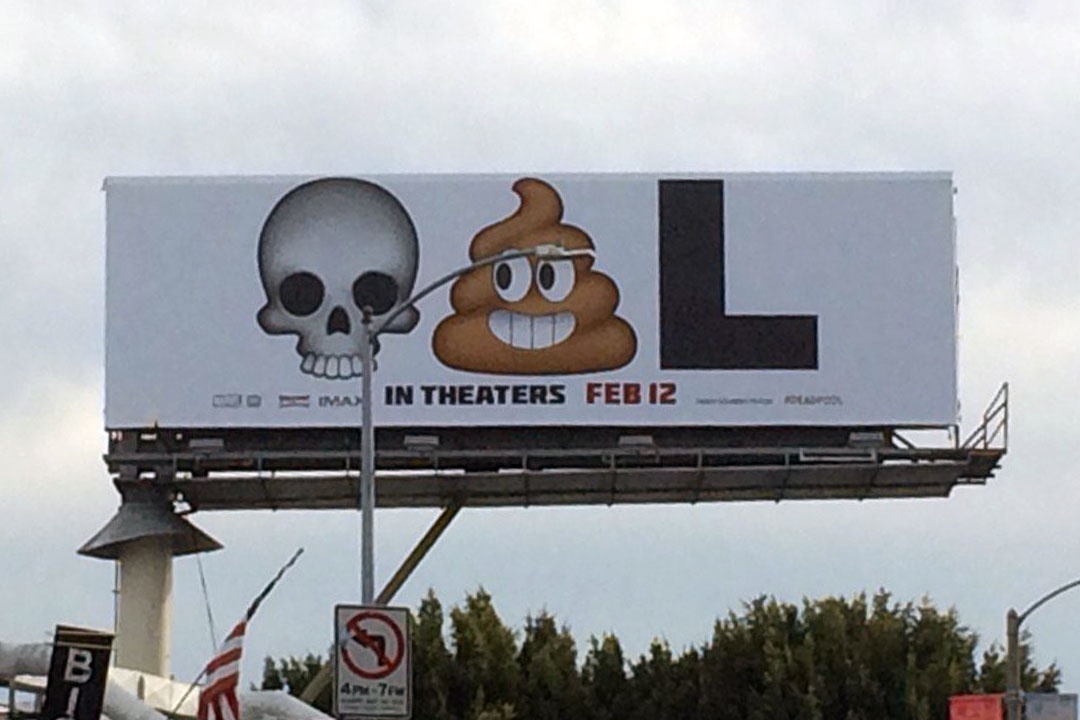
We like to reference billboards in our posts here, so take for example this use:

deadpool-emoji-billboard-pic

First of all, what is that?

Skull Poople?

A Super Bowl 50 reference?

Death to Poopy Face L (did I miss the others? and an ode to Death to Smoochy, one of my favorite Robin Williams movies)

Ohhh Dead Pool.  Like DUH.  (Insert sarcastic emoji).  And there is a pool, or at least a guy swimming in a pool, emoji.

Adweek last week called this billboard “so stupid it’s genius.”

We have written before on the use of emoticons and rights associated with it, but this was one of the first examples that I’ve using emojis as part of commercial speech.  So who owns the “skull” and “poo” emoji?

Well, like most legal questions, the answer is:  it depends.  Because emojis are part of the Unicode, their expression is dependent upon the platform in which the viewer sees the emoji.  An emoji viewed as part of an iMessage is different than one on an Android device or one in a tweet or one on Facebook or in your Google chat.  Because of that, it’s important to consider potential copyright issues before using this in an advertisement.  Assuming this was not a permissive use, the Dead Pool example shown may not qualify as a fair use of the skull or poo emojis.  Fair use is a subjective test that considers:

  1. the purpose and character of the use, including whether such use is of a commercial nature or is for nonprofit educational purposes;
  2. the nature of the copyrighted work;
  3. the amount and substantiality of the portion used in relation to the copyrighted work as a whole; and
  4. the effect of the use upon the potential market for or value of the copyrighted work.

It’s clearly a commercial use and may be considered to take the whole of the copyrighted work, but whether it’s effect of the use upon the potential market for or value of the copyrighted work (to the extent it is one) remains to be determined.

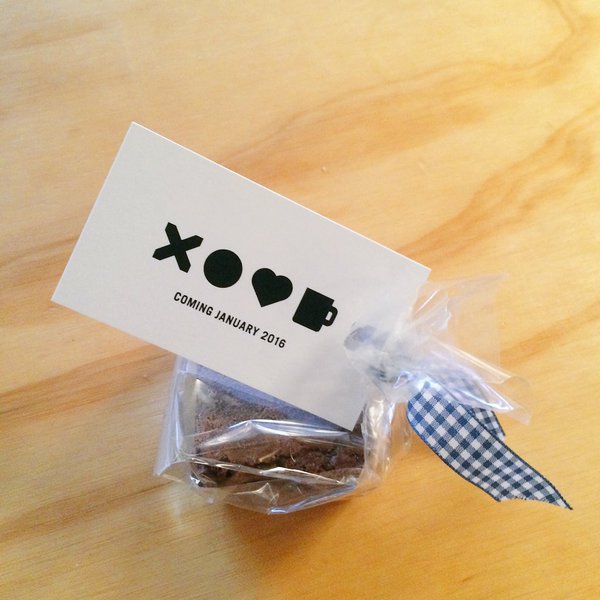
Is life in 140 characters or less moving us into a glyphful culture?  Bachelor Farmer recently launched a new cafe with no name but cleverly and brilliantly branded with a unique logo from iconography (designed by our good friends at Capsule), a logo that has even spurned a hashtag.

bachelor

Maybe once again Minneapolis’  prince, The Artist Formerly Known As Glyph, who’s playing sold out shows at Paisley Park tonight, was well ahead of the times.  Sort of surprisingly, with the benefit of 15+ years, there’s an article about how to write his glyph in Unicode.

The Detroit Lions have registered the phrase Defend the Den. This is part of what appears to be a growing movement in college and professional sports to trademark common or more particular phrases used at their sporting events.

Defend-the-Den_2

The Seahawks have been registering just about everything it can that deals with the number 12 – The 12s, We Are 12, Spirit of 12, and 12 itself. 12 or the 12th man is a common reference to the influence of the fans on a football game. Unfortunately for the Seahawks, Texas A&M beat them to the punch and registered the 12th Man in 2007. Seattle now uses the phrase under license.

Perhaps this is what is driving the push to register such phrases. Teams are worried that someone else will sneak in and attempt to prevent them from using a term at their games. To avoid this, they are racing to trademark terms first. The Seahawks, for their part, appear concerned about being able to use “Boom” and “Legion of Boom” as well.

It seems that policing some of these marks would be rather difficult. Defend the Den, for example, is used by a number of schools and teams with lions, bears, or other similar den dwelling animals as mascots. The Billings Wolves, Montana State University Bobcats, Hershey Bears, and Blake School in Minnesota, among others, all make use of the phrase “Defend the Den” based on a quick Google search. While trying to enforce rights against a minor league hockey team in Pennsylvania may not create much of a public image problem for the Detroit Lions, enforcing them against a school in Minnesota may leave a bad taste in people’s mouths.

James Mahoney, Razor’s Edge Communications

Somebody might steal my ideas.

I’ve heard this consistently over the years, including in a few conversations this past month.

One was with a woman who wants to market her art as greeting cards, but is certain that the “big” card companies would copy her ideas and elbow her out.

The other was with a carpenter who’s afraid somebody will copy his unique designs and import cheap, mass-produced knock-offs from China.

So neither is doing anything to establish a market for their work.

Their fear and loathing aren’t entirely unfounded. To wit:

Not long ago, I received an emailed school photo with a cheery “Just passing along [child’s] handsome school photo. Feel free to print!”

And when a columnist for The Wall Street Journal asked business leaders about their favorite apps, one answered, “Pinterest. I’m a visual person and … We just bought a ski house in Utah that needed bunk beds. I found 185 different bunk bed photos, emailed my favorite to the contractor, and he’s building a knock-off.”

Now individually neither of these is going to break the bank for the school photographer or the creator of the original bunk bed (though in the photographer’s case, at least, the loss of income is real and could be fatal if enough people violate the copyright). But both are prime examples of the blithe indifference most people have to the copyrights and other protections of artists and artisans.

Yet is that really enough reason to never do anything with one’s creations? Does it really make sense to settle for zero market because of vague fears that someone somewhere might do you wrong?

I don’t think so.

The better course is to get educated on how to protect your work through copyright registration, trademark, etc. Then lawyer-up to take action if and when you need to, and let those puppies out of the box.

And yes, I stole the idea for the title of this DuetsBlog from Hunter S. Thompson. The irony is not lost on me.


To the extent you’re also all about brands and trademarks, and you imagine a trademark story with each brand you might encounter, I suppose there are an infinite number of ways, right?

One of the Peace Coffee shops in our office building offers K’UL chocolate, and the point of sale display caught my eye, so I snapped this cool pic, to engage in a little trademark storytelling:


KULChocolate

K’UL Chocolate appears to be a new brand, founded in Minneapolis, so that’s also pretty cool. Actually, even more than cool today, since it’s been downright frigid here the last few days!

So, as I suspected, the brand name is intended to be pronounced the same as “cool” — and it has an interesting and creative origin, according to the company’s website:

“We create great tasting, good for you, functional chocolate and energy bars with the finest all natural ingredients. The name, K’ul (pronounced cool), comes from the Mayan word for energy, which is what our bars provide you with – the ability to do more and do it better.”

A review of the USPTO’s file history for the K’UL trademark application for nutritional supplement energy bars and cocoa based energy bars is as surprisingly simple as the product’s ingredient listings. The only issue that the USPTO flagged related to the description of goods; no mere descriptiveness refusal based on foreign equivalency (Mayan languages apparently aren’t dead); and no likelihood of confusion refusals, despite these other phonetically similar federally-registered marks for similar goods (so, perhaps a crowded field with narrow individual rights):

  1. KÜL FUEL for sports drinks;
  2. COOL MINT CHOCOLATE for grain-based ready to eat energy bars (MINT CHOCOLATE disclaimed);
  3. COOL ENERGY for nutritional supplements for boosting energy;
  4. COOL RUNNINGS for energy drinks;
  5. COOL CONFIDENCE for energy mints; and
  6. ICE COOL for energy drinks.

I’m thinking K’ul Chocolate probably thought it was pretty cool the USPTO’s assigned examining attorney didn’t gum up the chocolate with arguments like these that prevented registration (just last year) of KÜL HANDBAGS for fashion handbags, based on the prior registered mark for COOL HANDBAGS (stylized) in connection with backpacks, beach bags; book bags; and gym bags:

“Applicant’s mark and the registered mark are similar in sound, appearance, and commercial impression. In this case, the marks contain terms that look and sound similar. KÜL and COOL look similar because the terms seem to suggest the same word – “cool”. The marks also sound the same, as the KÜL is pronounced the same as “cool”. Thus this term and COOL paired with the term “Handbags” as the main components of the marks. The commercial impression created by the marks is also similar in that the combination of terms immediately names the type of goods identified, as well as suggesting a quality of the goods. Consumers would experience confusion when speaking about or observing the marks based upon the similarities detailed above.”

KULHandbagLet’s just say, it would be even cooler for K’ul Chocolate, if the other COOL energy food and beverage brands were to view their rights narrowly, and chill on raising any objections as well.

Perhaps there’s an added intentional and subliminal benefit of K’ul Chocolate being for sale in the ever-so-tranquil Peace Coffee shops?

Suppose you’re a brand manager or trademark counsel for one of the previous COOL brands, would you chill or start to melt down, and why?