I know what you’re thinking. It’s about time that we Duets Bloggers shared our war stories on our past lives in seedy bars, taking on any unfortunate soul who might say the wrong thing at the wrong time, or just generally make us mad. After all, what else would you expect from a bunch of attorneys obsessed with guns, motorcycles, and, Disney villains, I guess (Derek, you’re not helping us with any street cred here). Unfortunately, dear readers, those aren’t the type of “bar fights” I’m talking about.

No, I’m talking about the similarly exciting and dangerous world of healthy snack bars – for when your life is too interesting and too “on the go” for a real meal (“Sorry mom, no time for meatloaf, I’ll just grab a Kind Bar. I’m opening for AC/DC on top of a mountain in 20 minutes and I need some ‘lektrolytes“). Kind is a major player on the healthy snack food scene, but it is constantly looking over their shoulder at their sinister arch-rival Clif. The two have been waging an epic battle featuring more than 17 vitamins, all natural ingredients, and more animosity than you’d expect.

The battle reached a new peak this year, however, when Kind sued Clif for trade dress infringement over the new packaging for Clif’s MOJO brand snack bars. The complaint alleges that Clif has intentionally infringed Kind’s unique and distinctive packaging. Samples of the packaging for both products are shown below:

Trade dress can be protected as a trademark, but it depends on the type of trade dress at issue. As a generally matter, product packaging can be inherently distinctive while product configurations would require a showing of secondary meaning. Additionally, trade dress rights will not extend to claimed trade dress features that are considered either generic or functional. However, even common and functional elements can be protectable if a number of non-protectable elements are combined in a way which creates an overall distinctive commercial impression.

Kind’s biggest issue with Clif’s packaging is that it has included a transparent window, which allows the consumer to see the actual bar itself. However, Kind has been careful not to claim rights in this feature as it could be (and should be) considered functional. Instead, Kind softens its argument to merely claim protection to the overall combination of the features, such as using “opaque end caps,” selling a 40 gram bar, putting the product benefits on the front of the wrapper, and, of course, the clear, transparent element of the wrapper. For Kind’s sake, I’m hoping these legal arguments aren’t as transparent as their wrappers. It doesn’t look like there is much there.

And if you were thinking the same thing, well, you should feel pretty good about yourself. The judge presiding over the preliminary injunction proceeding seemed to agree, stating:

“At this stage I would be likely to find for defendant. I’ll leave you with that depressing thought for the weekend.”

The attorney for Kind replied with what, I can only assume, was a statement written by his client’s marketing department: “It only gives me a mountain to climb.”

Even if Kind loses the battle, at least they may have gotten a new tagline. They may want to put it on the back of the bar, though. Someone may already have trade dress rights in putting information on the front of products…
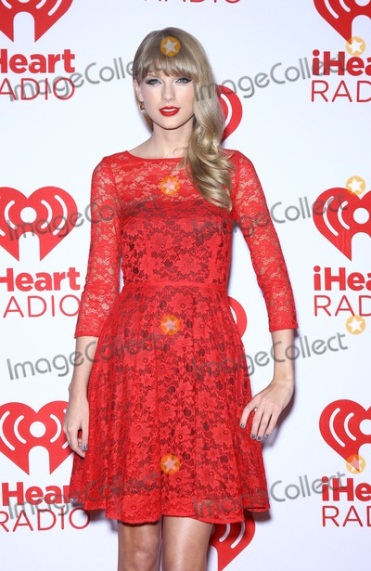
Born on December 13, 1999, Taylor Swift touts the number 13 as her lucky number.  The second sentence on her Website is “I love the number 13.”  This love is often memorialized by a henna tattoo on her hand (see below).  Taylor Swift tries to sit in a seat in row 13 at award shows.  Indeed, Swift claims the number is her lucky charm and has led to numerous wins at these shows.  However, “Lucky 13” was not so lucky for Swift on May 20, 2014.


Blue Sphere, Inc. d/b/a Lucky 13 filed a lawsuit in federal court against Taylor Swift and companies associated with her alleging trademark infringement and unfair competition among other claims. Blue Sphere owns the trademark LUCKY 13® in connection with the marketing and sale of various products including clothing, athletic, bags, backpacking, wallets, key chains, and shoes among other things. 

The Complaint alleges that on or about March 2013 Taylor Swift partnered with a greeting card company to sell greeting card sweepstakes using the mark.  It further alleges Swift’s business empire understands intellectual property and actually enforces its own trademarks. Accordingly, the Complaint continues that, the Swift business empire knew not to attempt to register the mark “Lucky 13“ for apparel because it was already owned by Blue Sphere.      

Will 13 now be an unlucky number for songstress Swift?  Will Swift write a song about this dispute with Blue Sphere a/k/a Lucy 13 as she has done when she is unlucky at love?

– Mark Skoultchi, Catchword Brand Name Development

As you may have heard, the Internet is undergoing a growth spurt of unprecedented proportions. Over 1000 new global top level domains (gTLDs) are in the midst of launching, so in addition to familiar extensions like .com, .org, and .net, expect to start seeing .nyc, .company, .nike, and .golf. And, of course, about 1000 more.

A gTLD Crash Course: Crash now, don’t crash later.

Anyone can apply for a website at a new gTLD, except the branded ones like .nike or .sony. But, buyer beware, the individuals or companies who own the gTLDs can charge however much they want for domains employing their extensions. For example, registering www.xyz.luxury will cost you $600/year, though inversely www.luxury.xyz will cost you under $10/year.

The new extensions all have a “sunrise” period, during which owners of existing trademarks can pre-register domains corresponding to their trademarks before the general public. This is to prevent somebody from getting to Spam.food before Hormel does, for example.

Following the sunrise period is the pre-registration period. This is a length of time before the gTLDs go live when there are no restrictions on who can apply for a domain. If there are multiple applicants for the same domain, some gTLD owners have promised to give it to the first applicant, while others will let them bid against each other in an auction. Though the start and end dates for the sunrise and pre-registration periods are different for all the gTLDs, many registrars allow you to create customized watch-lists for your gTLDs of interest.

How will people react to 1000 new gTLDs?

Though only time will tell, the Internet’s growing pains should be minimal. The new gTLDs will be as searchable as any other website is now, and because Google itself has applied for over 100 new gTLDs there’s a good chance the search giant will be tweaking its algorithms to account for the new extensions. Furthermore, internet users are already growing accustomed to .com alternatives. In recent years we’ve seen an increase in usage of country top level domains like .co, .ly, and .me (not to mention .net and .biz). Though it won’t happen overnight, consumers will similarly come to accept the most used new gTLDs as well.

The other indication that many of these gTLDs will attract significant usage is that, quite simply, the internet is getting more and more crowded. Barring an apocalypse, internet usage worldwide will increase dramatically in the coming decades, and businesses and individuals will be forced to turn to the new gTLDs for their own slice of the web.

Inevitably, though, not all new gTLDs will succeed. Shorter extensions that have clearly implied communities or industries will see the highest demand, like .health, .law, .and .book, but vaguer extensions lacking robust communities or user groups might fall by the wayside—extensions like .gripe, .blue, and .boo. Furthermore, there are many extensions that overlap with each other. With the release of .pics, .photo, .photos, and .photography, it is likely that one or two of these will become the default and the others will fade away. Same with .dating and .singles, .fish and .fishing…you get the idea.

The BIG companies and their gTLDs

Some companies with new gTLDs surely have grander plans for them than just selling domains to interested buyers. To enhance internet book sales, Amazon might allow authors who sell through them to build out websites for their books at a .book address, where customers could go to read interviews, find book tour dates, watch book trailers, and of course, buy books. Nike, on the other hand, might build out sites like soccer.nike or Jordans.nike to give shoppers direct access to products or brands. It’s even possible that Nike could give loyal customers personalized .nike sites where they could shop, customize clothing, build out their wardrobe, and share pictures of them dunking, etc. And what will Google do with their myriad of new extensions? Of course, only time will tell.

Using a .com domain vs. a new gTLD

The question for technology managers, entrepreneurs, and new businesses is this: When launching a web presence, should you choose a .com domain or a new gTLD? Well, as you might expect, the answer is complicated, so let’s go through a few scenarios.

Continue Reading Business in the Age of the New gTLDs

We’ve spilled a lot of digital ink on the importance of “look for” advertising when a brand owner wants to legally own a non-traditional trademark like a single color, or perhaps the shape of a product, or even product packaging or containers, among other potential non-traditional marks.

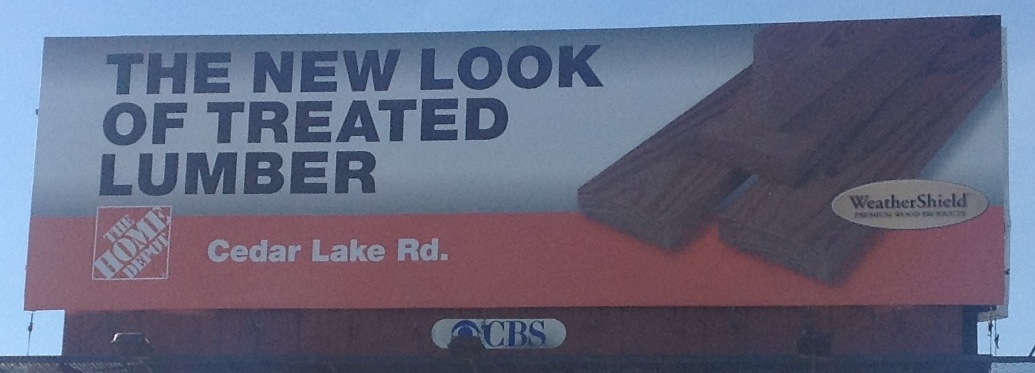
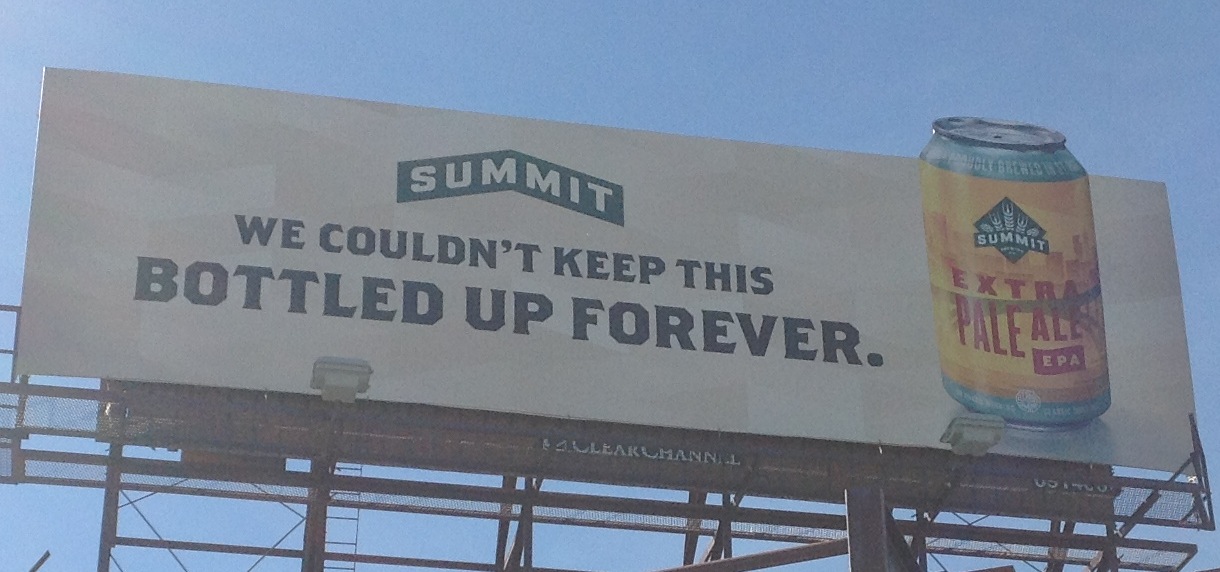
So, when I discovered three billboard ads within a 2 mile stretch of Interstate 94 East on the way into Minneapolis — each focused on “new looks” — my curiosity about the brand owner’s possible motivation for these ads got the best of me (marketing types, how about a little help here?):

The purpose of Anheuser-Busch’s Michelob Golden Light billboard seems to be focused primarily on managing the expectations of existing consumers. It informs of a “new look” to the label, but it clearly doesn’t want happy existing consumers concerned that the change in appearance also signals a change in the product’s taste, it doesn’t: Same Smooth Taste.

By depicting the product on ice, and given the time of year, it also might function as a demand enhancement ad, if I’m correctly following Seth Godin’s post from earlier this morning about three kinds of advertising: Direct response ads, trust ads, and demand enhancement ads.

And, if there was something remarkable or unique about the non-verbal portions of the beer label, drawing attention to the “new look” also could serve a powerful “look for” benefit to enhance legal protection, but given the rather typical non-verbal elements here, I’m thinking it serves little “look for” benefit for the trademark types in the crowd.

Goodness knows, when Anheuser-Busch wants to own a non-traditional trademark it knows how to go about it, remember the bowtie Budweiser can, launched last year? It became federally-registered, just two weeks ago.

With respect to the Home Depot WeatherShield billboard ad, the idea of treated lumber for my outdoor deck project that doesn’t have the typical green hue is enough to get me into Home Depot this summer to check it out, so my experience definitely supports the demand enhancement purpose. Since the “new look” of this lumber is purely functional, however, I’m seeing no non-traditional trademark ownership potential for this new look. Even perfect non-traditional trademark look-for advertising can’t remove functional features or product attributes from the public domain.

The Diet Coke billboard ad seems to share similar purposes to the Anheuser-Busch Michelob Golden Light billboard ad, but it has more potential, it seems to me, to perform a solid “look for” function to enhance legal protection of the non-verbal, incomplete, or partial elements of the new Diet Coke can. Recall that Coca-Cola is the master of executing partial branding: Bits and Pieces of Brands = Trademarks.

Although it is possible to try to accomplish too much in a single advertisement, as Godin’s post from this morning implies, brand owners should look for opportunitites to build a “look for” purpose into existing ads that might serve other primary purposes, especially those where the “new look” can be owned, not only from a marketing perspective, but from a legal perspective too.

Finally, what about this one, doesn’t this one say, look for, without saying look for? This strikes me as a very creative way to communicate a packaging change. Well done Summit.

Can you believe it was on the same stretch of I 94 East outside downtown Minneapolis?

How do you see the purpose(s) of these billboard ads? Effective?

UPDATE:

After posting the above in the morning, I was hauntingly delayed in the protein bar aisle at Target, until I finally located my favorite breakfast bar, then enjoying comfort that the NEW LOOK doesn’t mean a different taste:

Be forewarned.  What you are about to read could very easily be characterized as a rant.

Earlier this week, I was driving home from work when I heard a radio commercial for Mountain Dew Kickstart.  Similar to the above visual advertisement, the radio spot touted the perfect combination of “dew, juice, and electrolytes.”  And, with a substantially quicker cadence and hushed tone, the announcer added “for taste” after “electrolytes” before quickly wrapping up the commercial.  As you will note from the above ad, “electrolytes” includes an asterisk which directs the reader to nearly illegible text that states “electrolytes for taste.”

Being the naturally curious and cynical person that I am, I felt compelled to research and analyze why  Mountain Dew (or PepsiCo) felt the need to effectively shout “electrolytes” while only whispering “for taste”.  And honestly, after looking into the matter further, I can’t think of any good reason other than to intentionally mislead consumers.

My research began with the very basic question of “What are electrolytes?”  The answer, physiologically speaking, is pretty straightforward:

 Electrolytes are substances that are present in the human  body that are essential to the normal function of our cells and organs. They  help maintain proper fluid balance and nerve and muscle functioning. The most commonly measured electrolytes are sodium, potassium, chloride, and  bicarbonate. We lose electrolytes when we sweat. Maintaining a health balance  of these electrolytes in the body is critical, which is why some experts  recommend electrolyte replacement during and after exercise.

Electrolytes have also become a “buzzworthy” concept in health and fitness marketing because strenuous exercise, or exercise in extreme heat, can deplete certain electrolytes below optimal levels.  Sports drinks–like original Gatorade–were developed with increased electrolytes for quick electrolyte replacement via liquid consumption during or after strenuous exertion.  Thus, people often (wrongly) associate “electrolytes” with health, fitness, and energy.  And while “electrolytes” are an important ingredient for many legitimate sports drinks, Mountain Dew Kickstart’s caffeine  and sugar levels would make it a nightmare as an actual sports drink for electrolyte replacement.  Hence, the “for taste” qualifier.

So why do I think Mountain Dew is being deceptive?  All it has done is accurately stated that it contains electrolytes and that they are simply “for taste” and not for some other purpose, right?  Well, simply stated, the only conceivable reason to reference electrolytes in a drink like Kickstart is to dupe customers into thinking this drink somehow has qualities associated with health, fitness, or energy that it does not have.  You know what other drinks have “electrolytes for taste”?  Virtually every other soft drink on the market (including regular Mountain Dew), natural fruit juices, and plain old salt water.  Thus, touting the fact that a beverage has “electrolytes for taste” is the equivalent of advertising the hydrogen molecules in water.  It serves no purpose other than to prey upon people that simply don’t understand.  Shame on you, Dew!

My disdain with advertisements like this range from a disappointed shake of the head to frothing at the mouth with steam pouring out my ears.  At certain times, I consider these advertisements to be mildly unethical; at others, I consider them to be maliciuosly predatory.  At its most basic and best, marketing is an important function that creates brand awareness and honestly informs consumers about important qualities of products or services.  This, in turn, allows the  consumer to make educated purchasing decisions.  At its worst, marketing is the devil ushering society down the road to a real-life Idiocracy.  In an almost frightening moment of prescience, Idiocracy even foresaw the buffoonery surrounding a misunderstanding of electrolytes.

Sadly, this Kickstart campaign is only one example in what appears to be a new normal.  I’ve previously posted on ethical issues in advertising, and the lack of a meaningful code for self-regulation or even self-reflection.  (See here and here.)  As renowned sociologist Jimmy Kimmel demonstrated, we have a generation of “gluten free” converts who don’t even know what gluten is.  We have a multi-billion dollar “organic” food industry where there is virtually no evidence supporting the conclusion that “organic” foods are healthier than conventional foods.  And we have “greenwashing” where advertisers and promoters “mislead consumers regarding the environmental practices of a company or the environmental benefits of a product or service.”  (See here.)  These industries are all like extravagant houses built on piles of bullshit–they look good, but you’ll never be able to escape the stench.

As a practical matter, its difficult to do anything about these advertisements with lawsuits because, under current law, it’s generally difficult to win a “technically true, but deceptive nonetheless” claim.  That may change in the future, but for now, we’re stuck with self-regulation and the sage advice of attorneys that clear the ads.  I implore everyone to look inward and do the right thing.

Rant over.

Taylor Swift, also known as “Tay Tay” to us hip folk, was hit with a trademark infringement suit this week. Blue Sphere d/b/a as Lucky 13 Clothing has been selling apparel under the LUCKY 13 mark for more than 20 years. Blue Sphere claims that Tay Tay has caused confusion among the marketplace by selling clothing with the phrase “lucky 13” on her official website.

My first thought with these lawsuits is normally “are you real?” And it turns out, Lucky 13 is a real brand, with a website and everything! They also have a registration for the LUCKY 13 mark in connection with clothing.

According to Tay, the number 13 is a meaningful number for her specifically. She was born on December 13 and she is often seated in row number 13 (or row M, which is the 13th letter of the alphabet). Unfortunately for T, the “I really like it and it has personal meaning” defense is not specifically enumerated in the Lanham Act.

I reviewed her website, but didn’t see any clothing with “Lucky 13.” Perhaps the offending items have been removed. Because of this, I can’t tell whether the Big T was actually using the LUCKY 13 phrase as a trademark for her clothing, or whether she as merely using it as a decorative element. After all, my first thought after hearing about the lawsuit was “Lucky Brand Jeans is suing Taylor Swift?” As it turns out LUCKY brand jeans is in no way affiliated with LUCKY 13 brand apparel. On top of that, “lucky number 13” is a commonly known phrase. I’m not convinced that the Swift Machine’s use would truly constitute trademark infringement.

My favorite part about the dispute though is that the complaint also states that T Swift is “has been photographed with permanent or temporary tattoos and markets herself as liking fast cars and dangerous men who drive them inappropriately.” According to Blue Sphere, this is the same demographic that their clothing targets. While the similarity of channels of trade is an important aspect of evaluating a claim of trademark infringement, whether or not one “likes fast cars” normally is not a factor that affects the likelihood of confusion analysis. I haven’t seen it mentioned in a complaint before. Like, ever. Like, never, ever, ever.

Much of the success of Apple products can be traced to Apple’s emphasis on design as being equal or greater than the technical advancement of its products.  Talking with a product designer the other day, we both remarked on how often companies do the opposite of Apple – they care more about getting a new product to market than spending the time and resources on getting the design right.

The value that Apple places on design shows in its prolific filings of design patents, which they file not only for the shape of the product but also even the graphic icons. Apple was granted a patent (D671,558) in November 2012 for this graphic icon on a display screen:

Do you recognize it?

The broken lines around the figure indicate portions of a display screen and the lines form no part of the claimed design.

The standard of review for determining whether a design is patentable is whether the ornamental configuration is novel and nonobvious to one of ordinary skill in the art, namely a designer of similar products.

I know we have some talented designers among our readers, so based on that patentability standard should this later filed Samsung design be patentable?   Again, only the solid lines form the claimed design.  Is it novel and nonobvious?

And while we’re at it, let’s talk trademark significance. Without the names of the companies, do either of these images icons indicate source to you?  I’m not sure that either of these function as a trademark.

I would not be surprised if the icons and other design patents come into play as Apple and Samsung continue to battle over their patent portfolios and failed again to come to a resolution of their ongoing patent dispute.

Aaron Keller, Managing Principal, Capsule

Leaving a rigorous visit to the gym recently I was wandering through the parking lot and found myself pulling on the handle of someone’s car. It was white. It had all the visual indicators to help me identify my particular BMW. It was nearly in the same spot I had parked my car.

So, why was I tugging away in frustration on someone’s door?

Well, we have a case of mistaken brand identity. My embarrassment was minimal and the other brand of automobile was left with out any real damage.

It made me consider the design process at this competing brand.

There are many variations on design methods between corporations and firms, but the common threads are these. Get informed using research (trends, movements, human behaviors, technologies, etc). Start forming a plan (design strategy, inspiration and direction, design brief). Then design possible solutions until you come to a final design execution. Again, there are many variations on this approach above, but this is a common practice. The question is this, what is the Hyundai design process?

Let me venture a guess here.

Design Process: Buy a BMW. Drive it to the design floor. Take it apart. Measure everything. Find ways to make each part cheaper. Put it all back together and return it to the BMW dealership. Recreate the BMW using all the cheaper parts and pieces. Design a manufacturing line and start producing near exact copies. Hire a really good lawyer.

Done.

I took the badge off my BMW and the Hyundai (using my less than impressive Photoshop skills). You tell me, which one is in this photo?

Since 2000, Capital One Financial — the nation’s largest direct bank — has been promoting its credit card services by asking What’s in Your Wallet? Three years later it began promoting banking and other financial services using the same iconic tagline, slogan, and question. By 2011, it had achieved so much traction that What’s in Your Wallet? was inducted into the Advertising Walk of Fame as one of the 16 Greatest Slogans in History.

Given what I recently saw on Boylston Street in Boston, the question might need to be updated to take into account the Capital One 360 Cafés popping up across the country.

Blending credit card, banking, and financial services with restaurant and cafe services appears groundbreaking for a financial services brand. Capital One 360 invites consumers to “Swing by a Café today and discover a bank disguised as a place you’d actually like to be.” Their Twitter page reads: “Saving money should be as easy as grabbing a coffee. We’re not just another bank, we’re a community space for you. Stop by, grab a coffee, say hi & save a bit.” Their website goes on, “Let’s Make Banking History”:

“At Capital One 360®, we believe banking should fit comfortably into everyday life. That’s why we’re not just online and mobile; we can now be found in Cafés opening across Boston. A place where you can get your banking questions answered or simply recharge your lives with free WiFi, tips on saving time & money, and freshly-brewed Peet’s Coffee®. See for yourself how together we can challenge every preconception of what a bank can be.”

It will be interesting to follow this generous offering of space and free services to see whether the business model can be sustained, as there are some skeptics in the crowd, given the high cost of real estate and the usual expense of operating retail locations. It’s notable that St. Cloud, Minnesota already landed a Capital One 360 Café, not the Twin Cities yet, but perhaps Cafés are on the way to us too!

Marketing types, if you’ve seen this concept executed before by another financial services or banking brand, please let us know, because it appears to be a novel undertaking for a credit card and bank brand. It remains to be seen, however, whether this creative and engaging brand extension will disrupt the category and force competitors to follow suit.

Extending credit card brands to provide restaurant reservation services is nothing new, but before seeing the Capital One 360 Café in Boston, I haven’t seen any credit card brand serving up actual restaurants or cafes themselves. For example, American Express, Visa, and Mastercard all have been providing restaurant reservation services for some time.

So, imagine my surprise to learn that Visa actually has a federal registration for the VISA mark in connection with “restaurant services” — without qualification or limitation.

The 2008 specimen of use in the prosecution history at the USPTO is questionable to say the least. Indeed, it appears the more recent description of services covering Visa’s single-letter V mark is a little more intellectually honest, given the submitted specimen of use: “Restaurant services, namely, restaurant reservation services, and restaurant ratings and reviews, providing information in the field of fine dining restaurants and fine dining events.” It will be interesting to follow whether Visa modifies the “restaurant services” description when it files a Section 8 & 15 Declaration for VISA in Int’l Class 43.

Having said all that, for the trademark nerds in the crowd, if this Capital One 360 brand extension is really ground-breaking and intended to “make banking history,” you’d think the appropriate trademark filings would be there to support the new services, right?

It was more than a bit surprising, especially considering how robust the Capital One trademark portfolio is, to find no coverage of record at the USPTO for any cafe or restaurant services, under any of their marks. Any ideas why? Hopefully this is not an indication of Capital One’s limited commitment to this new offering.

With brand extensions as far afield is this one appears to be, it’s even more important to lock up the rights early to facilitate a more graceful geographic expansion of the concept.

Hopefully for Capital One, it won’t encounter (during its expansion) any local owner of conflicting trademark rights who is inclined to ask Capital One, by the way, “What’s in Your Wallet?”

In addition of course to good beer and good friends, a good bar for me is defined by a good game: photo hunt (the NSFW version) and foosball at Murphy’s, bar olympics at Steny’s (where I dominated at the tricycle races), volleyball at Fat Daddy’s, bocce ball in the basement of Half Time Rec, lawn bowling at Brit’s, and lately a surprisingly competitive trivia night at New Bohemia.  Some of these teams even have their own Twitter handles and use the same name every week to indicate the source of their trivia talents – I guess I’d better start handing out my card on trivia night.

One game I have not seen much at bars in the Twin Cities and Milwaukee is skee ball. I think the last time I played skee ball was at a Circus Pizza or a Chuck E. Cheese.  It wasn’t until I read about Skee-Ball Inc.’s dispute with competitive skee-ball league Brewskee-Ball that I learned that SKEE-BALL is a registered trademark for “game in the nature of a bowling game.”  In 2011, Skee-Ball sued the operators of Brewskee-Ball for trademark infringement in a case that is still pending.  Despite raising an affirmative defense that the term is generic in its answer to Skee-Ball’s complaint, earlier this month, Full Circle United, LLC (which operates the Brewskee-Ball league)  filed a petition to cancel the SKEE-BALL trademark with the TTAB as being a generic term.

Prior to the lawsuit, a federal registration was obtained for the mark BREWSKEE-BALL  for “entertainment in the nature of skee-ball games; entertainment services, namely, arranging and conducting of skee-ball competitions; providing a website that provides statistics for skee-ball league players; providing recognition and incentives by the way of awards to demonstrate excellence in the field of skee-ball.”

Surprisingly, the identification for the registered mark includes the registered term “skee-ball.”  Under the trademark rules, the identification is supposed to list generic terms for the goods or services and it is “inappropriate to use a registered mark to identify a kind of product or a service, because such a mark indicates origin in only one party and cannot be used to define goods that originate in a party other than the registrant.”  TMEP 1402.09.  The Trademark Office is supposed to look for this when accepting identifications of goods and services, but no objection was made.

As it fights Skee-Ball now in court and at the USPTO, Brewskee-Ball has joined the recent trend that we’ve seen with other smaller fish arguing trademark rights with a bigger fish like FiftyThree with Facebook over PAPER, Exit 6 Pub and Brewery and StarbucksCafé Roubaix Bicycle Shop and Specialized.  And they’re raising revenue for their legal battles through crowdfunding and anti-establishment swag.   While Exit 6 Pub got a lot of attention for changing its Frappicino beer name to simply The F Word, Brewskee-Ball’s take has the most aggressive tone that I’ve seen.  The Brewskee-Ball Twitter background reads in a graffiti font  “THERE’S NO WAY TO SAY SKEE BALL EXCEPT SKEE BALL” and their skeethepeople.com website features an interesting take on Lady Justice, with uneven weights on her scale of justice.


It’s clearly safe to say that this trend is not going away anytime soon.  It’s relatively cheap to set up a website, get a Twitter handle, tweets some hashtags, and generate some sympathetic noise about your trademark dispute.

And while we’re probably not quite there yet – at what point do the bullied become the bullies?

#SKEETHEPEOPLE #Twitteractivism #notgoingaway #itsfriday #enjoytheweekend #iloveJimmyFallon #classic