– Derek Allen, Attorney –

When I wrote my last post, the only statements we had from Donald Sterling regarding his recent scandal were those contained on the recording that got him in trouble in the first place.  Since then, he spoke publicly for the first time in an interview with CNN’s Anderson Cooper and somehow managed to come off worse than he did in the secret recordings.  And he’s made clear, as people close to him have feared, that he intends to fight the NBA tooth-and-nail if it tries to force him to sell the Clippers.

Assuming the case finds its way to the court system, I feel very confident predicting how it’s going to turn out.  It starts with an idea that one of my professors, Douglas Baird, calls the “big boy rule.”  Under the big boy rule, “big boys” like corporations and wealthy individuals are free to enter into pretty much agreement they want.  This is in contrast to people like consumers, first-time home buyers, and people who buy shares from the stock market who are provided some level of protection by our laws and the court system because they are “little boys” for purposes of those types of deals.  In the case of Donald Sterling and the NBA, both are “big boys.”

Because they are big boys, they are free to reach their own agreements, with the agreement at issue here being the NBA Constitution and By-Laws.   Under that agreement, a 3/4 vote of NBA owners is enough to kick an owner out of the league.  Under that same agreement, the decision to do so is “final, binding and conclusive, as an award of in arbitration.”  Assuming the vote to kick him out happens (and it will) and assuming that Donald Sterling takes it to the court system (and it sounds like that’s likely), he’s going to be facing the same challenge as any party who seeks to overturn an arbitration award in court.  In technical legal terms, he’ll be up [blank] creek with a paddle–just ask any litigator who’s tried it.

The reason for this is that courts do not look at arbitration awards, consider the evidence that the arbitrators saw, and then decide whether the arbitrators we right.  It isn’t a do-over.  Instead, a court just looks at whether, again in technical legal terms, the award was totally nuts.  If there is any basis whatsoever for the arbitration award, a court is going to uphold it.  To bring it back to the Sterling case, there is certainly ample evidence supporting the NBA’s decision to kick him out of the league, so that decision is going to hold up in court.  So, duetskateers, feel free to ignore the 24 hour news cycle as it debates this case over the next months (and maybe years) because you already know how its going to end.

Brent Carlson-Lee 

Like a growing number of consumers, I pay attention to where my food comes from. For most products, quality and price still rule but food miles can break a tie.

But when I’m searching for specialty products, authenticity plays a big role. And country of origin is a key attribute, so much so that the European Union has jumped into the fray.

Do I trust Spanish wine? Of course. Do I trust Norwegian lefse? Yep. Do I trust Italian pepperoni? Sure do…but where exactly is THIS pepperoni from?

Let’s break it down.

The packaging is reminiscent of the Italian flag, but Jefferson is a decidedly un-Italian name. Must not be Italian.

And that outline looks a lot more like Wisconsin than the Italian “boot.” Maybe it’s from Wisconsin? It does say “Wisconsin Quality.” Must be made in Wisconsin.

But wait a minute, just below “Wisconsin Quality” it states “Made in Kansas.”

So apparently this is Italian-inspired, Wisconsin-quality pepperoni made in Kansas…by a company with a mailing address in Arkansas.

I’ll pass.

(The) INTA was not in the cards this year, as Hong Kong would have been a very long flight, and besides, Boston (Strong) prevailed instead, to feed my insatiable hunger for creative inspiration at HOW Design Live 2014.

Barbara Walters, (the) Oprah, step aside, here comes Debbie Millman of Sterling Brands:

This interview was thoroughly enjoyable, Seth’s generous spirit and his numerous incites were truly inspiring.

As Seth put it, Debbie went “straight to the ninth inning” in asking why reading The Lorax brings him to tears, but he resisted them in his answer this morning, explaining to thousands that this Dr. Seuss classic leaves him thinking carefully about the importance of being a good “steward of the Earth” for future generations.

Fear and the lizard brain were discussed much, and Seth noted his “most profound” quote to be: “Anxiety is nothing but re-experiencing failure in advance.” Profound indeed. Since fear is hard-wired and it cannot be completely avoided for those who are sane, Seth recommends learning to, and pressing on, to “dance with the resistance.” So, when it shows up, “we welcome it, we dance with it.”

In discussing Seth’s view that “effort isn’t the point, impact is,” he encouraged others to avoid “wandering generalities” (credit, Zig Ziglar), and ask youself: “What is the smallest thing I can master?” Then, build from there. This is not the first time Seth has argued to make it smaller. I suspect doing so also will help to tame the lizard brain in all of us.

Last, when asked by a member of the audience what the bravest thing is that he has ever done, it was an easy answer, no close seconds, Seth remarked: “Having kids.” Amen to that.

Thanks Debbie, thanks Seth, for sharing with all of us . . . .

On my reading list, now:

V is for Vulnerable, Stop Stealing Dreams, Self-Portrait as Your Traitor, and I’m going to re-read The Lorax . . . .

What’s on yours?

– James Mahoney, Razor’s Edge Communications

“Brand” and “branding” are the current darlings of the fashionista class. They’re rapidly driving those terms into the realm of cliché by busily associating them with practically everything you can think of.

But in the midst of branding’s 15 minutes of fame, a potentially crippling challenge faces the non-brand that we have come to rely on: the Internet.

The US Department of Commerce announced in March that it will not renew the contract that gives it oversight of some core functions of the Internet Corporation for Assigned Names and Numbers (ICANN). Thus, the US will relinquish control over key technical elements of the Internet’s infrastructure.

For those unaware of ICANN’s role, it maintains the root-zone filenames and addresses that are the bedrock enablers of the Internet as we know it. Since the beginning, these have been controlled and maintained by a multi-stakeholder, worldwide community of developers, engineers, and network administrators.

Instead, the Administration thinks that this control should be Balkanized among a “world body” of governments and other interested parties, who chafe at the current US role.

Bad idea. In fact, very bad.

It will enable a government to control the flow of information and expression not only within its own borders, but also beyond them because control of root-zone filenames and addresses effectively means control of the Internet and what can flow across it. We have already glimpsed harbingers of this in governmental firewalls and adverse action taken to stifle opposing views and alternative news sources.

Despite its flaws, the US is still seen as that “shining city on a hill” by much of the world’s population. Our country remains the epitome of opportunity and freedom, even in the face of perceived shortcomings in the expression of those ideals.

Until very recently, the opportunity and freedom that the US embodies could be seen only dimly from afar—a beacon unreachable by the vast majority, which made it an unattainable desire.

The Internet changed all this. It is the reachable embodiment of all of the positive virtues that the US represents. For the first time in history, a nation has created something that puts its ideals and possibilities within reach of the majority of the world. And the rules of that medium, such as they are, are firmly linked to those inspiring notions of freedom and opportunity for every voice able to tap into it.

This is why the status quo of US oversight of the Internet, specifically the ICANN functions, is in the best interest of the world’s peoples. Relinquishing it to a “world body” likely dominated by governments, jeopardizes the everyday person’s ability to experience the beginnings of freedom and opportunity, and to be inspired to bring that virtual capability into the reality of their own country.

As the US is the shining city on a hill, so the independence of the Internet, guarded by US stewardship, is the shining possibility in the world’s living rooms. It is too impactful a force for progress to abdicate.


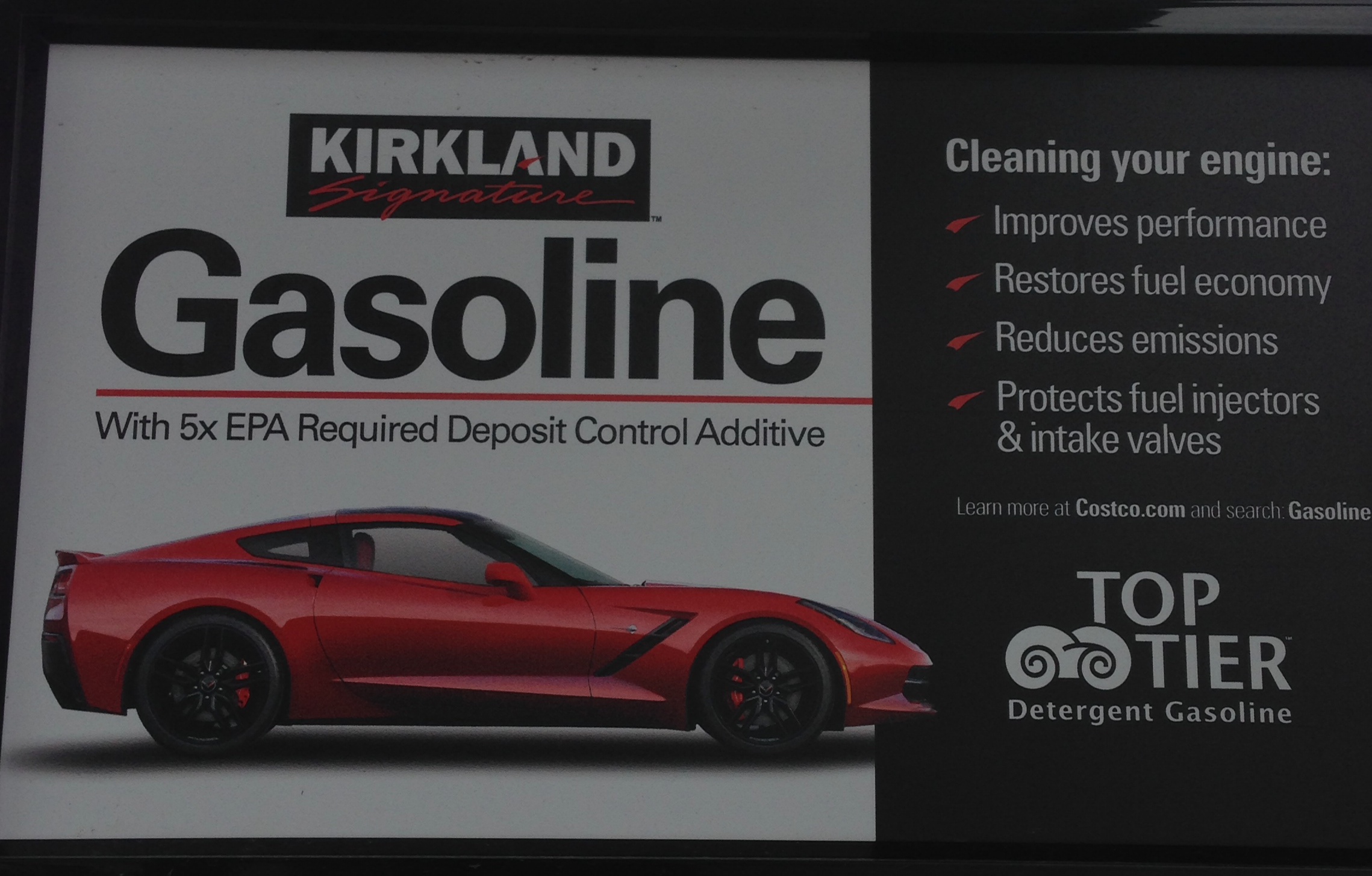
While filling up my gas tank at our local Costco last week I coudn’t resist capturing this photo of pump signage to ask our dear readers a few pointed questions:

Is there any doubt that the automobile depicted in the Costco advertisement is a Corvette Stingray? If so, HiConsumption should resolve any lingering questions.

How did you know (if you did), before checking out the 2014 Corvette Stingray photos on HiConsumption? Perhaps the federally-registered Stingray logo on the front quarter panel behind the wheel? The barely visible Corvette logo on the wheels? The overall shape and configuration of the automobile?

Although GM has a long list of non-traditional trademark registrations to sift through on the USPTO database, I was unable to locate one covering the current shape of the Corvette Stingray (I suspect our friends who are also patent types could probably locate some design patents covering the ornamental design of the vehicle, so I didn’t bother going there), but I did locate a few trademark configuration registrations covering earlier Corvette model shapes of actual vehicles and toy replicas (here [cancelled], here, and here).

Marketing types, how would you go about obtaining the Corvette image to incorporate in the above advertisement? Would you feel the need to obtain permission from GM to display these ads at point of sale? I hope so.

Legal types, is there any legitimate basis for Costco claiming fair use here? I’m thinking not — assuming this use is not authorized or licensed, it appears to appropriate the goodwill of GM to attract attention to and help sell Kirkland Top Tier gasoline. Remember this little gem from five years ago in our archives? The Costco ad above — depicting the entire profile of the vehicle shape and design — seems even less justified than the partial Corvette image in the Schlitz ad, at least from where I’m sitting.

Last, do you suppose this ad on signage slipped by Costco’s legal department or might there be an aggressive stand on fair use, or perhaps if questioned, an attempted defense to challenge GM’s underlying rights — I’m assuming GM can establish acquired distinctiveness in the shape if it had to, even without a federal registration (but a single piece of paper as proof would be much better).

Remember what happened when Tiffany (the jewelry company, not our Tiffany) complained about Costco’s unauthorized use of the Tiffany name?

Costco counterclaimed for cancellation on genericness grounds, so what might we expect here, assuming the point of sale advertisement was not authorized or licensed by GM?

I’m thinking this signage is going bye bye, how about you? So, why don’t we just start the count-down now?

–Ben Kwan, Attorney

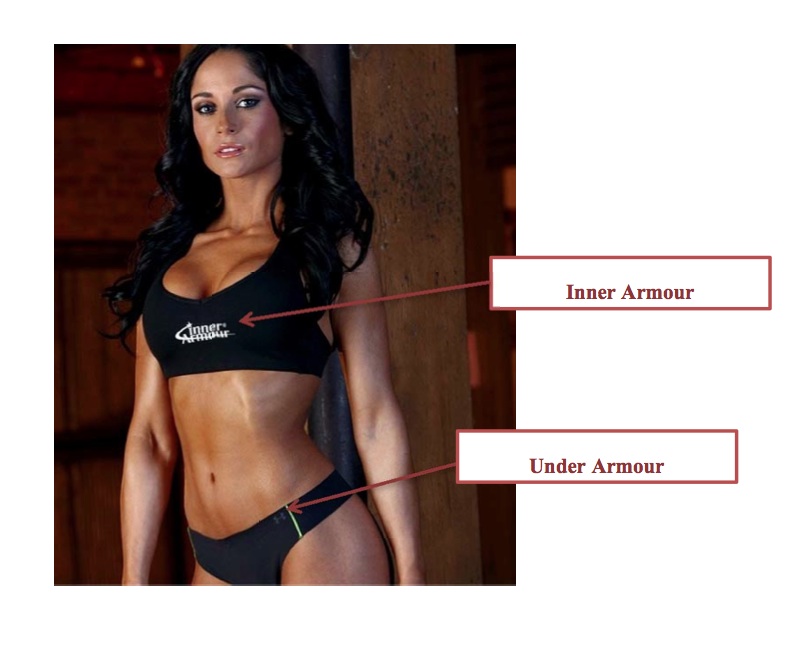
This week, Under Armour, the Baltimore-based athletic apparel behemoth gave us a new take on the well-pleaded complaint.  Under Armour sued Florida-based I A Nutrition, Inc., for trademark infringement in the U.S. District Court for the District of Maryland.  The complaint alleges infringement based on I A Nutrition’s use of the “Inner Armour” mark for the sale and promotion of dietary supplements for athletes.  The complaint is filled with full color images like this:

An image filed with the Under Armour lawsuit shows Inner Armour marketing where a model wears not only an Inner Armour Sports Bra, but an Under Armour bottom, of all things.
Show, Don’t Tell — Complaint Drafting Edition. Under Armour’s complaint against the company behind “Inner Armour” sport drinks and apparel includes lots of images like this.

Part of the suit alleges that, over time, Inner Armour has encroached on Under Armour’s space by moving into apparel. “Making matters worse,” the lawyers allege, “Inner Armour has featured in its advertising athletes wearing both INNER ARMOUR and UNDER ARMOUR-branded clothing.”  Oops.

To walk into court and adequately state a claim for relief, a party’s complaint has got to allege facts that are “plausible on [their] face” under the Supreme Court’s somewhat recent reconsideration of the half-century-old standard for bringing a lawsuit. For non-lawyers, things were getting a little willy-nilly, so the Court wanted to raise the bar on what it should take to sue.

Since the two Supreme Court cases raising that bar came down (see a Wiki on pleading discussing Twombly and Iqbal), lawyers have been very diligent about beefing up their complaints. And apparently we’re getting creative with where we look for facts that meet the new “plausibility” standard.

While the folks behind Inner Armour likely made a marketing blunder with that photo shoot themselves, the Inner Armour people likely had nothing to do with something else the Under Armour lawyers uncovered for their complaint — a screen grab from Tumblr.

The complaint explains:

“Reflecting the public’s recognition of Under Armour’s innovative and expansive product line, Under Armour has regularly received and continues to receive unsolicited beverage-development proposals—some of which even suggest ‘ARMOUR’ marks, such as the proposal for INNER ARMOUR beverages shown below. Another unsolicited proposal was posted on the Tumblr website on March 5, 2012, suggesting that Under Armour develop nutritional supplements under the mark ‘INNER ARMOUR’.”

Here’s a screen grab of the Tumblr user’s post that was included in the complaint:

A screen grab of the Tumblr post by an Under Armour fan that Under Armour’s lawyers put in their complaint against the people behind “Inner Armour”

How’s that for a fact showing likelihood of confusion? When Under Armour’s customers are posting suggestions on a social media site like Tumblr that Under Armour market itself as “Inner Armour” for products that are a natural progression from its athletic apparel, I wonder what else a lawyer could mine out there to support a claim, let alone some other filing?

I’m dying to tell my own story about a great social media find recently — but the case is ongoing, and it wasn’t a huge “get,” just something that would have made the other side look bad.  Alas — maybe the story will be good for a CLE presentation someday.

In any event — the Under Armour complaint made a great use of charts, tables, full color images, and, as you saw above, a great little bit from social media.  Check out the full complaint here.

On my first day of law school, I received a piece of advice that sticks with me today: if you don’t know, the answer is always “it depends.” In the world of advertising, the most common “easy answer” is “sexy.” If you can’t think of anything clever, just put a picture of a guy with six-pack abs, or a woman in a bikini in the ad. It works for burgers, cigarettes, clothes, deodorant, anything! Arguably the connection is stronger where the product involves beauty or attractiveness, like clothing and perfume, but most of these ads are a bit of a stretch.

A few months back, fellow Duets Blogger Brent discussed the unrealistic image of beauty created by modern advertising.  It certainly isn’t a new phenomenon, but societal definition of beauty have changed. Just a few decades ago magazines were telling women that they were too skinny. Regardless, advertisers have been relying on the “put a pretty lady in the ad” solution for years, like this ad for projectors from 1959. However, an ad released this week has been receiving a bit of global press for putting a new twist on the strategy:


Spoilers below the bump, so watch the video first. It’s Safe For Work, I promise.


Continue Reading Rebranding “Sexy”

It’s a rare phenomenon in the 21st century when a US start-up car company can make commercially viable vehicles essentially from scratch, let alone one using new technology and bucking the dealership model.  Tesla’s been in the news a lot recently – fires, new lithium battery factories in the US (curiously the largest lithium deposits in the world are believed to be in Afghanistan), and a 60 Minutes feature story that edited in an engine growl to a nearly silent vehicle.

Even minus a growling engine, Tesla models are S-E-X-Y.  Seriously, they applied for federal trademark protection for Model S, Model E, Model X, and Model Y.  No branding expert can convince me that that’s a coincidence.

However, despite the cute branding, Tesla recently abandoned its Model E mark.  Several car articles on the matter (here, here, and even The Hollywood Reporter here) left it to speculation as to why the mark was abandoned.  The publicly available record though suggests an interesting story.

My initial reaction was that maybe it had faced a descriptiveness refusal as an electric car.  However, upon looking at the file histories for the three MODEL E applications (here, here, and here), they all had been approved and published for opposition.  In other words, the Trademark Office did not find a reason to reject the applications, including on the basis of descriptiveness.  Tesla did not let these applications as we trademark nerds like to say “die a natural death,” instead it expressly abandoned the applications, which normally only happens when there is a dispute.

Who would have thought that dispute would be between the car company most aligned with a flashy mass-produced electric car and the original production car?

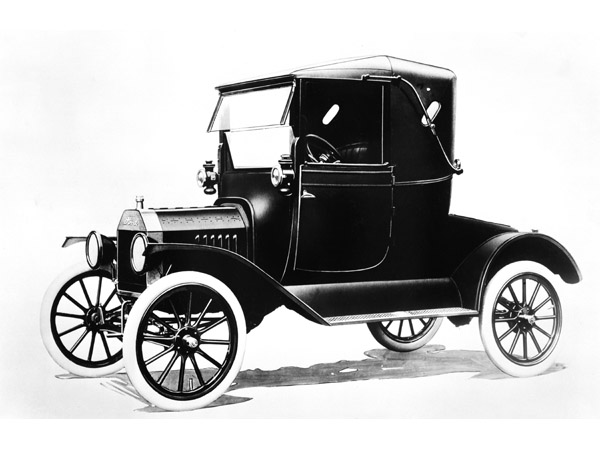
As shown in the file histories, extensions of time to oppose were filed by Ford Motor Company, who happens to still own active registrations for the well-known and antiquated MODEL T.  But these registrations are still alive for some ancillary products: hand tools, namely, pocket knives; children’s activity books and various desk items; key fobs and plaques; clocks and collector coins; banks; and toys.

Ford however filed a new intent-to-use application on May 29, 2013 for MODEL T for “automobiles”.  The Tesla intent-to-use applications were filed August 5, 2013, including Tesla’s application for MODEL E in connection with “automobiles and structural parts therefor”.   Therefore, Ford’s application has priority.  Arguably, MODEL T and MODEL E sound similar and were applied for with respect to identical goods.  Where the goods are identical, “the degree of similarity [between the marks] necessary to support a conclusion of likely confusion declines.” See TMEP 1207.

Ford has prior use and registration of the identical MODEL E mark for various electrically powered vehicles, which was cancelled in May 2010.   Ford also applied for MODEL E for “automobiles” in December 2013, yet the application was surprisingly not refused registration over Tesla’s prior filed and still pending MODEL E application, despite being an identical mark for identical goods.

Given Tesla’s express abandonment,  Ford and Tesla likely reached some agreement regarding the MODEL E mark and perhaps this only fuels further speculation that Ford is interested in buying, or at least partnering with, Tesla.  Depending on that agreement, Tesla may be bringing S-E-X-Y back after all if Ford is licensing it back to Tesla.


– Mark Prus, Principal, NameFlash

Almost everyone loves a good magician. The magician’s sleight of hand technique in making a coin or playing card disappear delights us, as we usually take pleasure in being fooled in this manner. Once fooled, our brain rapidly kicks into gear and tries to figure out how he or she did the trick. Sometimes you figure it out, and then you get even greater pleasure. But even when you can’t figure it out, you are amazed!

Magic tricks only work if two things occur. First, the magician must divert your attention away from where the actual trick is happening, and second, your brain must fill in any missing information by combining what you already know with whatever you perceive at that very moment.

The science behind this “filling in process” by the brain is fascinating (read the Discover magazine article referenced at the end of this post). The sub-headline of the article says it all…“The eye and brain work in a partnership to interpret conflicting signals from the outside world. Ultimately, we see whatever our brains think we should.” 

Truth be told, the magician is not creating the illusion–your brain is creating the illusion that something has happened (when in reality the magician has done something else). Using this technique from magic can lead to powerful branding.

This “filling in” process has been shown in numerous studies to be important to generating lasting recall and favorable persuasion. If the person’s brain is engaged and filling in the gaps, then the person will remember the experience and be favorable towards it.

Let’s say you want to name a new product (or it could be a service or a company or something else). A strong name for this product would give the consumer enough information about the product so that the consumer’s brain is engaged and starts to fill in the missing information, just as it would if you were viewing a magic trick. This was validated in a study in The Journal of Consumer Research in 2005 where the investigators looked at differences in names for crayons. The findings indicate that consumers preferred “slightly ambiguous” names such as “Blue Haze” or “Alpine Snow” to plain descriptive names such as “Blue” or “White” because the engagement of the brain with a slightly ambiguous name causes the brain tries to complete the “puzzle,” which leads to stronger recall and persuasion.

A great brand name will provide some sense of perspective to the target customer and the product itself, but it won’t provide the whole story. A great name leaves enough to the imagination so your brain gets engaged in the product/name combination and makes you curious about a product and willing to investigate it further. Just as a magician would tantalize your brain with enough “facts” and cause your brain to “fill in” the rest of the story, a great brand name is magical.

It’s that time of year again, the Minnesota fishing opener is upon us this weekend, so Rapala is sporting its new billboard in the Twin Cities metro area, as shown below:

“Winner, winner, walleye dinner,” is an obvious play on the far more frequently uttered “winner, winner, chicken dinner” positive outcome phrase, that apparently derives from early casino dining experiences. In fact, Ballys has decided to cash in on this phrase by obtaining a federal registration covering the phrase for gaming machines.

And, last year, Raising Cane’s, a fast food chicken restaurant chain (one that my kids strongly prefer over Chick-fil-A, by the way) obtained a federal registration for the same phrase in connection with restaurant services.

Yet, less than two months ago, an intent-to-use application for “Winner! Winner! Grouper Dinner!” was filed by Team Lobo in Naples, Florida, for t-shirts, so I suspect we won’t see Rapala’s above tagline appearing on t-shirts this year. For a comparison of nutritional facts concerning grouper v. walleye, see here.

Curiously, last year Rapala expressly abandoned its “Bass Friends Forever” t-shirt trademark application, shortly after it was published for opposition, leaving us to wonder who may have added some tension to their fishing line? Perhaps PVH Corp, based on these rights in BASS?

So, here’s my suggested Rapala billboard tagline for next year: Eat More Walleye.

What do you suppose Chick-fil-A would have to say about that?

In case you’re wondering about status of the Eat More Kale dispute — the USPTO has been sitting on Bo Muller-Moore’s 71-page Office Action Response for eight months now, so stay tuned.