Nicola Hill, Associate and Jude King, Trainee Solicitor, Browne Jacobson LLP

This is the era of celebrity. It has become a global commercial enterprise in its own right. From launching personalised perfume ranges to being the face of fashion houses, there can be no doubt that celebs are a high value commodity. As such, every star wants to protect their image or name. Yet whilst many states in the US recognise a ‘right of publicity’ – the right to control the commercialisation of their own image – such a right has never existed under English law. As Colin Birss J succinctly put it at first instance in this case:

“Whatever may be the position elsewhere in the world, and however much various celebrities may wish there were, there is today in England no such thing as a free standing general right by a famous person (or anyone else) to control the reproduction of their image.”

This position was confirmed recently by the Court of Appeal (CA) in Fenty v Arcadia, who upheld Rihanna’s $5 million claim in passing off against the British fashion retailer, Topshop, but denied the existence of an image right under English law. It came as a mixed blessing to many in the celebrity field, who had pinned hopes on Rihanna’s case being an opportunity to finally introduce image rights into the UK.

The case involved a well-known UK fashion retailer Top Shop – a store synonymous with London cool. Topshop began selling a t-shirt featuring an image of RiRi herself both online and in their stores. Despite having a licence from the photographer allowing them to use the image, Topshop did not have Rihanna’s permission, who then complained to Top Shop that the sale of the t-shirt without her permission infringed her rights. Topshop’s response, one could say, was that she should just ‘shut up and drive’.

Rihanna subsequently brought proceedings against the fashion giant alleging passing off (N.B. this is a long-established English common law tort requiring the Claimant to prove goodwill, misrepresentation and damage).

At first instance, Birss J clarified that English law does not treat merchandising and endorsement differently; what is required for both is that a substantial portion of those considering the product will be induced to think it is authorised by the artist, and that they are in some way responsible for their quality/appearance. He considered the evidence at hand and found that Rihanna met all three criteria. Rihanna was thus successful and granted protection under the, ahem, ‘umbrella’ of the English legal system.

On 22 January 2015, the CA delivered its judgment. It upheld the first instance decision, concurring that Rihanna had the requisite goodwill in the goods in question, both as a style icon in her own right and having her own fashion line and collaborations with companies such as Gucci and one of Topshop’s biggest rivals, River Island. The CA further found misrepresentation on the facts because Rihanna had previous associations with Topshop and also the image appeared to be a publicity shot for her then current album ‘Talk That Talk’ so the relevant public were likely to be deceived into thinking that the product was authorised by Rihanna. Damage was proven through the loss of merchandising business in addition to loss of control over her reputation. It was held that Birss J was correct in upholding passing off, but to the disappointment of many, there was no likelihood of the CA introducing an image right any time soon.

Further, the CA was at pains to reiterate that this case turned squarely on its facts and that the sale of clothing bearing recognisable images of celebrities does not, in itself, amount to passing off. This case is clearly not designed to open the floodgates for false endorsement claims.

So what does it mean going forward? Firstly, there is clearly no intention to introduce a US-style image right into the UK. Neither is it intended that passing off becomes a back-door personality right. What Fenty does do, however, is to send a clear message to English retailers and designers to exercise caution in using celebrity imagery. It also gives our superstar clients a glimmer of hope that, in the right circumstances at least, they might be able to take back some control over use of their image in England. So for that… Take a Bow, Rihanna.
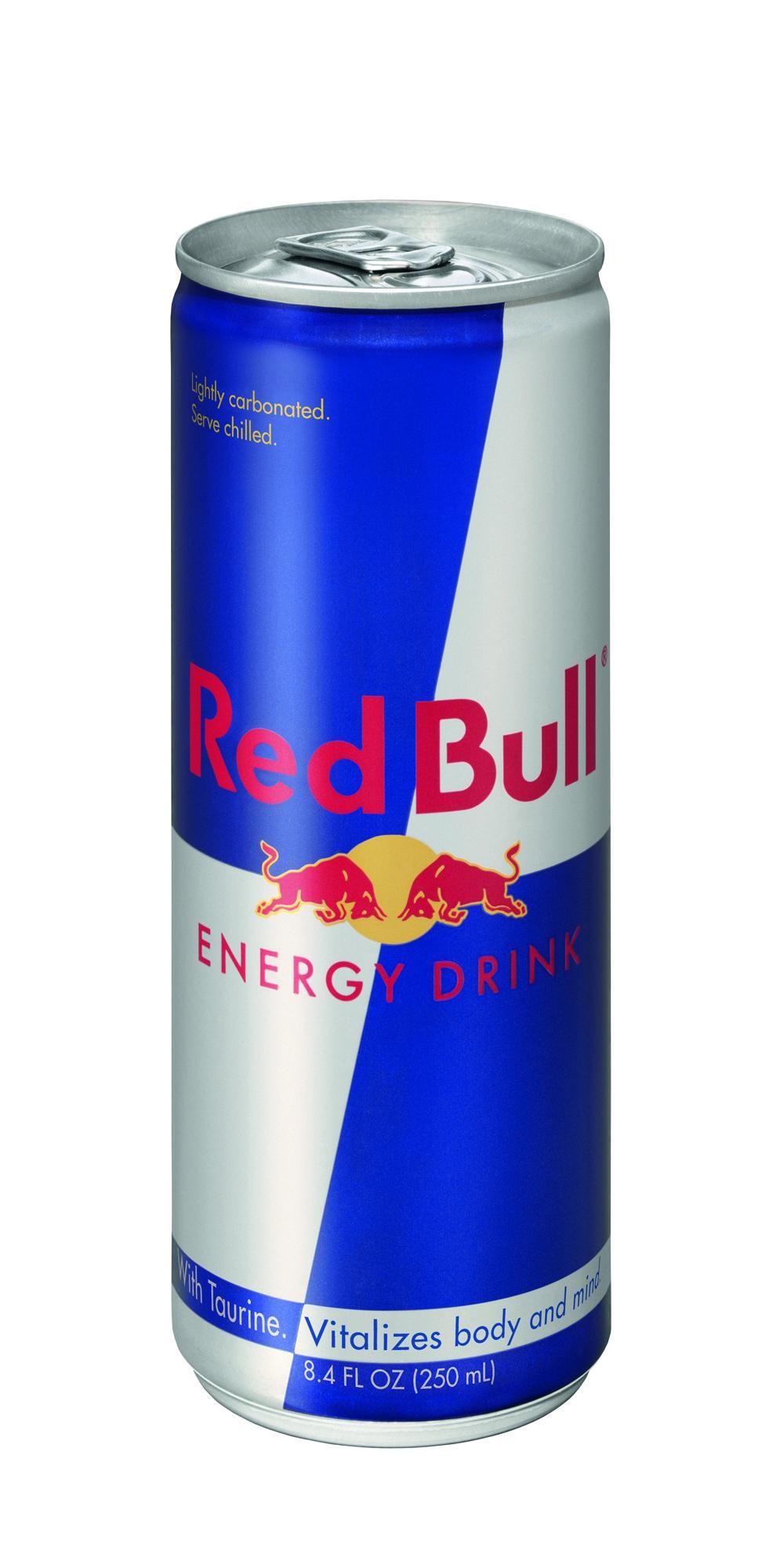
It’s no secret that Red Bull has a strong trademark enforcement strategy. Too strong, according to some. In its defense, IP counsel for Red Bull has stated that

With a brand as famous as Red Bull you can certainly imagine the type of coat-tailing that goes on by third parties and we invest a lot of time and money to stop such infringements as the brand is that important to the company.

I agree with the sentiment behind the statement. But sometimes the sentiment gets lost in translation. In 2014, Red Bull pursued legal action against a U.K. brewery that began selling beer under the brand Redwell. After a strong public reaction, the company clarified that:

Red Bull has all along been willing to allow Redwell to maintain its mark for beer so long as they do not use it for energy drinks.

Fair point, but I can’t help but wonder, was there ever any indication that Redwell might sell energy drinks? Do consumers expect producers of beer to also produce energy drinks (or vice versa)?

Fast forward and Red Bull finds itself in a similar situation. On Jan. 28, 2015 the company filed a Notice of Opposition to Old Ox Brewery’s application to register its OLD OX BREWERY mark in connection with beer, ale, lager, stout and porter. Red Bull claims that the OLD OX BREWERY mark is likely to create confusion with its RED BULL mark.

As a general rule, the two main factors in the analysis involves (1) the similarity of the overall commercial impression of the marks; and (2) the relatedness of the goods. Setting aside the issue of whether energy drinks are related to beer (which deserves an article all on its own), my initial reaction is that OLD OX BREWERY is simply too dissimilar to create a likelihood of confusion. Whether marks create an overall similar commercial impression depends on similarities between sight, sound, and meaning of the mark.

Other than the number of syllables, OLD OX doesn’t sound or look anything like RED BULL. Accordingly, Red Bull is relying heavily on the “meaning” of the marks. And that’s where things get interesting.

It certainly wouldn’t be the first time where the meaning of the marks trumped differences in sight and sound. Yet when this occurs, the goods are usually identical. For example, CYCLONE and TORNADO found confusingly similar in connection with wire fencing or PLEDGE and PROMISE found confusingly similar in connection with furniture wax.

So what is Red Bull’s argument for similarity in meaning? Paragraph 9 of the Notice of Opposition alleges that:

An “ox” and a “bull” both fall within the same class of “bovine” animals and are virtually indistinguishable to most consumers. In addition, an ox is a castrated bull.

Apparently Red Bull has little faith in the ability of consumers to distinguish between various classes of bovine animals. That would include cows, bulls, oxen, yaks, bison, buffalo, steer, longhorns, and apparently antelopes (Wikipedia threw me a curveball there).

But Red Bull’s claim does not rest solely on the bovine nature of oxen and bulls, but also the fact that an ox is a castrated bull. The implied claim being that the image of a castrated bull creates the same commercial impression as the RED BULL mark. If that’s the case, I’d suggest sending those legal fees to the marketing department to fix that issue. I knew that Red Bull gave you wings, but I guess I never asked what they took in return.

In my mind, the shared similarity in meaning of a bovine animal does not overcome the stark differences in sight and sound between the marks.  In particular an old ox, having suffered through a particular medical procedure, doesn’t scream “energy drink,” but instead, the polar opposite of the commercial impression that Red Bull tries to create. But maybe I’m missing something, kind of like an old ox.

— Jessica Gutierrez Alm, Attorney

In the wake of our 49th Super Bowl (er, “The Big Game”), it seems the Seahawks are not only making headlines with their last minute calls, but also with their IP strategies.

https://www.duetsblog.com/files/2015/02/seattleseahawks.gif

Over the past couple of years, the Seahawks have filed for registration of several marks, including at least a dozen applications filed in 2014.  Some of the applications drawing attention lately include the Seahawks’ attempts to register the phrase GO HAWKS and the word BOOM, both in standard script form, for various goods and services.  Additional applications filed in 2014 include phrases such as WE ARE 12, THE 12s, and LEGION OF BOOM.

So far, the team’s attempts to register GO HAWKS brought challenges from the NHL (for the Chicago Blackhawks) and NBA (for the Atlanta Hawks).  The application is also drawing attention from the University of Iowa (the Hawkeyes).  But arguably, the broadest application recently filed by the Seahawks is for the number “12” for use on capes, jerseys, sweatshirts, and long-sleeved and short-sleeved shirts and t-shirts.

Seattle Seahawks’ 12th Man Flag

For anyone who, like myself, is an infrequent football fan at best, the number 12 signifies the fans.  That is, each team usually has eleven players on the field at a time.  “The 12th Man” recognizes fans’ role in supporting the team to victory.  But then, doesn’t every American football team have a 12th Man in the overzealous crowds of painted faces and nacho cheese?  Texas A&M doesn’t think so.

The University has held a registration for 12TH MAN since the 1990s.  In 2006, Texas A&M sued the Seahawks for using “12th Man” to describe Seahawks fans.  The suit ended in a license agreement, in which the Seahawks agreed to pay an annual licensing fee of $5,000 to use the phrase in limited circumstances. Under the license, the Seahawks are permitted to raise a flag at the start of each game and call it the “12th Man Flag.”  The flag can have the number 12 on it, but not the word “man.”  The ‘Hawks also can’t sell any merchandise featuring the phrase.

Batch No. 12 Bourbon

The Seahawks do hold a registered trademark for their blue and white 12th Man Flag, and are  apparently now working to further protect their use of the phrase in relation to their own team.  In addition to filing their own recent applications, the Seahawks have also formally challenged pending applications for 12 NATION, filed by former Seahawks kicker Norm Johnson and his son Jordan Johnson, and BATCH NO. 12, filed by a small Washington distillery in relation to a line of spirits.  Norm and Jordan Johnson abandoned their application after the Seahawks’ challenge, stating that they didn’t have the funds to pursue the fight.  The Washington distillery has different color combinations for its Batch No. 12 labels, one of which is an admittedly familiar blue and green.

The team even challenged an application for DISTRICT 12, filed by Lions Gate Films in connection with the Hunger Games franchise, but, perhaps due to public backlash, has since withdrawn and allowed the application to move forward.

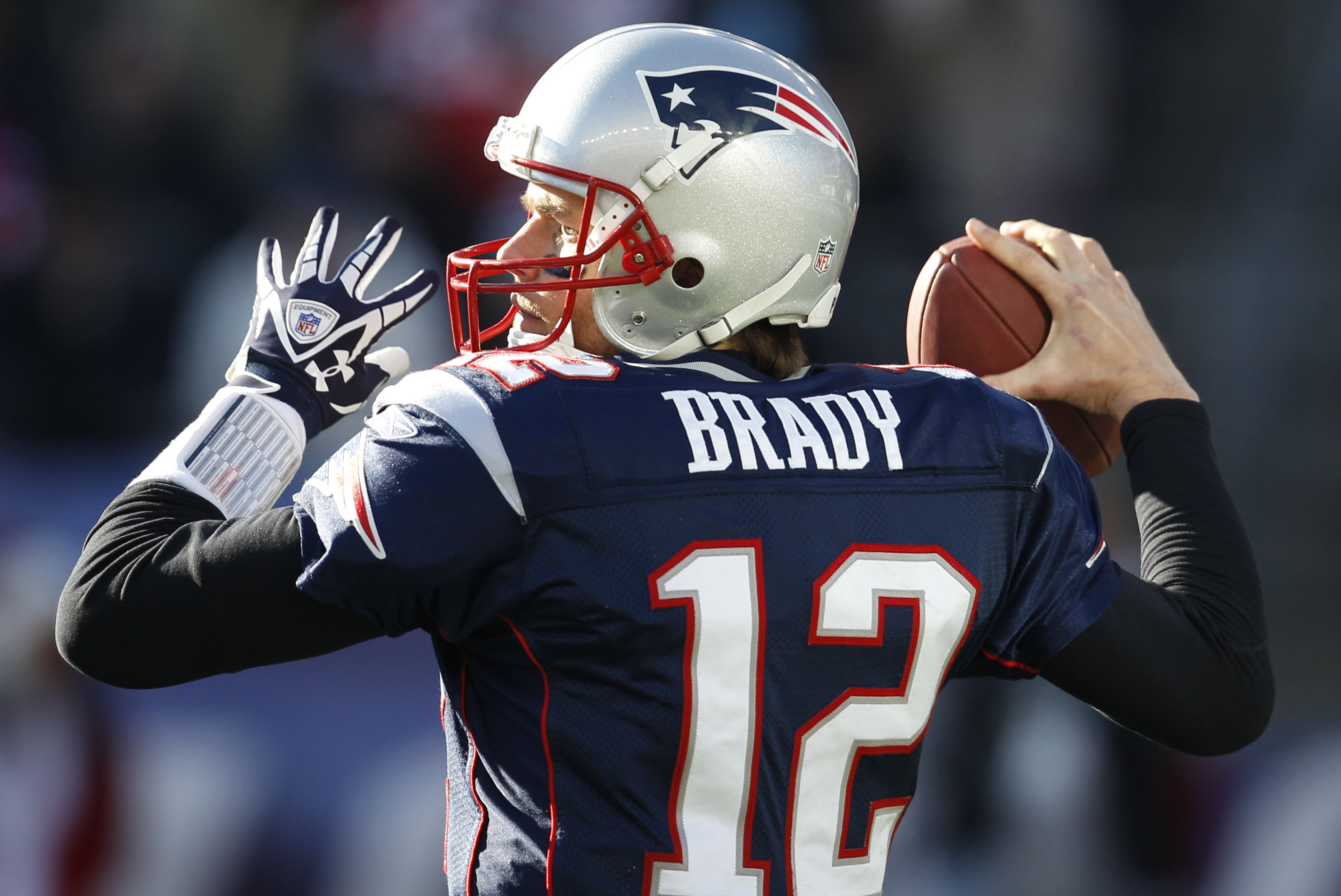
The Seahawks also recently filed an application for the number “12” in a  stylized font similar to what appears on their jerseys.  New England Patriots quarterback Tom Brady may have something to say about that one.

Tom Brady: New England Patriots #12

While the Seahawks’ IP strategy may be somewhat aggressive, a large trademark portfolio is not unique to the team, nor is trademarking everyday terms and phrases.  For a couple of examples, the Raiders own JUST WIN BABY, and the Patriots own DO YOUR JOB.  Trademarks for standard form numbers for various goods and services are also not new.  (How about “31” in connection with retail ice cream services, or “5” for a certain Chanel perfume?)

Based on a USPTO online search, the Seahawks currently hold 51 active trademark registrations (including granted and filed applications).  Teams use their marks not only for licensing and merchandising profit, but also to instill the team’s brand in the minds of fans.  Perhaps one reason the Seahawks brand is so well recognized is due to their increased efforts to leverage their IP.  However, the team’s latest round of applications may be stretching the brand’s reach a bit too far.  Maybe it’s time the Seahawks take a page from the Patriots’ playbook, and deflate their strategy.

USPTO Drawing for Claimed Mark

As our loyal readers know, we love bringing non-traditional trademarks within your sights for consideration, even if they’re hanging from the ceiling, so here’s another to explore:

Roll & Hill’s Modo Chandelier


The claimed mark is described as “a three-dimensional configuration of a chandelier having three sides and 10 globes. The top rod and the 10 light bulbs shown in broken lines serves to show positioning of the mark and form no part of the mark.”

Here is some information about the designer:

“Jason Miller opened his Brooklyn-based design studio, Roll & Hill, in 2010 to satisfy his desire “to make products that appeal to the American market.” Nestled somewhere between mass production and custom design, Roll & Hill creates lighting fixtures that assume a classic form and style while appealing to a contemporary American sensibility. As Miller sees it, Americans prefer more warmth and visual weight than their European modernist counterparts, who are stylistically rooted in minimalism.”

Any predictions on how this brand new product configuration trademark application will be examined by the USPTO?

I’m thinking it will receive a functionality refusal, a lack of distinctiveness refusal, and a failure to function as a trademark refusal . . . .

Do you think these refusals could be overcome?

If so, how would you respond to them?

Let’s suppose you’re a non-profit like the NRA, you sell stuff on your NRAstore.com, and you’d like to promote the fact that your website has over 30 product demonstration videos available that can easily be viewed online by potential consumers before they buy stuff from you.

Let’s also suppose that when you sell stuff, 100% of your profits go directly toward supporting your non-profit mission and its vital programs. Impressive numbers, that’s really good stuff.

To encourage the sale of stuff on your website, you might be tempted to promote the existence of the product demonstration videos by calling them “flix,” or you might even refer to the video library as your “NRA FLIX,” but would you create an email promotion that looks anything like this?

Upon further reflection, might you expect to hear from the good folks at Netflix, the owner of a federally-registered trademark looking like this?

What do you think, is there a plausible case of likelihood of confusion? Is Netflix a famous mark for dilution purposes? If so, is there a likelihood of dilution? Would you surrender?

Now that Super Bowl XLIX is in the rear view mirror, and the New England Patriots have been duly congratulated for winning anything but a Mediocre Bowl, for those of us with no pigskin in the big game this year, it’s time to think about the possible magic of Super Bowl L.

Wait what? Is that really a good idea, given the recognized meaning of the L-word?

After all, Glee and others have done too impressive of a job cementing the “loser” meaning to L, even though another more positive alternative branding cliche exists: Leadership (as we’ve noted before).

The NFL began using Roman numerals to designate each Super Bowl, beginning with the single-letter V in 1971 for the 5th Super Bowl, and continuing through X to designate the 10th Super Bowl in 1976, all the way to XLIX as depicted above.

However, back in June 2014, the NFL finally announced it would lose the Roman numeral graphic design, kind of like the disappearing 13th floor in an elevator, because Super Bowl “L” wouldn’t be aesthetically pleasing by itself, at least to some — probably unlucky too.

So, next year, Super Bowl L won’t exist, instead we’ll be talking about Super Bowl 50, the Golden Bowl, to be played in the Golden State at the home field of the San Francisco 49ers, who mined for gold back in the day.

Then, after a one year hiatus from that pesky singular Roman numeral, the NFL plans to be back in the Roman numeral business with Super Bowl LI in Houston, and more importantly, Super Bowl LII in Minneapolis in 2018. Make sure to come see us!

I’m thinking the NFL probably made the right call in losing the solo L for the 50th Super Bowl, the graphic on the left below just doesn’t work and only invites ridicule — but, do our readers who are graphic designer types agree? Was there no possible way to sell an elegant solo L?


What do you think, will the Roman numerals make a comeback in Houston for Super Bowl 51?

Oh, I almost forgot, what did you think of the Super Bowl ads?

Budweiser tugged at the heartstrings again, this time with Puppy Love.

Seems like there were lots of ads promoting other television programs — since I’m a huge fan of The Voice and Mad Max Beyond the Thunderdome, that combo was hard to beat for me.

Fiat’s use of a little blue pill to introduce the new 500X made me, as a trademark type, wonder what Pfizer thought about it, can you say Viagra?

Does Fiat not appreciate that Pfizer also owns a non-traditional trademark registration for the color blue as applied to a diamond shaped dosage tablet?

Was Fiat’s use of a hexagonal-shaped tablet enough to avoid the scope of non-traditional trademark rights held by Pfizer? Might some have thought it simply was another funny co-branding Super Bowl ad?

So, which Super Bowl ads were your favorites and why?

-Wes Anderson, Attorney

First off, hello DuetsBlog! I’m delighted to join Steve and the rest of the team here, and I hope I can add to the excellent content that authors past and present have brought to the site.

I’ll start my post with a statement that’s obvious to all trademark lawyers: brands can be valuable assets. One reason for this is that many customers form a lifetime devotion to their favorite brand, and they pass that devotion on to their children.

This is particularly true for food. I know that when it comes to pickles, I am loyal to Claussen, both because my parents bought them exclusively when I was a child and because the company’s headquarters is in my childhood home of Woodstock, Illinois.  It’s a one-two punch that Vlasic just can’t match.

Two brave souls in France took this sort of brand loyalty even further — by attempting to name their newborn daughter “Nutella,” after the famous chocolate-hazelnut spread of questionable nutritional value.

Unfortunately for them (or perhaps fortunately for the daughter), the local court in France blocked the new moniker, ordering that the child be named “Ella” instead.  The judge stated that “Nutella” is a trade name, and as such “it is contrary to the child’s interest to have a name that can only lead to teasing or disparaging thoughts.”  Clearly, this judge prefers jam on his toast.

If only the parents lived in the United States, then they may likely have realized their dream. While many European countries place various restrictions on baby names, American parents may generally use a trademark as a personal name, so long as it is a word mark and both parents consent to the name.  Brand loyalty may have some limits abroad, but the courts on our shores would hardly object to baby Nutella.

That said, American courts have stepped in when the name is not actually a word (the Roman numeral “III”) or, more controversially, on religious grounds (“Messiah”).

Of course, personal names are not impervious to trademark infringement. Personal names may not be used in a confusingly-similar fashion to a senior trademark, particularly a famous mark. And marks that are “primarily merely a surname”  are generally not registrable in the U.S. This is bad news for the Marriotts of the world who want to start a family hotel chain, or a Mott with a breakthrough recipe for apple sauce (as opposed to baby food).

As for baby Ella: if there’s a silver lining in all this, it’s that she will have far less trouble starting up her own hazelnut spread business.

It’s the week before Super Bowl, the week when I can’t look at my Twitter feed.  Why?  Well because I follow Ad Age, Adweek, the Minneapolis Egotist, and enough of you creative folks that my feed has been inundated with previews of Super Bowl ads over the past few days.  While the information is enticing, I consider myself a purist who must wait until the Big Game before I see any of the Super Bowl ads.   The halftime shows have been terrible, so what other reason is there for a Minnesotan to watch the Super Bowl other than for the ads?

My family always ranks each ad, we groan at the many lame and poorly executed concepts that someone spent millions on, and, at the end of the game, we announce our favorites.   Maybe you do something similar at your parties — it’s certainly something we’ve done with the DuetsBlog team since I joined.  Everyone seems to have an opinion on their favorite ad, which you will find in newspapers around the country and from anyone on Twitter with two thumbs.   Given that, I should have come up with a clever name and trophy for an award for the best Super Bowl ad because there’s never been an established “winner”…

Deflating that grand idea, in steps the Clio Awards, some of the most prestigious awards in advertising.  According to Adweek, the Clio Awards has established the Clio Creative Bowl, “a juried competition to find the top commercial aired during the Big Game on Feb. 1.”  What took them so long.  Jury members include creative officers from top agencies, including Adweek’s Agency of the Year, droga5 (who if that sounds familiar, we mentioned them here).  The winners will be announced on Monday.

And it’s a super-sized award – the Super Clio.

Maybe DuetsBlog needs to establish its own Oscar or Clio – the Duey Awards – to celebrate Duey’s 6th birthday.   What categories would you like to see?


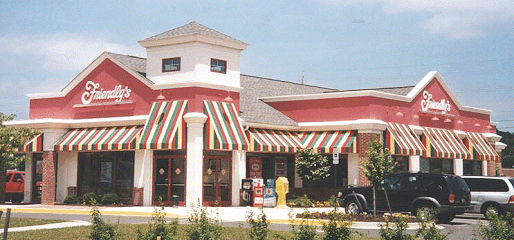
As the brand manager or trademark counsel for Friendly’s, would you be friendly toward Freddy’s?

I remember the Friendly’s restaurant chain when we lived in Columbia, Maryland, back in the days when I clerked for a Senior Judge on the Court of Appeals for the Federal Circuit in Washington, D.C., so at my first sighting of the about-to-open Freddy’s restaurant location in Maple, Grove, Minnesota (shown above), it brought memories of Friendly’s to mind:


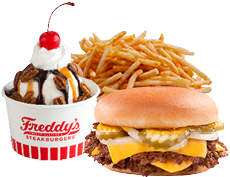
Beyond the similarities as to sound, appearance, and cadence of the names, the graphic design of the cursive logos, the possessive forms, the color schemes, and trade dress, they seem to have a similar menu focus too:


Yet, they appear to peacefully coexist on the Principal Register at the USPTO (Friendly’s and Freddy’s), and it further appears from the location maps for each restaurant chain (Friendly’s v. Freddy’s) that there are some areas of geographic overlap too, although I haven’t studied the maps closely enough to determine how many miles separate the actual locations within a particular state.

Now, I’m not suggesting a brand manager or trademark counsel go all out crazy here — Freddy-Krueger-style, but I’ve also seen far worse cases pursued too.

What do you think, is there a plausible case of likelihood of confusion here, or would this be another example of trademark bullying?

Do you suppose these growing chains will ever bump into each other, and if so, will there be polite exchanges of, “excuse me” — is there any possibility of real friendship in their futures?

It’s that time of year again. Time to tiptoe around and avoid use of or make any reference to the Super Bowl. Whoops. Anyway, we’ve discussed this phenomenon before:

Advertisers — fearful of NFL legal action — strain and contort to avoid the two words that could make out a nominative fair use of the Super Bowl trademark, opting instead for pairs of other code words like “Super Sunday,” the “Big Game,” “Super Party,” or “Superb Owl” coverage.

Welcome to the advent of “Bowl Viewing Parties,” not Super ones, but Lavo and Tao ones:

Please, would someone just lawyer up, and call it the Super Bowl, while calling the NFL’s bluff?