On Monday, November 27, 2017, the U.S. Supreme Court heard argument in Oil States Energy Services, LLC v. Greene’s Energy Group, LLC, No. 16-712. The case presents a direct challenge to the U.S. Patent and Trademark Office’s (“USPTO’s”) “inter partes review” (“IPR”) process, under which third parties can petition the USPTO’s Patent Trial and Appeal Board (the “PTAB”) to cancel one or more claims of an already-issued patent.

Photo Credit: Fox

ScotusBlog recently offered a brief introduction to Oil States’s “remarkably pedestrian” backstory:

Petitioner Oil States sued respondent Greene’s Energy, contending that Greene’s Energy was infringing a patent that Oil States holds on technology useful for preserving wellhead equipment in the oil and gas industry. Predictably, Greene’s responded by seeking inter partes review, hoping that the PTO would invalidate the Oil States patent. When the PTO concluded that the patent in fact was invalid, Oil States raised the stakes, arguing that Congress violated Article III and the Seventh Amendment when it authorized an administrative agency to invalidate the patent without affording Oil States an opportunity for a jury trial.

If the Supreme Court decides that IPR is unconstitutional, the holding will have major consequences. As an initial matter, many would-be litigants have chosen to pursue IPR petitions instead of patent defenses or claims in court because the IPR process is faster and more cost-effective than federal litigation. For example, a typical medium-sized patent dispute costs around $3M to litigate in federal court, but IPR proceedings are one-tenth the cost. The average time to trial is around 2 years, 3 months, whereas IPR proceedings take just over half as long to conclude. In addition to offering advantages to litigants, IPR proceedings have played a significant role in lightening the federal patent docket, addressing more than 1,000 patent cases with dispositive effect. Usually, patent cases are stayed pending an IPR proceeding. Thus, the IPR process in many cases eliminated the need for protracted federal litigation.  

As Oil States neared oral argument, several commentators offered their take on how the case might turn out. But the Justices’ questions at oral argument provide better hints at whether affirmance or reversal will result:

Right out of the gate, Chief Justice Roberts asked the petitioner, Oil States, to explain its distinction between the USPTO’s post-grant procedures that are “examinational” in nature, versus those which are adjudicative. The distinction relates to the federal government’s separation of powers between its three branches, with the judiciary serving the role of adjudicating disputes–as provided by Article III, which vests the “judicial power” in the federal courts. Getting to the heart of the matter, Justice Sotomayor asked, “What is so fundamentally Article III that changes [the IPR] process into an Article III violation?” Suggesting an answer to her own question, the Justice stated, “Both [IPR processes and other post-grant processes] are just informing the PTO of the nature of its error and giving it an opportunity to correct its error.” Justice Ginsburg later chimed in: “[IPR] is geared to be an error correction mechanism and not a substitute for litigation.” Justice Breyer appeared to agree, stating, “I thought it’s the most common thing in the world that agencies decide all kinds of matters through adjudicatory-type procedures often involving private parties. So what’s so special about this one…?” Justice Kagan remarked, “it seems a little bit odd to say, sure, the government can reexamine this…but there’s some line that falls short of what” is constitutional.

Justice Gorsuch suggested that the distinctions between permissible examination and impermissible adjudication could be avoided by focusing on whether there is a private or public right involved, the idea being that public rights (e.g., licenses) need not be adjudicated by an Article III court. Justice Kennedy asked, “[C]ould Congress say…we will grant you a patent on the condition that you agree to this procedure; otherwise, we don’t give you the patent?” Justice Alito later asked a similar question. Justice Kennedy followed up, “Could Congress say that we are reducing the life of all patents by 10 years?” When counsel for Oil States answered yes, he responded, “Well, then that–doesn’t that show that the patent owner has limited expectations as to the scope and the validity of the property right that he holds?” Justice Gorsuch begged to differ, however, stating “we have a number of cases that have arguably addressed this issue…in which this Court said the only authority competent to set a patent aside or to annul it or to correct it for any reason whatever is vested in the courts of the United States.” But Justice Sotomayor, seemingly rejecting that argument, stated that at least one of the cases cited by Justice Gorsuch (McCormick v. Aultman) did not involve determinations of constitutional law, nor did it involve statutory analysis of post-grant procedures because none were applicable or available at the time that case was decided.

Turning to the respondent, Greene’s Energy, Justice Breyer fired off the first question, asking whether it was a “problem” that a company could invest $40B in developing a patent and could have it for 10 years before an IPR proceeding cancelled the patent. He asked, “Is there something in the Constitution that protects a person after a long period of time and much reliance from a reexamination at a time where much of the evidence will have disappeared,” suggesting a due process-flavored argument. Chief Justice Roberts followed up, asking whether Greene’s Energy’s position is that “If you want the sweet of having a patent, you’ve got to take the bitter that the government might reevaluate it at some subsequent point.” Finding agreement, he said, “Well, haven’t our cases rejected that…proposition? I’m thinking of the public employment cases, the welfare benefits cases. We’ve said you…cannot put someone in that position.”

The discussion shifted to whether the availability for subsequent judicial review of the PTAB’s IPR decisions bears on IPR’s constitutionality. Justice Sotomayor remarked, “That..was what troubled me deeply about you telling Justice Kagan that, without judicial review, that this would be adequate. I mean, for me, this–what saves this, even a patent invalidity finding, [is that it] can be appealed to a court….[H]ow can you argue that the…PTO…has unfettered discretion to take away that which it’s granted?”

Justice Gorsuch again brought up the public-private rights distinction, noting that “there’s an abundance of law going back 400 years. Justice Story says it. I mean, you know, this is not a new idea, that once [a patent is] granted, it’s a private right belonging to the inventor.”

Finally, the Court turned its attention to the Government’s argument. Justices Gorsuch and Roberts asked about the “bitter with the sweet” argument. The Government responded that employment and welfare decisions are often made by executive officials and must always comport with due process, but need not be adjudicated by courts in the first instance.

Justices Breyer and Roberts then steered the conversation toward factors that might help distinguish private rights from public rights. Justice Breyer expressed the view that the large investment underlying a patent might justify a due process or takings clause argument, but the Government responded that there is no as-applied challenge in this case.

The Government also brought up the adjudication versus examination point, arguing that IPR is distinct from typical judicial functions, which involve determining liability between private litigants and assessing monetary damages. For example, an infringement action involves determining liability for use of a patented idea and the reasonable royalty damages that should be paid for that use. IPRs, on the other hand, merely address patentability and do not involve liability or damages. The Government also noted that the executive frequently employs adjudicative proceedings to take appropriate executive action. IPR is no different.

In the end, as always, divining the eventual decision from the Justices’ questioning is more art than science–no puns intended. Justices Sotomayor, Ginsburg, Breyer, and Kagan all appear to endorse the view that IPR proceedings do not violate separation of powers. Justices Kennedy and Alito also seem to fall in the same camp. On the other hand, Justices Breyer, Roberts, and Sotomayor’s questions suggest that these Justices think there may be serious due process concerns. Only Justices Gorsuch, Breyer, and Roberts were interested in the public rights versus private rights distinction, but two of those Justices expressed doubts about the distinction’s defining features. If I had to call it, I would guess that the Court will find that IPRs, as currently structured, do not violate separation of powers or due process and are therefore constitutional. Stay tuned for updates on this important case.
What do you think of when you hear the word Velveeta? Me too, childhood — complete with piping hot Campbell’s tomato soup — and perfectly melted grilled cheese sandwiches. Later in life, at least for me, came liquid gold and RO*TEL queso dip, usually on weekend game days. And, my daughter might add to the Velveeta memory mix, perfectly smooth shells and cheese.

Velveeta can conjure up some less than innocent and charitable thoughts too. Eventual trips to the doctor. Perhaps cardiac stents. And, even probing medical questions like, is that yellow loaf or brick really cheese? Turns out, it’s technically not real cheese, rather the box even calls it “Pasteurized Prepared Cheese Product.” What does that even mean?

Yet, Kraft apparently has felt no shame, remorse, or even second thoughts in continuing to maintain the original 1923 Velveeta trademark registration for “cheese,” despite an FDA warning letter some fifteen years ago that apparently led to the more accurate “Pasteurized Prepared Cheese Product” appellation.

As a trademark type though, and putting aside the interesting trademark abandonment question of whether Kraft actually uses the Velveeta mark in connection with the recited goods, “cheese” — the notion of a coined trademark comes to mind with Velveeta too. The kind of trademark that is invented, or let’s say, made up, or produced for the exact purpose of functioning as a trademark indication of source.

Some other examples of coined marks include Exxon, Rolex, and Google. Some call those types of marks the gold standard since they are the strongest trademarks along the Spectrum of Distinctiveness. They are often singular in meaning, and ripe for dilution protection.

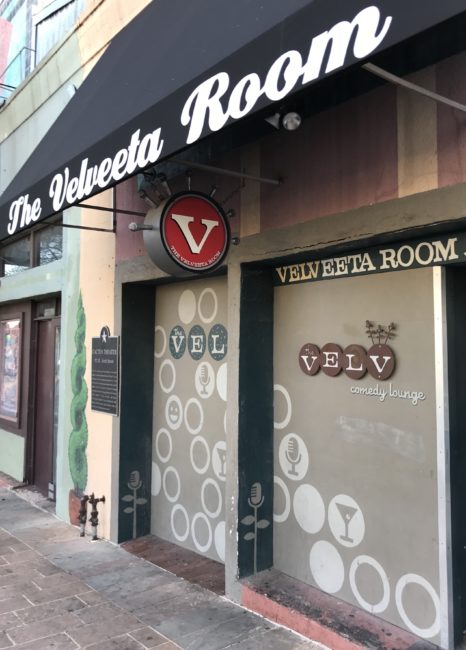
So, imagine my surprise seeing a “room” dedicated to Velveeta, as I walked 6th Street with one of my sons, this past weekend, in Austin, Texas, inspiring me to capture the image shown above to further document and discuss it: The Velveeta Room.

My surprise was especially fine-tuned since the apparently-non-eponymously named room did not appear — at least, on the surface — to be promoting liquid gold, yellow bricks, golden loafs, queso, or even shells and cheese, much less the almost century old Velveeta “cheese” brand or distinctive box.

Mind you, there was a day when Kraft appeared to give a serving of some serious trademark enforcement attention to the likely famous Velveeta trademark, even when the target showed up selling comedy as opposed to calories.

Back in the day, circa 1993, Kraft opposed registration of Blue Velveeta for “entertainment services in the nature of comedy and musical acts.” It appears the improv act melted away in the mid-90s — not sure whether it was voluntary or not.

The Velveeta Room apparently began around the same time as Blue Velveeta, circa 1988. Perhaps either of their fans can help explain their branding, because I’m at a loss. Did the improv group or does the comedy lounge specialize in cheesy humor? Pasteurized jokes? Fake laughter and chuckles? Or perhaps, unhealthy routines and the need for medical attention?

The irony has not escaped me that the Velveeta product was invented to solve the problem of “broken cheese” and the Velveeta brand and trademark was invented or coined to identify, distinguish, and indicate the source of an engineered — or to some, fake cheese product.

It remains to be seen whether the Velveeta trademark registration is itself “broken,” whether the brand simply melts away over the next century, whether its meaning will further evolve and blend into a smoothly-delivered butt of jokes, or whether Kraft will laugh all the way to the bank.

Instead of saying the traditional Happy Thanksgiving exclamation this year, I thought I’d reframe it this way: Happy Thankfulness and Gratitude!

Thankfulness is a state of mind. It is a choice, a repeated fork in the road for each of us. Gratitude is a decision we can make and live, every minute of the day, every day of the year, even during moments of tension, confusion, and fear.

Turns out choosing to live with a spirit of gratitude and thankfulness is closely linked to the happiness most seek and many long for in their life.

With that, and recognizing how it is impossible for me to list all those who consistently remind me of my choice of thankfulness and gratitude, here are just a few highlights:

Please know that if you’re reading this now, whatever you’re thinking at the moment, I’m ever so thankful for you too, Happy Thankfulness and Gratitude!

As you experience Thanksgiving Day today, what reminders exist for you to choose a spirit of thankfulness and gratitude? And, what about tomorrow? The day after tomorrow?

-Martha Engel, Attorney

On December 11, I will be presenting a CLE on Brewery and Distillery Law, discussing trademark issues affecting breweries and distilleries.  One of the topics that I’ll spend some time on during that presentation – and one that we’ve covered a lot here – is how the Trademark Office considers beer to be sufficiently related to wine and other spirits when evaluating a pending application for a likelihood of confusion with a registered mark.  The same has, in a few cases, been said about these alcohol products being related to restaurant services or bar services.

In today’s episode involving this issue, Heritage Distilling Company in Washington filed a trademark application in 2016 for a standard character mark BSB for “distilled spirits”.  The Trademark Office refused registration of this mark, however, based on a prior registration by Black Shirt Brewing Company for the following mark for “brewpub services; taproom services; taproom services featuring beer brewed on premises.”

Trademark image

Meanwhile, Heritage Distilling Company filed for the logo below and that went through the office with ease.  Not even an Office Action.  It was filed on April 28, 2017 and registered on October 3, 2017.

Trademark image

Heritage Distilling Company appealed the Examining Attorney’s rejection of its standard character mark for BSB claiming, in part that brewpubs and taprooms are not generally known for distilled spirits.  Although finding the marks to be similar, the Board agreed that the claimed services of the registration were not sufficiently related to support a likelihood of confusion.  “To establish likelihood of confusion a party must show something more than that similar or even identical marks are used for food products and restaurant services.”  In re Coors Brewing Co., 343 F.3d 1340 (Fed. Cir. 2003).  The Board further noted that “the definitions of taproom and brewpub refer to beer and food, not spirits. ”  Based on the evidence of record, the Board determined that the Examining Attorney had not satisfied the “something more” requirement here and found that the goods and services were not similar or related.  Only because the record failed to show these goods were related, the Board reversed the refusal.

So what if Black Shirt Brewing Company had instead filed for their mark on “bar services”?  It’s possible that the Board may not have reversed the refusal because there would have been a more clear association between a distilled spirits and bar services.

Taking that a step further, what if Black Shirt Brewing Company had filed for the mark on “beer”?  That would have likely made a refusal of BSB in standard characters over BSB on beer more difficult for the Trademark Office to reverse.  The “something more” standard would not apply when comparing goods to goods – beer to distilled spirits – as it does when comparing food products and restaurant services.  The brewery never filed for its house mark for beer, yet a few months after these applications were filed, they filed for some of its beer names for “beer”.   Here’s the specimen from one of those filings in 2014.  Would you have filed for BSB for beer?

https://tsdrsec.uspto.gov/ts/cd/casedoc/sn86372733/SPE20140823081858/1/webcontent?scale=1

And whatever the man called a living creature, that was its name.

Genesis 2:19

Naming things is a fundamentally personal, human act that sometimes – in a profession all about brand names – we take for granted. It’s easy to forget when we are clearing, registering, and protecting names, that at a basic level we are engaging with an essential part of human existence not so far removed from the story of Adam’s naming of living creatures in Genesis. True, Adam may not have had to concern himself with trademarks and intellectual property rights, but we trademark lawyers do.

Lately, I’ve been thinking a lot about this act of naming and names – not brand names, but specifically, baby names. My wife and I are expecting a baby on December 1, and among many of the things to do, naming the baby is perhaps the most important. So while my wife and I work on that, I thought I’d use the opportunity to take a closer look at a case that reminds us of how a personal name can become something else – a brand name – and what happens next.

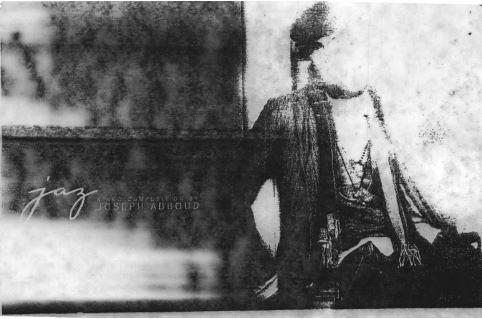
Ten years ago, while I was in law school taking my first trademark law course, the famous fashion designer Joseph Abboud was learning about trademark law the hard way: in court. The lawsuit (about suits) against Joseph Abboud claimed that his marketing and promotional activities as Joseph Abboud for a new clothing line called “jaz” infringed trademark rights to the name – you guessed it – “Joseph Abboud.” So how did it come to pass that the real person named Joseph Abboud was being sued for using his own name?

Well, it turns out that in his rise to the top of the fashion industry through the 1980s and 1990s, Joseph Abboud registered his personal name and variations as trademarks in connection with his clothing. Then, in 2000, Joseph Abboud sold his company JA Apparel and its trademarks, including the trademarks “Abboud” and “Joseph Abboud,” for approximately $65 million. As part of the transaction, Joseph Abboud transferred all of his rights to the following:

[T]he names, trademarks, trade names, service marks, logos, insignias and designations [of Joseph Aboud]. . . . and [a]ll rights to use and apply for the registration of new trade names, trademarks, service marks, logos, insignias and designations containing the words “Joseph Abboud,” “designed by Joseph Abboud,” “by Joseph Abboud,” “JOE” or “JA,” or anything similar to or derivative thereof, either alone or in conjunction with other words or symbols . . . for any and all products and services. . . .

In addition, the designer Joseph Abboud further agreed not to compete with the JA Apparel for a period of time.

But wouldn’t you know, the designer Joseph Abboud couldn’t sit idle and, despite his agreement, he began to engage certain third parties in preparation for the launch of a new line called “jaz” and began promoting it as Joseph Abboud, the fashion designer. When JA Apparel found out, it sued to stop Joseph Abboud on the grounds that it had acquired the exclusive rights to use the name Joseph Abboud, not just the trademarks. In other words, while perhaps “jaz” didn’t infringe the trademarks, Joseph Abboud’s use of his own name to promote it did, and furthermore it breached the contract. In a page right out of Mad Men, the attorneys for JA Apparel even published a full-page ad announcing that “The Finest Trademark Attorneys in the World Wear Joseph Abboud®.”

After a bench trial, the district court agreed with these finest trademark attorneys in the world and concluded that the agreement made by Joseph Abboud transferred not just certain trademarks to JA Apparel, but also the right to use his own personal name for commercial purposes, including in the phrases “a new composition by designer Joseph Abboud” or “by the award-winning designer Joseph Abboud.” Nevertheless, although providing “sweeping injunctive relief” was necessary to ensure that JA Apparel received the full benefit of its bargain, the court determined Joseph Abboud could make media appearances as himself or as a fashion expert, but not to promote clothing in competition with JA Apparel.

On appeal, the Court of Appeals for the Second Circuit found the word “name” as used in the agreement ambiguous and vacated the decision of the district court, remanding returning it for a full refund. Additionally, the court of appeals held that if the contract was not breached, then the district court would need to determine whether Joseph Abboud’s use of his own name constituted trademark infringement by examining specific proposed advertisements. For example, one advertisement featured the “jaz” mark prominently with an image of Joseph Abboud and the disclaimer “Designer Joseph Abboud is no Longer Associated or Affiliated with JA Apparel Corp., the owner of the Trademark ‘Joseph Abboud’TM.” Such advertisements presented the “jaz” mark and Joseph Abboud’s name in ways which might not be infringing or could reasonably be fair use.

On remand, the district court examined additional extrinsic evidence and discovered that the word “names” appeared only in the final draft of the agreement and that nothing in the discussions between the parties explained the reason for its inclusion. Instead, the word “names” was part “laundry list of words” under the “more general penumbra of ‘trademarks’” – essentially a substitute for “brand names” not “personal names.”   Reversing its prior conclusion, the court concluded that Joseph Abboud had not sold his personal name. Unfortunately, for Josheph Abboud, the inquiry did not end there.

The problem, the court explained, was that while Joseph Abboud may not have sold all rights to commercially use his personal name to JA Apparel, Joseph Abboud did register his name as a trademark and he did sell that trademark to JA Apparel. And in such circumstances, Joseph Abboud would be permitted to use his name to advertise his affiliation with other businesses, so long as such use was not in an “overly intrusive manner:”

This is a case in which an individual elected to use his name for many years as a trademark, building up substantial goodwill; he then sold the same, but intends to continue to commercially exploit his name by designing clothes in competition with the purchaser of the trademark. This case therefore presents an inherently difficult scenario, because Abboud’s use of his name in the sale of clothing will inevitably lead to consumer confusion.

The court’s solution was to allow the following ad and similar ads, with the addition of a conspicuous disclaimer making clear that Joseph Abboud, the designer, was no longer affiliated with Joseph Abboud, the apparel brand:

The court was even stronger in its approval of the following possible ad, proposed by JA Apparel, noting that the placement, size, and useage of Abboud’s name, together with the disclaimer (unreadable in the image below), arguably would remove the likelihood of any confusion:

The court was not so enthusiastic about the following ad, which it called “utterly confusing” because Joseph Abboud’s personal name would be used in a virtually identical way as the Joseph Abboud trademark, suggesting “jaz” is merely a sub-line of clothing:


The review of the ads above helped the court craft the following permanent injunction against Joseph Abboud, showing just what happens when a name becomes a brand name:

Abboud may not use his name in any manner on “jaz” clothes, labels, hang-tags, or product packaging.

Should Abboud choose to use his name in promotional and advertising materials, he must do so in a way that is not inconsistent with this Court’s fair use analysis.

Abboud’s name must be used descriptively, in the context of a complete sentence or descriptive phrase, and must be no larger or more distinct than the surrounding words in that sentence or phrase.

Abboud is to prominently display his trademark “jaz” (or any other trademark) elsewhere in the advertisement, both to alert consumers that “jaz” is the source—in the trademark sense—of the new clothing line, and to minimize any resulting confusion.

Finally, should Abboud use his name as proposed in [the ads] or anything similar, he must include a disclaimer of any affiliation with JA Apparel and products sold under the Joseph Abboud trademarks. The disclaimer must be displayed in a font that is no smaller than the accompanying text in which Abboud uses his name.

The lesson for all of us is that a personal name, when it becomes a brand name, becomes something that can be bought and sold just like any other trademark. And after that sale, while some personal uses of a name will be fair use, any use of the name as a brand name will likely result in confusion (if the goods are the same or related).  Sometimes the use of a personal name is inevitable, but business owners and celebrities should take care when they decide to use their personal name as the brand name for their business, especially if they are not exactly ready to retire from what made them famous and successful when they sell their business.  Otherwise, they may find themselves with a name that’s become something they can’t use.

— Jessica Gutierrez Alm, Attorney

Simon Tam wasn’t the only one barred by the Lanham Act from reclaiming a historically derogatory term.

Dykes on Bikes is a nonprofit lesbian motorcycle organization.  According to their website, the group’s mission is to “support philanthropic endeavors in the lesbian, gay, bisexual, transgender, and women’s communities, and to reach out to empower a community of diverse women through rides, charity events, Pride events, and education.”  In 2015, Dykes on Bikes tried to register their logo as a service mark for entertainment.  The application was put on hold pending the outcome of Matal v. Tam, as the Supreme Court considered whether Simon Tam could register his band name—The Slants.  In view of the Court’s landmark decision holding the disparagement provision of the Lanham Act unconstitutional viewpoint discrimination, Dykes on Bikes will move forward with its trademark application as well.

It was in 2003 when Dykes on Bikes first sought to register the name of their organization as a service mark for education and entertainment services.  Registration was refused on the basis that the mark was disparaging to lesbians.  The organization appealed to the TTAB, arguing that the word “dyke” had become a positive term and a symbol of pride and empowerment.  Dykes on Bikes won their appeal before the TTAB.  But when the mark was published for opposition, an individual named Michael McDermott filed an opposition claiming the mark was disparaging to men.  Ultimately, McDermott’s opposition was dismissed for lack of standing.  In particular, McDermott failed to show either (1) he possesses a trait or characteristic implicated by the proposed mark; or (2) others share the same belief of harm from the proposed mark.  The TTAB dismissed McDermott’s opposition and the Federal Circuit affirmed.  DIKES ON BIKES was successfully registered in 2007.

Because they had already won the disparagement battle for their first mark, Dykes on Bikes was surprised to face another disparagement refusal for a second mark.  In 2015, the group sought to register their logo as a service mark.  They sought review by the TTAB, and the case was put on hold pending the outcome of Matal v. Tam.  Dykes on Bikes also filed an amicus brief in the Tam case, arguing in favor of Tam’s position.  After the Supreme Court held in Tam that “the disparagement clause violates the Free Speech Clause of the First Amendment,” the DYKES ON BIKES W M C logo was approved for publication.

Dykes on Bikes and The Slants had similar goals.  As Dykes on Bikes described in their amicus brief, both groups “have chosen to reclaim self-referential terms as trademarks for the benefit of the groups those terms refer to.”  They also drew a distinction with respect to a certain NFL team name: “the Washington Redskins have chosen a term that is unrelated to the people who identify as members of the football team and is commonly understood to be a slur which members of the identified group have not reclaimed.  Whatever the constitutionality of the PTO’s treatment of the Redskins mark, the team’s use of that name is immoral and Dykes on Bikes encourages the Washington Redskins to give up their trademarked name as a matter of respect and decency.”

While the Tam decision may have opened the proverbial flood gates of offensive trademark applications, it also allows for these positive trademark uses in reclaiming derogatory terms.

AM General, manufacturer of Humvee military vehicles, has sued Activision Blizzard for trademark infringement, based on the use of the “Humvee” and “HMMWV” marks for the virtual military vehicles displayed in Activision’s Call of Duty video games. See the complaint here, filed last week in the Southern District of New York. For those of you who are not avid video-gamers, Call of Duty is a military-themed first-person shooter game–and it’s one of the best-selling games in the world, selling more than 250 million copies since 2003.

AM General owns federal trademark registrations for the marks HUMVEE (Reg. No. 1697530) and HMMWV (Reg. No. 3026594), for use in connection with the military trucks that the company manufactures. (“HMMWV” is an acronym referring to High Mobility Multipurpose Wheeled Vehicle.)

This dispute raises issues similar to those I’ve discussed in recent posts (such as here) regarding the gap between trademark use in the real-world, versus trademark use in the virtual realm, such as in video games, which involve depictions of arguably related goods or services. Here, it is questionable whether consumers would be confused as to source. There is no indication that AM General sells video games, or that Activision sells military vehicles.

For example, in E.S.S. Entm’t 2000, Inc. v. Rock Star Videos, Inc., 547 F.3d 1095, 1100 (9th Cir. 2008), the court held that consumer confusion was unlikely based on a video game’s reference to the mark “Play Pen,” referring to a real-world strip club, because: “The San Andreas Game is not complementary to the Play Pen; video games and strip clubs do not go together ….  Nothing indicates that the buying public would reasonably have believed that ESS produced the video game or, for that matter, that Rockstar operated a strip club.”

Nevertheless, confusion as to source isn’t the only actionable type of confusion–there’s an argument that consumers could be confused as to whether there is an affiliation, sponsorship, or approval between Activision and AM General as to the Call of Duty video games and the references to the HUMVEE and HMMWV marks, such as a licensing deal. Such an argument is reinforced by AM General’s allegations in the complaint that it has licensed the use of its HUMVEE mark in several other video games.

However, Activision may also have several defenses, including a nominative fair-use defense. The defense of nominative fair-use may apply where a defendant uses a mark solely to describe and refer to the plaintiff’s product, but not the defendant’s product, for purposes such as comparison, criticism, or simply a point of reference. Here, it would seem that Activision is using the HUMVEE and HMMWV marks nominatively, to refer to AM General’s military vehicles, rather than any of Activision’s products.

A free-speech defense may also apply for artistic expression under the First Amendment. The Rock Star Videos case, cited above, has relevant discussion of this defense in a similar context. In that case, the court applied the Second Circuit’s “Rogers test,” under which “an artistic work’s use of a trademark that otherwise would violate the Lanham Act is not actionable unless the [use of the mark] has no artistic relevance to the underlying work whatsoever, or, if it has some artistic relevance, unless [it] explicitly misleads as to the source or the content of the work.” Rock Star Videos, 547 F.3d at 1095 (quoting Rogers v. Grimaldi, 875 F.2d 994, 999 (2d Cir. 1989)). The court held that this defense was established, because the San Andreas video game was an artistic work; the reference to the “Play Pen” mark for a strip club had “at least some artistic relevance” (this is a low threshold–the level of relevance “merely must be above zero”); and the reference did not explicitly mislead consumers as to the source of the work.  Id. at 1099-1101.

Similarly here, Activision could argue that its video game and the references to AM General’s marks are merely artistic expression; that the references to the HUMVEE and HMMWV have at least some non-zero level of artistic relevance; and such references do not explicitly mislead consumers.

It will be interesting to see the defenses raised by Activision and how this dispute ultimately plays out. Activision’s answer to the complaint will be due in a couple weeks. How do you think this case will be resolved? Stay tuned for updates.


North Memorial Health must be spending significant advertising dollars at the moment, with a variety of ads appearing all over the Minneapolis skyway system, above is one current example.

In addition, there are a series of humorous and sarcastic TV ads that were designed to poke the bear of our broken health care system, congrats to Brandfire on their creative work here.

The current ad campaign follows the health system’s rebrand and slight truncation earlier this year, from North Memorial Health Care to North Memorial Health:

“The brand campaign consists of TV, out of home, digital and print advertisements. It pokes fun at the industry by showing experiences of customers and attitudes of healthcare that are universally frustrating.  The print and outdoor advertisements also demonstrate that North Memorial Health accepts its share of the blame, but commits to working harder to deliver an unmatched experience for the customer.”

So, I guess, if patients admit to having Googled their symptons prior to their appointment, they will no longer be scolded for doing so by doctors, nurses, and other health care providers, right?

But, what about the glaring Google reference in the above skyway ad, did North Memorial Health need permission from Google for the gratuitous reference?

You may recall, a few years back I wrote about Google surviving a genericness challenge (Tucker and Jessica have provided updates), drawing attention to possible meanings of the word Google:

“The word google has four possible meanings in this case: (1) a trademark designating the Google search engine; (2) a verb referring to the act of searching on the internet using the Google search engine; (3) a verb referring to the act of searching on the internet using any search engine; and (4) a common descriptive term for search engines in general.”

Seems to me, in the North Memorial Health ad shown above, Google could be understood as the verb meanings in both (2) and (3), as the capitalization doesn’t point uniquely to Google.

There is little doubt that no Google permission is required for the ad, because nominative fair use ought to apply, given the plausible, but not required meaning of the above definition in (2).

More interesting to me though, is the question of whether classic fair use could apply as well to the Google use, given the plausible, but not required meaning of Google in definition (3) above.

If so, I’m not sure I’ve encountered an example or case before where both classic and nominative fair use applied, perhaps this is a first, so what do you really think, without Googling it, of course?

This Friday, yours truly will be presenting “Making Your Business Blogging Visible” at SME (Sales and Marketing Executives of Minnesota), and you can learn about all of the details here.

Given the title, as you might have guessed, I’ll be sharing some perspectives on how DuetsBlog came to be, where we’ve been, how we’ve been doing what we do, and where we’re headed.

As you well know, we’re passionate about bringing lawyers and marketers together, much earlier in the creative process, and in the process we’ve shined a spotlight on the infamous Dr. No.

If you have been here from the beginning or if you have been curious enough to check out our inaugural post on March 5, 2009, you know that we believed our audience to be two-part:

“If you are a lawyer and you find yourself getting in the way more than facilitating the process, you need a regular dose of Duets Blog. If you have no formal legal training and your intellectual property lawyer prefers roadblocks over intelligent collaboration, join our conversation on Duets Blog.”

Nowadays, following my recent and invaluable work in Seth Godin’s altMBA workshop, I’m thinking it might make sense to reframe “who this is for” in this way:

“People who love brands that need intellectual property lawyers, whether they know it or not.”

While on this amazing journey of more than 2,200 blog posts (roughly 1/3 are from me), we’ve grown, evolved, and we’ve shared scores of guest posts from dozens of non-lawyer guest bloggers.

We’ve also enjoyed getting to know you, and we’ve enjoyed your countless published comments, your perspectives and blog ideas, and all of our amazing off-line conversations and friendships.

Although we haven’t yet reached the remarkable goal of 7,000 blog posts (like the one who is admired), each one of us has enrolled for this work and each one of us lives by this sage guidance:

“I write every word. I don’t understand outsourcing something this personal, a privilege this important.”

Here’s a question, is it really a blog post, if the person’s name next to the title is not the actual, the real author? Blogging is really personal, even if individuals are writing on a team or group blog.

As I mentioned in the promotional video for this Friday’s SME luncheon event, “I’m looking forward to meeting you, this is a dialogue you will not want to miss, see you soon!”

UPDATE: Use promo code BAIRD for the bargain SME rate of $39.

-Wes Anderson, Attorney

Hello (again) DuetsBlog! Readers may have noted my recent absence from the blog. I recently embarked on a new stage of my career as in-house corporate counsel, and Steve gave me the opportunity to contribute as a guest blogger.

Even in my in-house role, I remain a trademark law hobbyist. One of the great hidden gems of the Trademark Office’s online database are “file wrappers” – the aged paper folders that served as the formal records for trademark registrations until the early 2000s, when the PTO went fully digital. As a means of preserving the old paper records, the Trademark Office provides public access to full-color scans of these folders.

For example, I’m willing to wager that nearly every reader of this blog owns a pair of GOLD TOE socks. And sure enough, Gildan USA Inc. owns a trademark registration dating back to 1964, No. 770,389 for the GOLD TOE trademark.

One interesting thing to note – as the classic GOLD TOE socks have gold weaving on the toe section, one would expect a modern-day application to require a Section 2(f) claim of acquired distinctiveness. And sure enough, TSDR states the registration is subject to a Section 2(f) claim, but that limitation is nowhere to be found on the registration certificate itself. The renewal filings of record also fail to make any reference to a Section 2(f) claim. So where did it come from?

Here, the file jacket has the answer – and seems to suggest just how precarious PTO record-keeping once was. The first page contains a litany of stamps recording various filings dating back from 1963 all the way to 2004 – still, no Section 2(f) claim. But on page 2, at the very bottom, some Trademark Office employee appears to have made the notation “2(f),” in pencil:

When exactly was this claim made? Did the registration owner make a declaration as to sufficient past use? That’s unclear – all we have is a simple notation.

So, if you have some free time this weekend, I can think of no better way to spend it than delving into the trove of file wrappers preserved on the PTO website. If you find an interesting one, let us know!